
Quick answer
A 7-day Sri Lanka itinerary without a private driver works best along the railway: Kandy for two nights, the scenic train to Ella for two nights, and a bus or shared taxi down to the south coast for two nights at Mirissa or Unawatuna, with the train or expressway bus back towards Colombo. Sigiriya is harder to reach by public transport and adds roughly half a day each way, so it is often dropped or reached with a single booked transfer.
Key takeaways
- Public transport journeys in Sri Lanka typically take one and a half to two times as long as the same trip by car.
- The railway links Colombo, Kandy, Nuwara Eliya and Ella, and runs along the south-west coast to Galle and Matara.
- Sigiriya has no railway station; reaching it means buses via Dambulla or a booked transfer.
- Ride-hailing apps operate in Colombo, Kandy, Galle and some other towns, and tuk-tuks fill most gaps.
- A single booked transfer for the hardest leg often saves most of a day without the cost of a week-long driver.
How public transport changes a 7-day Sri Lanka itinerary
Sri Lanka's public transport is cheap, extensive and a genuine experience in itself, but it is slow. Buses stop frequently and wind through every town; trains are scenic but often delayed. As a rough rule, allow one and a half to two times the car journey time for any leg.
Over a week, that difference adds up to about a day and a half. The classic 7-day route's six road days, including the long Ella to Mirissa run, become very hard to fit without losing a stop. The solution is to re-draw the week around the railway, which links the places that matter most.
The trade is flexibility. With a driver, you stop where you like; on public transport, you travel between towns and explore each on foot, by tuk-tuk or by app taxi.
- →Allow one and a half to two times the car journey time.
- →Plan around the railway rather than the roads.
- →Expect less flexibility for roadside stops and detours.
The public transport week, day by day
This version starts in Kandy, reachable from the airport by a combination of transport or a single booked transfer, and uses the hill-country railway as its backbone. It keeps the train, Ella and the south coast, and treats Sigiriya as an optional add-on.
It uses three bases with two nights each, which is the realistic number when every transfer takes most of a day.
- →Day 1: Airport to Kandy by booked transfer or train via Colombo.
- →Day 2: Kandy: Temple of the Sacred Tooth Relic, the lake, Peradeniya gardens by bus or tuk-tuk.
- →Day 3: Train from Kandy to Ella, roughly six to seven hours.
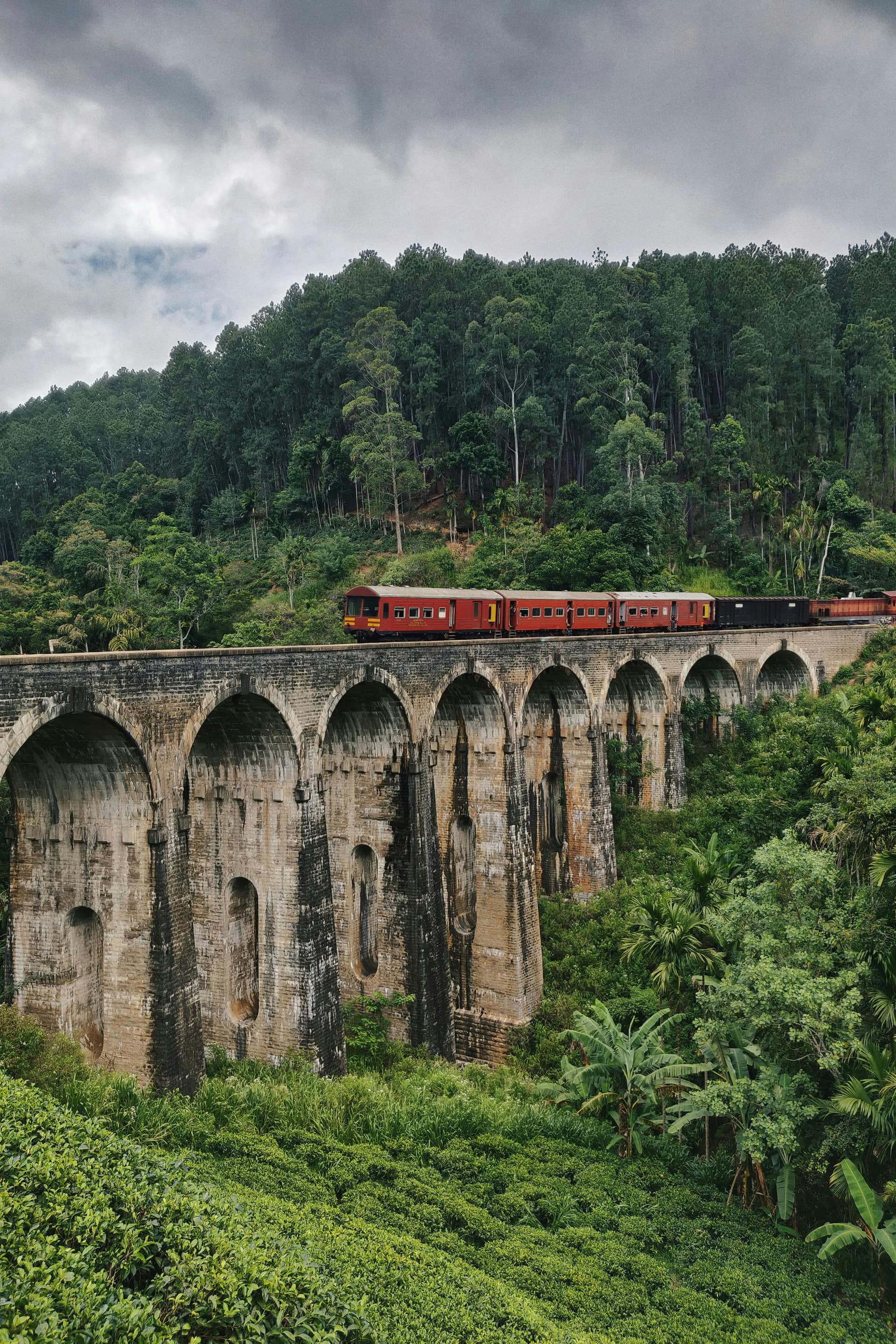
- →Day 4: Ella: Nine Arch Bridge and Little Adam's Peak at dawn, Ella Rock for keen walkers.
- →Day 5: Bus or shared taxi from Ella to Mirissa, roughly five to seven hours with a change.
- →Day 6: Mirissa beach or whale watching; Galle by train or bus.
- →Day 7: Train or expressway bus towards Colombo and the airport.
Trains on the 7-day route
Two railway lines do most of the work. The main line runs from Colombo Fort to Kandy and on through the hill country to Nanu Oya, Ella and Badulla. The coastal line runs south from Colombo along the sea to Galle and Matara, passing close to Unawatuna and Weligama.
Reserved seats on the hill-country line sell out well ahead in high season, and are the one booking to make as early as possible. The coastal line is less crowded for reserved seats but can be busy in unreserved carriages, especially at weekends. Check current services and booking methods when planning, since they change.
- →Colombo to Kandy: roughly two and a half to three and a half hours by train.
- →Kandy to Ella: roughly six to seven hours; book reserved seats well ahead.
- →Colombo to Galle: roughly two to three hours on the coastal line.
Buses, tuk-tuks and app taxis
Buses reach almost every town in Sri Lanka. Government and private buses run on the main roads, with air-conditioned intercity services on some routes, including the expressway buses between Colombo, Galle and Matara. They are cheap and frequent, though often crowded, and large bags can be awkward.
Tuk-tuks cover short distances everywhere; agree the fare before setting off, or use a metered tuk-tuk where available. Ride-hailing apps operate in Colombo, Kandy, Galle and some other towns, offering tuk-tuks and cars at transparent prices, which removes the haggling.
The Ella to south coast leg is the hardest on public transport, usually requiring a bus to Wellawaya and a change towards Matara. Many independent travellers take a shared or private taxi for this one day, which cuts the journey to roughly four to five hours.
- →Intercity buses are cheap and frequent; expressway buses are faster.
- →Agree tuk-tuk fares first, or use an app where available.
- →Consider a one-off taxi for Ella to the coast.
Adding Sigiriya without a driver
Sigiriya has no railway station, and reaching it by public transport means a bus to Dambulla and a local bus or tuk-tuk from there. From Kandy, that takes roughly three and a half to four and a half hours; from the airport, most of a day.
To include it, add two nights near Sigiriya at the start of the week and cut a night from Kandy and one from the coast, or book a single private transfer from the airport to Sigiriya and from Sigiriya to Kandy. That hybrid approach, public transport for most of the week and a driver for the hardest legs, is how many independent travellers handle it.
Luggage and comfort on public transport
The single biggest practical difference without a driver is luggage. With a car, bags stay in the boot; on buses and trains, you carry them, often through crowded carriages and aisles. Travelling with one medium backpack or small case per person is close to essential.
Some tuk-tuk and taxi drivers can carry luggage between towns separately for a fee, and some guesthouses will hold bags for you. For families or older travellers, the weight of carrying everything every other day is often what tips the balance towards a driver.
- →One medium backpack or small case per person.
- →Keep valuables in a small bag on your body.
- →Ask guesthouses about holding bags or arranging luggage transfers.
Is it worth going without a driver
For solo travellers, young couples and budget-minded visitors comfortable with crowds and delays, travelling without a driver is cheaper and brings you closer to everyday Sri Lankan life. For families, older travellers and anyone short on time, the savings rarely justify the extra hours on the road.
Lankan Stays & Trails arranges one-off transfers for independent travellers as well as full driver-guided weeks, which is often the most sensible compromise. Our guide to hiring a driver for a 7-day itinerary sets out the costs of the full option for comparison.
Frequently asked questions
Can you travel Sri Lanka in a week by public transport?
Yes, if you build the route around the railway: Kandy, the train to Ella, then the south coast. It is slower than travelling with a driver, typically one and a half to two times the car journey time, so fewer stops fit into seven days.
How do I get to Sigiriya without a driver?
Take a bus to Dambulla and a local bus or tuk-tuk from there. From Kandy that takes roughly three and a half to four and a half hours. Many independent travellers book a single private transfer for this leg because there is no railway station at Sigiriya.
How do I get from Ella to Mirissa by bus?
Usually a bus from Ella to Wellawaya, then a connection towards Matara and a short hop to Mirissa, taking roughly five to seven hours in total. A shared or private taxi cuts that to roughly four to five hours and is worth considering for this one leg.
Are there Uber-style apps in Sri Lanka?
Yes. Ride-hailing apps operate in Colombo, Kandy, Galle and some other towns, offering tuk-tuks and cars at upfront prices. Coverage outside the main towns is patchy, so in smaller places tuk-tuks booked directly remain the main option.
Is public transport in Sri Lanka safe?
Generally yes, though buses are crowded and driven fast, and pickpocketing can occur in packed carriages. Keep valuables in a small bag on your body, and avoid leaning out of train doorways, which causes serious injuries on the hill-country line every year.
Is it cheaper to travel Sri Lanka without a driver?
Substantially, since bus and train fares are very low. The saving is balanced by extra travel time, more limited flexibility and the effort of carrying luggage. For families or groups splitting the cost, a private driver is often closer in price than expected.