
Quick answer
For a slower first trip to Sri Lanka, base at three places rather than six: the Cultural Triangle for three or four nights, a hill country tea estate for three or four, and one coast for four or five. This covers the ancient sites, the tea landscape and the sea, with day trips from each base rather than constant repacking. A safari can be added from either the Cultural Triangle or the coastal base.
Key takeaways
- Three bases over twelve nights covers most of what six bases would, because the Cultural Triangle sites are all day trips from one place.
- A tea estate bungalow is the clearest example of accommodation that works as a destination rather than a base.
- Minneriya or Kaudulla allows a safari from the Cultural Triangle without a dedicated safari base.
- Galle Fort rewards staying put more than any other stop, since its character emerges after five in the afternoon.
- What a slow trip genuinely gives up is the hill country train and one of the ancient capitals, which is a small loss.
What slowing down actually costs
It is worth being precise about the trade, because the usual framing of slow travel is vague about what is lost. A three-base Sri Lanka trip gives up specific things, and they are fewer than most travellers expect.
What you keep: Sigiriya, Dambulla, one ancient capital, the tea country, a safari, and a coast. That is the full set of four elements, because the Cultural Triangle sites are all day trips from a single base and a safari can attach to either end of the trip.
What you give up: the Kandy to Ella train, which is genuinely one of the great rail journeys and the clearest loss; one of the two ancient capitals; and either Kandy or one hill country town depending on where the hill base sits. That is the honest list.
- →Kept: Sigiriya, Dambulla, one ancient capital, tea country, a safari, a coast.
- →Given up: the Kandy to Ella train, which is the clearest single loss.
- →Also given up: one ancient capital and either Kandy or one hill town.
- →The four elements survive intact, which is the point.
The Cultural Triangle as one long base
The Cultural Triangle is the region best suited to staying put, because every major site is a day trip from Sigiriya or Habarana. Dambulla is roughly twenty to thirty minutes away, Polonnaruwa roughly an hour and a half, Anuradhapura roughly an hour and a half, and Minneriya or Kaudulla roughly an hour.
Four nights in one hotel here covers Sigiriya at opening, Dambulla in a late afternoon, Polonnaruwa on a bicycle, and an afternoon safari, with a full day left unscheduled. That is more than most six-base itineraries manage in the same region, with none of the packing.
Habarana is the better base for this pattern, since it sits at the road junction and shortens the drives to Polonnaruwa and the parks. Choose a property with grounds and a pool, because the middle of the day here is hot and the point of a slow trip is having somewhere worth returning to.
- →Every Cultural Triangle site is a day trip from one base.
- →Four nights covers Sigiriya, Dambulla, Polonnaruwa and a safari afternoon.
- →Habarana shortens the drives to Polonnaruwa and the parks.
- →Choose grounds and a pool; the middle of the day is for staying in.
A tea estate as the hill country base
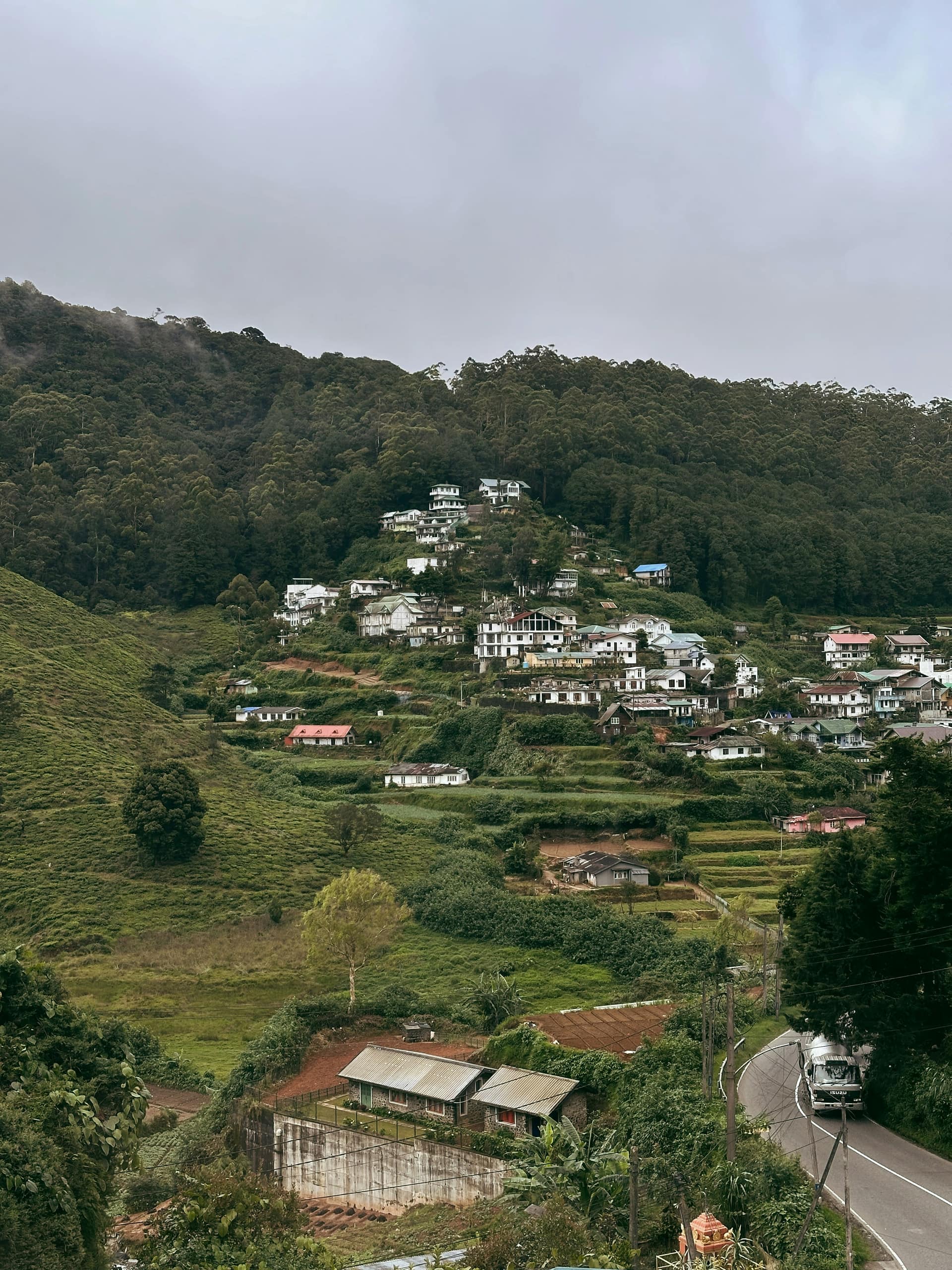
The hill country is normally covered by moving between Kandy, Nuwara Eliya and Ella. The slow version replaces all three with a single tea estate bungalow, and this is the change that most improves an unhurried trip.
Tea estate bungalows are colonial-era planters' houses on working estates around Nuwara Eliya, Haputale and Dickoya, typically with a handful of rooms, a resident cook and walking directly from the door. A day there can be an estate walk, a factory visit and a long lunch, with no driving at all.
The trade is the train and the Ella sights. A traveller who wants Little Adam's Peak and the Nine Arch Bridge should base at Ella instead, which is the livelier option and still works as a single hill country base if three or four nights are given to it.
- →One tea estate base replaces Kandy, Nuwara Eliya and Ella.
- →Estate bungalows offer walking from the door and a resident cook.
- →A day can be a walk, a factory visit and a long lunch, with no driving.
- →Base at Ella instead if Little Adam's Peak and the bridge matter.
The coast, given proper time
The coastal base is where a slow trip gains the most, because four or five nights converts a beach stop from a pause into an actual rest. This is the part of a standard itinerary most often cut to two nights, and it is the wrong cut.
Which coast depends on the month: the south and west roughly December to March, the east roughly May to September. Within the south, Talalla and Tangalle suit a slow trip better than Mirissa, whose central strip is busy and loud in high season.
Galle deserves a specific mention, because it rewards staying put more than any other stop in Sri Lanka. The fort changes entirely from around five in the afternoon when day visitors leave, and only people sleeping inside the walls experience that. Two nights there plus three at a quieter beach is a strong coastal block.
- →Four or five coastal nights turn a pause into an actual rest.
- →South and west roughly December to March; east roughly May to September.
- →Talalla and Tangalle suit a slow trip better than central Mirissa.
- →Galle rewards staying inside the walls more than any other stop.
Fitting a safari without a safari base
The safari is the element that appears to require a fourth base, and it does not. Minneriya and Kaudulla sit roughly an hour from a Cultural Triangle base, so an afternoon drive attaches to the existing stay without a night of its own.
This works particularly well between roughly June and September, when the elephant Gathering at the receding reservoir edges is generally at its strongest, though it depends on rainfall and is never guaranteed.
For travellers who want a leopard attempt rather than elephants, Yala or Udawalawe does need its own night, which makes four bases rather than three. That is still a slow trip by any reasonable standard, and one night at a safari camp between the hills and the coast is a small concession.
- →Minneriya and Kaudulla sit roughly an hour from a Cultural Triangle base.
- →An afternoon drive attaches to the existing stay with no extra night.
- →The Gathering is generally strongest roughly June to September.
- →A leopard attempt at Yala needs its own night, making four bases.
Shaping a slower first trip
A twelve-night slow shape is four nights in the Cultural Triangle at Habarana, four at a hill country tea estate, and four or five on a coast, with a safari afternoon attached to the first base. That is three bases, three transfers, and roughly four unscheduled days across the trip.
Lankan Stays and Trails builds these deliberately and will say what is being given up rather than implying nothing is. The commonest reaction we get from travellers who choose this shape is that they would not have believed it covered as much as it does, which is mostly a consequence of how much of a conventional itinerary is spent in a vehicle.
Frequently asked questions
Can you see Sri Lanka properly with only three bases?
Largely, yes. Four nights in the Cultural Triangle, four at a hill country tea estate and four or five on a coast covers the ancient sites, tea country, a safari and the sea. The main losses are the Kandy to Ella train and one of the ancient capitals.
What do you give up on a slow Sri Lanka trip?
The Kandy to Ella train, which is the clearest loss, one of the two ancient capitals, and either Kandy or one hill country town. All four core elements of a first trip survive, because the Cultural Triangle sites are all day trips from one base.
Where is the best place to stay put in Sri Lanka?
A tea estate bungalow in the hill country, where the accommodation works as the destination, and the Cultural Triangle, where every major site is a day trip from one hotel. Galle Fort also rewards staying, since its character emerges after five in the afternoon.
Can I do a safari without a separate safari base?
Yes. Minneriya and Kaudulla sit roughly an hour from a Cultural Triangle base, so an afternoon drive attaches without a dedicated night. A leopard attempt at Yala or Udawalawe does need its own night, making four bases rather than three.
How many nights should a coastal stop get on a slow trip?
Four or five. That converts a beach stop from a pause into an actual rest and allows a genuinely unscheduled day. Splitting it as two nights inside Galle Fort and three at a quieter beach such as Talalla works well.
Are tea estate bungalows good for slow travel?
They are the clearest example of accommodation working as a destination. Colonial-era planters' houses on working estates, typically with a handful of rooms, a resident cook and walking from the door, they remove any need to drive during the stay.
Is a slow trip to Sri Lanka worth it on a first visit?
For travellers whose priority is rest rather than coverage, yes. A conventional first itinerary spends a substantial share of its days in a vehicle, and removing most of that changes the trip more than the two or three missing destinations do.