
Quick answer
Galle is the better choice for history, architecture, food and a short stay, while Mirissa is the better choice for a swimming beach and for blue whale watching from roughly November to April. Galle Fort is a UNESCO World Heritage town whose ramparts take about an hour to walk; Mirissa is a sheltered crescent bay roughly 45 minutes to an hour further east. With one night, choose Galle. With three or more nights in season, base in Mirissa and give Galle a half day or a final night.
Key takeaways
- Galle Fort is a walled town of roughly 36 hectares, founded by the Portuguese in 1588 and inscribed by UNESCO in 1988.
- Mirissa is a beach bay with a whale-watching harbour, and its sea is calm roughly December to April.
- Galle and Mirissa are roughly 40 kilometres apart, which is 45 minutes to an hour by road.
- Galle works in every month because the fort does not depend on the sea; Mirissa is a seasonal choice.
- One night in Galle Fort and two or three in Mirissa is the split most travellers are happiest with.
The short verdict on Galle vs Mirissa
Galle vs Mirissa is less a contest than a question of what the south coast is for on your trip. Galle Fort gives you a compact, walkable old town with ramparts, churches, a mosque, galleries and some of the best restaurants outside Colombo. Mirissa gives you sand, a sheltered bay and the island's best-known whale-watching harbour.
The two do not substitute for each other. Galle has no proper swimming beach inside the walls, and Mirissa has no historic centre at all. Travellers who choose only one usually miss whichever half of the coast they left out, which is why the most useful answer is about proportion, not about a winner.
- →Choose Galle if you want culture, food, shade and a town to walk in.
- →Choose Mirissa if you want to swim, see whales or stay on the sand.
- →Choose both if you have three nights or more on the south coast.
- →Choose Galle alone if you visit from May to September.
What Galle gives you that Mirissa cannot
Galle Fort sits on a rocky headland and is still a living neighbourhood, with schools, courts, a mosque and families who have been there for generations. The Portuguese fortified the point from 1588, the Dutch took it in 1640 and rebuilt the walls through the following decades, and the British added the lighthouse and the clock tower.
A day in Galle is spent on foot. The rampart circuit is roughly three kilometres and takes about an hour, the grid of streets inside holds the Dutch Reformed Church of 1755 and the old Dutch Hospital, and sunset from Flag Rock draws half the town. The beach is the weak point: Lighthouse Beach is a small strip, and real swimming means Unawatuna, roughly 15 minutes away.
- →Rampart walk: roughly three kilometres, about an hour, best after four in the afternoon.
- →Restaurants and cafes: the widest choice on the south coast.
- →Rainy-day value: museums, verandas and covered arcades keep a wet afternoon usable.
- →Weak point: no swimming beach of any size inside the fort.
What Mirissa gives you that Galle cannot
Mirissa is a crescent of sand roughly a kilometre long with a rocky headland at each end. In season the main bay is usually calm enough to swim, Parrot Rock can be waded to at low tide, and Coconut Tree Hill on the eastern side is the photograph most people come home with.
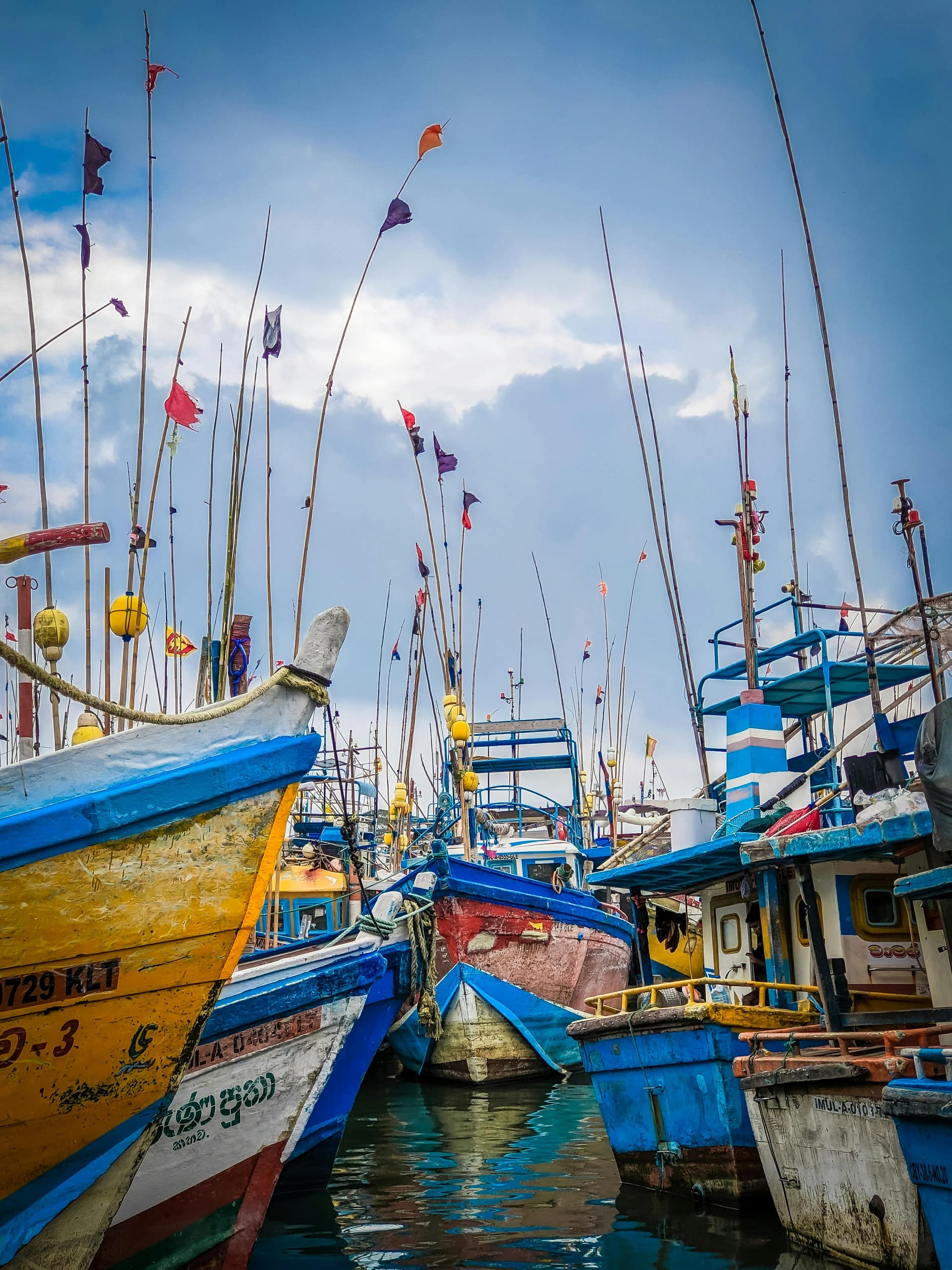
The harbour is the other reason to choose Mirissa. Boats leave at roughly six to half past six in the morning from November to April in search of blue whales, sperm whales and spinner dolphins, on trips of roughly three to five hours. Sightings are never guaranteed. The trade-off is noise: the central strip plays music late, and the main coast road runs directly behind the beach.
- →Swimming: the main bay is usually swimmable from roughly December to April.
- →Whale watching: roughly November to April, early morning, never guaranteed.
- →Beach life: sunbeds, seafood grills on the sand, surf lessons ten minutes away in Weligama.
- →Weak point: little to do when it rains or when the sea is rough.
How the season decides it
The south coast season settles the Galle vs Mirissa question more often than taste does. From roughly December to April the south-west is dry and the sea is calm, so Mirissa is at its best and Galle is hot but pleasant in the evenings. November is improving and April is still good.
From May to September the south-west monsoon makes the sea rough, the whale boats stop, and several Mirissa beach restaurants close or thin out. Galle Fort carries on almost unchanged because nothing about it needs flat water. Sri Lanka always has a good coast somewhere, and in those months the calm sea is on the east, around Trincomalee and Pasikudah.
- →December to April: both work, and Mirissa earns the larger share of nights.
- →May to September: Galle only, with the east coast for swimming.
- →October: the wettest month island-wide; Galle is the safer bet.
- →November: the sea is settling and the first whale boats go out.
Nights, bases and how to see both
Nights are the practical way to decide between Galle and Mirissa. A single night belongs in Galle Fort, because the fort is at its best after the day visitors leave and again at dawn. Two nights can go either way. With three or more, most travellers split: one night inside the fort and the rest on the beach.
Because the drive between them is only 45 minutes to an hour, a single base also works. Staying in Mirissa and visiting Galle for an afternoon and dinner is easy, and so is the reverse for a whale trip, though a 5 am start from Galle is less fun than it sounds. Unawatuna, Ahangama and Weligama sit in between and suit travellers who want one bed for the whole stay.
- →One night: Galle Fort.
- →Two nights: Mirissa in season, Galle out of season.
- →Three or four nights: one in Galle, the rest in Mirissa.
- →A week: add a second beach such as Tangalle or Hiriketiya.
Fitting Galle and Mirissa into a wider trip
Galle and Mirissa usually come at the end of a Sri Lankan route, after the Cultural Triangle, the hill country and a safari. Arriving from Yala or Ella, Mirissa is the nearer of the two by roughly half an hour to an hour, so it makes sense to reach the beach first and finish in Galle.
Galle is also the closer of the two to the airport: roughly two and a half to three hours on the Southern Expressway, against three to three and a half from Mirissa. That makes Galle Fort the natural last night. Lankan Stays & Trails plans most south-coast finishes in that order, with a private driver so the coast road between the two becomes part of the holiday.
Frequently asked questions
Is Galle or Mirissa better?
Neither is better overall, because they offer different things. Galle is better for history, architecture, restaurants and wet weather. Mirissa is better for swimming, beach days and whale watching from roughly November to April. Most travellers with three or more nights on the south coast visit both, since the two are under an hour apart.
How far is Galle from Mirissa?
Galle and Mirissa are roughly 40 kilometres apart along the coast road. The drive takes 45 minutes to an hour without stops, the bus roughly an hour to an hour and a quarter, and the coastal train roughly 45 minutes to an hour, with a short tuk-tuk ride from Mirissa station to the beach.
Can you swim in Galle?
Not really inside Galle Fort. Lighthouse Beach, below the ramparts, is a small patch of sand where locals paddle, but it is not a beach to plan a holiday around. The nearest proper swimming is in Unawatuna bay, roughly 15 minutes by tuk-tuk, or at Dalawella, roughly 20 minutes.
Should I stay in Galle or Mirissa?
Stay in Galle if you have one night, if you are travelling from May to September, or if food and architecture matter more than sand. Stay in Mirissa if you have two or more nights between December and April and want to swim or see whales. With three or more nights, stay in both.
How many days do you need for Galle and Mirissa?
Three to four nights covers both comfortably: one night in Galle Fort for the ramparts, an evening and a dawn walk, then two or three in Mirissa for a whale-watching morning, a beach day and a spare morning in case the sea is rough. Two nights is possible but rushed.
Is Mirissa worth visiting outside whale season?
Only partly. From May to September the south-west monsoon makes the sea at Mirissa rough, the whale boats do not run and some beach restaurants close. The bay is still handsome and rooms are cheaper, but travellers who want to swim are better served by the east coast in those months.
Is Galle worth staying overnight?
Yes. Galle Fort changes character after about five in the afternoon, when the coaches leave and residents come out to the ramparts for sunset. Staying overnight also gives you the streets at six in the morning, when they are empty, cool and at their most photogenic. A day trip misses both.