
Quick answer
A luxury 7-day Sri Lanka itinerary is at its best from January to March. From about 6 January, rates drop from festive peaks to ordinary high-season levels and minimum stays shorten. The south coast is dry with calm seas, whale watching off Mirissa is at its most reliable, and the hill country has its clearest mornings. The Cultural Triangle dries out through January and is settled by February. Book small lodges, tea bungalows and villas four to six months ahead.
Key takeaways
- January to March is the driest and most settled period on Sri Lanka's south and west coasts.
- Festive peak rates usually end around 5 January, after which ordinary high-season prices apply.
- Whale watching off Mirissa is most reliable from January to March, when the swell is lowest.
- Nuwara Eliya can fall close to freezing on clear nights in January and February.
- Rain in the Cultural Triangle eases through January and is uncommon by February.
Why these three months
A luxury 7-day Sri Lanka itinerary from January to March has the weather on its side at every stop. The north-east monsoon is fading in the Cultural Triangle, the south-west is months away, and the hills sit between the two in a dry, clear spell.
The season is also better value than the fortnight before it. Rates fall by a quarter or more after the first week of January, compulsory gala dinners disappear, and hotels that demanded five nights will again take two.
- →From 6 January: lower rates, shorter minimum stays.
- →February: the most settled weather of the year.
- →March: warmer, quieter, the sea at its flattest.
Sigiriya and the Cultural Triangle
Sigiriya in January still sees some rain, mostly in short afternoon showers, and the countryside is green with full reservoirs. By February the showers are rare, and by March the land is drying and afternoon temperatures reach 33 or 34 degrees Celsius.
These are good months for the dawn climb, with cool, clear mornings. Hot air balloons fly from near Dambulla through to mid-April. Elephants at Minneriya are scattered at this time, and Hurulu Eco Park is the usual choice for an afternoon safari.
Kandy and the hill country
The hill country has its best visibility of the year. Mornings in Nuwara Eliya and on Horton Plains are often cloudless, and the view from World's End, which is lost in mist by 9am in other months, lasts longer. Nights are cold, with occasional ground frost in January and February.
Ella is mild and mostly dry, and the train from Nanu Oya runs through clear air. Kandy is pleasant at about 28 degrees Celsius by day. The pilgrimage season on Adam's Peak is under way, and the mountain is lit at night for climbers.
- →Pack a warm layer for evenings above 1,000 metres.
- →Horton Plains: be at the gate by 6am for the view.
- →Reserved train seats sell out about 30 days ahead.
The south coast
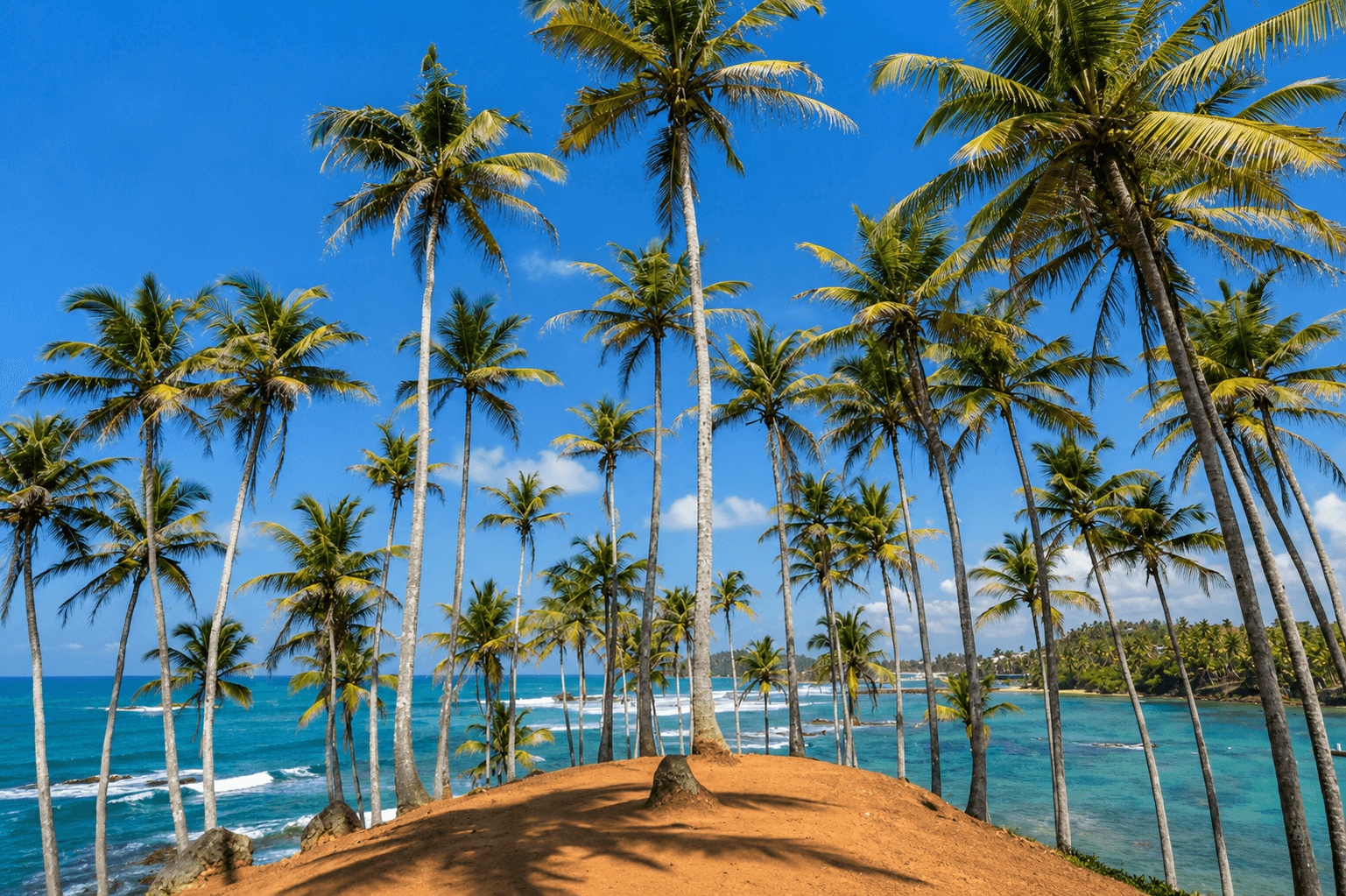
The south coast is at its finest. Days are dry and bright at 29 to 31 degrees Celsius, the sea is around 27 to 28 degrees, and the swell that makes swimming difficult in other months drops away. Bays such as Unawatuna, Weligama and Mirissa are calm.
Blue whales are seen off Dondra Head on most mornings, and a private charter from Mirissa is at its most comfortable. Sunsets are clear. This is the season to spend the extra on a beachfront room, because you will use the beach.
- →Whales: most reliable January to March.
- →Swimming: calmest of the year in sheltered bays.
- →Evenings: dry enough for dinner on the sand.
Dates to know
Several dates fall in these months. Independence Day on 4 February brings parades and a public holiday. Full moon poya days come once a month, with alcohol not sold or served publicly. The Navam Perahera in Colombo, a procession with elephants and dancers, is usually held around the February full moon.
School holidays in Europe in mid-February fill family rooms and villas for a week or two. Lunar New Year brings more visitors from East Asia in late January or February, on dates that shift each year.
What to book and when
Demand is steady from January to March without being frantic. The small properties are the ones to secure: lodges with fewer than 20 rooms, tea bungalows, tented camps and villas. Four to six months ahead is comfortable, and mid-February needs longer.
Lankan Stays & Trails sees more availability in the second half of January and in March than in February. If the choice is open, the first three weeks of March give warm seas, fewer visitors and the lowest rates of the high season.
Frequently asked questions
What is the best month for a luxury trip to Sri Lanka?
February, for the classic route of Sigiriya, Kandy, the hill country and the south coast. It has the most settled weather across all four regions. January after the first week and March are close seconds, with March slightly hotter and quieter.
Is January a good time to visit Sri Lanka?
Yes. The south and west coasts and the hill country are dry and clear. The Cultural Triangle still has some showers early in the month. Avoid the first few days if possible, when festive prices and minimum stays still apply.
How hot is Sri Lanka in March?
Warm to hot. Coastal temperatures are around 30 to 32 degrees Celsius, the Cultural Triangle reaches 33 or 34, and the hill country stays at 18 to 24. Humidity builds towards April. Early starts and midday rests keep sightseeing comfortable.
Are hotel prices lower in Sri Lanka after New Year?
Yes. From about 6 January, rates drop from festive peaks to standard high-season levels, typically 25 to 50 per cent lower at luxury properties. Minimum stays shorten and gala dinner charges end. Prices fall again from May.
Can I see whales in Sri Lanka in February?
Yes. February is one of the best months for blue whales off Mirissa, with calm seas and frequent sightings. Trips leave at about 6am and last four to six hours. Sightings are likely and never guaranteed.
Is it cold in the Sri Lankan hills in January?
At night, yes. Nuwara Eliya, at about 1,870 metres, can drop to 5 degrees Celsius or lower, with occasional frost. Ella is milder at 14 to 16 degrees. Days are pleasant and sunny. Bring a jumper, long trousers and socks.