
Quick answer
A luxury multigenerational Sri Lanka trip typically bases an extended family in two or three large private villas with staff, rather than moving daily, so grandparents and grandchildren can each set their own pace within one household. Most trips run roughly 10 to 14 days combining a coastal base, a hill-country or cultural stop and a short safari, with a private driver-guide handling all transport so no family member needs to navigate independently, and December to March offering the calmest coastal weather.
Key takeaways
- A basing strategy, staying two to four nights minimum at each of two or three large villas rather than moving daily, is the structural choice that makes a multigenerational trip manageable across different generations' energy levels.
- Private villas with multiple bedrooms and dedicated staff, including a cook who can accommodate different dietary needs across generations, are generally the best-suited luxury stay type for an extended family group.
- A single private driver-guide and vehicle sized for the whole group removes the need for any family member to navigate Sri Lankan roads independently, a genuine relief for travelling grandparents in particular.
- Sri Lanka sits roughly 3.5 to 4.5 hours ahead of Switzerland year-round, meaning minimal jet lag for both the oldest and youngest members of a travelling family group.
- December to March, the south and west coast's dry season, overlaps with Swiss Sportferien and the Christmas and New Year school break, the most common window for a multigenerational trip to align everyone's available dates.
Why a basing strategy works better than a moving itinerary
A trip that changes hotel every one or two nights suits a couple or solo traveller far better than an extended family spanning three generations, since packing and unpacking, transfer logistics and check-in timing all compound with each additional traveller. Basing the family in a small number of larger properties for several nights each removes most of that friction.
A well-chosen base also lets different generations self-select their own pace on any given day, grandparents resting by the pool while grandchildren join a beach or garden activity, without requiring the whole group to move together as a single unit for every excursion.
Two or three bases over 10 to 14 days, each held for three to five nights, is the shape that tends to work best: enough change of scene to keep the trip interesting, without the daily disruption of constant movement.
This structure also gives the trip a natural rhythm: an opening base for settling in and adjusting to the time difference, a middle base built around one shared activity everyone can join at their own pace, and a closing coastal base where the whole group can simply be together without much scheduling at all.
- →Two or three bases over 10 to 14 days, each held three to five nights, rather than daily moves.
- →A shared living space at each base lets generations self-select their own pace within the same household.
- →An opening base to settle in, a middle base for one shared activity, and a closing coastal base to simply be together.
Large private villas: the natural base for an extended family
A private villa with several bedrooms, a shared living and dining space, a pool and dedicated staff, a cook, housekeeper and sometimes a butler, functions as a household rather than a hotel, which suits an extended family far better than booking a block of separate rooms. Meals can be timed and adjusted around the group's actual routine, including different dietary needs across generations.
On the coast, a villa with direct beach or sea access reduces the need for younger or older family members to travel to reach the water each day. In the hill country, a larger tea-estate bungalow with multiple bedrooms offers a similar self-contained setup with a cooler climate as a change of pace.
Booking a villa with an accessible layout, limited stairs, step-free bathrooms, matters more for a multigenerational group than for most other trip types, and is worth confirming specifically with the property or operator rather than assumed from photographs alone.
- →Multi-bedroom private villas with staff: function as a household, adjustable meals, shared living space.
- →Beachfront villas: reduce daily travel needed to reach the water for less mobile family members.
- →Hill-country tea-estate bungalows: a cooler-climate base with a similar self-contained, multi-bedroom setup.
- →Accessibility: confirm stairs and step-free bathrooms directly with the property before booking.
Experiences that work across different generations
A private driver-guide and a vehicle sized for the whole group is the practical foundation of a multigenerational trip, since it removes the need for any family member, particularly older travellers, to navigate unfamiliar roads. It also allows the group to split for a morning, some joining an activity, others resting at the villa, and reconvene later without separate transport arrangements.
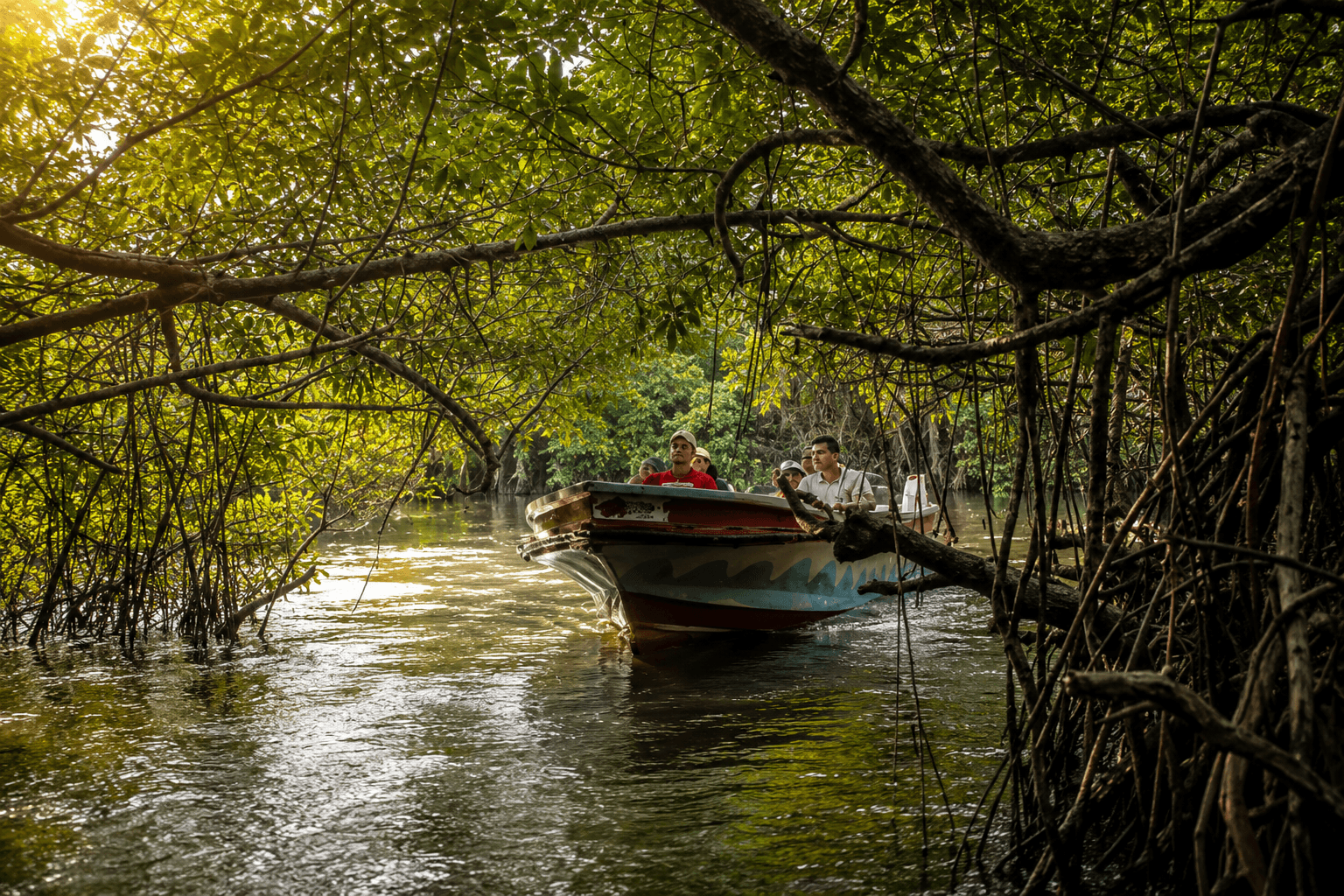
A private tea-estate visit or a gentle village and lake tour by boat near Habarana generally suits a wide age range better than a physically demanding hike, and a short, private safari drive of two to three hours works for most family members without the fatigue of a full-day excursion.
A private chef's table or a family-style dinner arranged at the villa, rather than a restaurant booking for a large group, tends to suit multigenerational groups particularly well, since it accommodates different appetites, timings and dietary needs in one setting.
- →A single vehicle and driver-guide sized for the whole group: no family member needs to navigate independently.
- →A gentle village and lake tour near Habarana, or a short two to three hour safari: suits a wide age range without full-day fatigue.
- →A private chef's table or family-style villa dinner: accommodates different appetites, timings and dietary needs in one setting.
Planning it from Switzerland: flights, visa and coordination
There is no non-stop flight from Zurich or Geneva to Colombo, so the journey connects via a hub such as Doha, Abu Dhabi, Dubai or Istanbul, or another European hub onto SriLankan Airlines. Total travel time typically runs roughly 12 to 17 hours depending on routing, and coordinating seating and connection times across a group with different comfort needs is worth doing directly with an airline or agent well ahead of departure.
Every traveller, regardless of age, needs an Electronic Travel Authorisation (ETA), applied for online before departure; confirm the current process and fee for each family member closer to the trip, since applying as a group still requires individual applications.
December to March suits a coastal-led multigenerational trip and overlaps with the Swiss Sportferien and Christmas break, the period when it is generally easiest to align availability across working adults, school-age grandchildren and retired grandparents, though it is also the busiest and priciest season, so booking large villas well ahead matters more here than for almost any other trip type given the limited number of properties large enough for an extended family.
Budget and coordinating a large group booking
USD is the more useful reference currency for quotes on a multigenerational trip, with CHF exposure coming mainly from the exchange rate at time of payment. Splitting the cost of a large villa across several family units, rather than pricing per person as at a hotel, is generally the more transparent way to divide the budget, and is worth agreeing among the family before booking.
A single point of contact managing the booking, whether a family member or an operator, tends to reduce confusion considerably when coordinating flights, ETAs and a villa across multiple households, particularly when travel dates need to align across different work and school calendars.
It is also worth agreeing in advance whether costs such as the driver-guide, villa staff gratuities and any group excursions are pooled and split evenly, or paid individually by each household as they arise, since this is a common source of friction on a large family trip if left unresolved until the trip is already underway.
Building your multigenerational itinerary
Lankan Stays & Trails builds multigenerational itineraries around a small number of large private villas and a single driver-guide for the whole group, so different generations can each find their own pace within one coordinated trip. Our pillar guide to the best luxury Sri Lanka experiences for Swiss travellers is a useful starting point for the stay types and regions this trip can draw from.
Families celebrating a specific milestone alongside their multigenerational trip may find our dedicated anniversary trip guide useful for pacing a celebratory stretch within the wider itinerary.
Frequently asked questions
What is the best type of accommodation for a multigenerational trip to Sri Lanka?
A large private villa with several bedrooms, a shared living space, a pool and dedicated staff generally works best, since it functions as a household rather than separate hotel rooms and allows meals and pacing to adjust across generations.
How many bases should a multigenerational Sri Lanka trip have?
Two or three, each held for three to five nights, tends to work best over roughly 10 to 14 days. Frequent moves between hotels are harder to manage across a group spanning young children to grandparents than a smaller number of longer stays.
Is Sri Lanka accessible for older family members?
It can be, but accessibility varies significantly by property. Confirm stairs, step-free bathrooms and general mobility around a villa or hotel directly with the property or an operator before booking, rather than assuming from photographs alone.
Do all family members need a separate visa application for Sri Lanka?
Yes, every traveller regardless of age needs an individual Electronic Travel Authorisation (ETA), applied for online before departure. Confirm the current process and fee for each family member closer to the trip.
When is the best time for a multigenerational trip to Sri Lanka?
December to March suits the south and west coasts and overlaps with Swiss Sportferien and Christmas school holidays, generally the easiest window to align availability across working adults, school-age grandchildren and retired grandparents, though it is also peak season.
How do we split the cost of a large villa across family members?
Most families split a villa's total cost across family units rather than per person, since villas price as a whole property rather than by room. Agreeing the split before booking, with a single point of contact managing payment, tends to avoid confusion later.
Does Lankan Stays & Trails arrange multigenerational family trips?
Yes. We source large private villas and coordinate a single driver-guide for the whole group, building itineraries that let different generations set their own pace within one shared, private trip.