
Quick answer
Okanda is a right-hand point break about an hour's drive south of Arugam Bay, beside the Okanda devalaya and the entrance to Kumana National Park. It offers long rights on good swells, suits intermediate and advanced surfers, and is far quieter than Arugam Bay's main breaks. The season is roughly May to September. Go with a driver who knows the road, start early, bring everything you need, and watch for elephants on the road, especially at dusk.
Key takeaways
- Okanda is about an hour south of Arugam Bay.
- The right-hand point suits intermediate and advanced surfers.
- It sits beside the Kumana entrance and Okanda devalaya.
- The season is roughly May to September.
- Elephants use the road; avoid driving back at dusk.
Where Okanda is
Okanda lies at the end of the road south from Arugam Bay, past Panama and its lagoons, where the coast meets the edge of Kumana National Park. The Okanda devalaya, a Hindu shrine linked to Lord Murugan, stands here on the pilgrim route to Kataragama.
The road passes paddy, lagoons, scrub jungle and wildlife country. Elephants, peacocks, crocodiles in the lagoons and wading birds are all common sights on the way.
There is very little at Okanda itself: the shrine, the park entrance, the beach and the wave. That isolation is the point.
- →At the end of the road south of Arugam Bay.
- →Next to the Kumana entrance and Okanda devalaya.
- →Lagoons and wildlife on the drive.
The wave
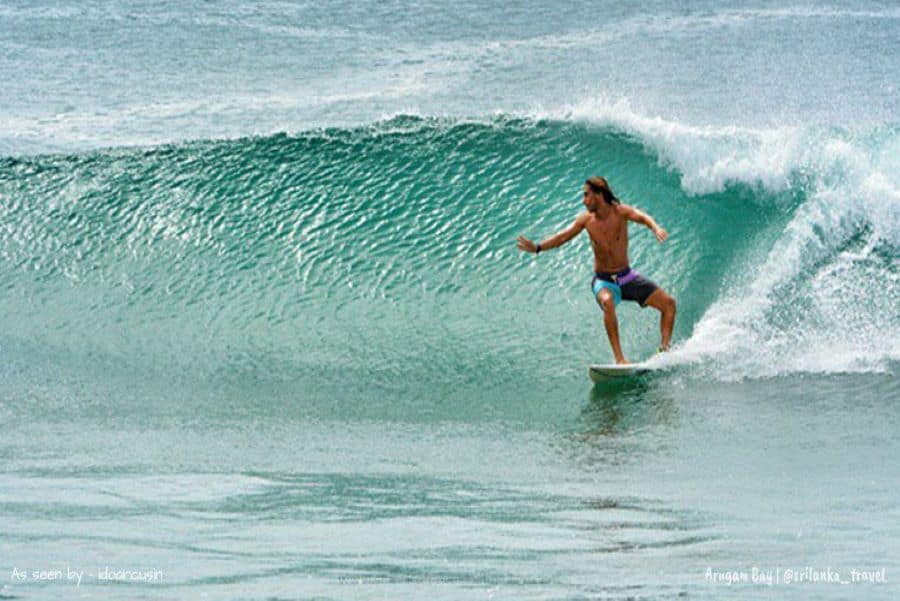
Okanda is a right-hand point that, on a good swell, peels along the point for long, rippable rides. It is more exposed than Arugam Bay's Main Point and can pick up more swell, which means more power and sometimes bigger waves.
It suits intermediate surfers who are comfortable on point breaks, and advanced surfers looking for an uncrowded alternative to Main Point. Beginners should stay at Arugam Bay's gentler spots such as Baby Point or Whiskey Point.
The bottom is a mix of rock and sand, and currents can run along the point on bigger days. Watch the set-up before paddling out.
On the right day, rides along the point can be long enough to rest your legs on the paddle back. Count the sets, watch where the regulars take off and paddle out from the inside of the point rather than across the main peak.
- →Long rights on a good swell.
- →Intermediate to advanced.
- →Mixed rock and sand bottom.
Getting there
Okanda is roughly an hour's drive from Arugam Bay, depending on road conditions. Most surfers go by tuk-tuk or car with a driver who knows the road, leaving at dawn for a morning session.
Elephants use the road, particularly at dawn and dusk. Drivers slow down and keep a safe distance; never get out to approach or photograph an elephant on foot. Plan to drive back well before dark.
Surf camps and guesthouses in Arugam Bay organise Okanda trips, often combined with Peanut Farm or Elephant Rock on the way.
- →About an hour by road from Arugam Bay.
- →Leave at dawn; return well before dark.
- →Never approach elephants on foot.
Season and conditions
The east coast season runs roughly May to September, when the south-west monsoon blows offshore here. June to August is usually the peak, and Okanda often has waves when the inner points are small.
Mornings bring the cleanest conditions. Afternoon winds can pick up, so most trips aim for a dawn session and return by lunch.
From October to April, the north-east monsoon brings onshore winds and rain to the east coast, and the south coast is in season instead.
- →May to September season.
- →June to August usually peak.
- →Morning sessions are cleanest.
What to bring
Facilities are minimal, so bring water, food, sun protection and any repair kit you might need. There is no board hire at Okanda, so bring a board suited to point waves.
Reef booties help on the rocky entry. Keep valuables to a minimum and leave nothing in sight in the vehicle.
Respect the devalaya: dress modestly if you visit the shrine, and keep noise down around it.
- →Water, food and sun protection.
- →Your own board and leash.
- →Booties for rocky entry.
Combining Okanda with Kumana
Okanda pairs perfectly with a Kumana safari. Surf at dawn, then join an afternoon jeep safari from the Okanda gate for birds, elephants and the chance of a leopard. Kumana's season overlaps with the surf season.
Lankan Stays & Trails can arrange an Okanda day from Arugam Bay with a driver who knows the road and a Kumana jeep in the afternoon. For the main Arugam Bay breaks, see the Arugam Bay surf guide.
Frequently asked questions
How far is Okanda from Arugam Bay?
Okanda is about an hour's drive south of Arugam Bay, depending on road conditions. The road passes Panama, lagoons and jungle on the edge of Kumana National Park. Most surfers go by tuk-tuk or car with a local driver, leaving at dawn and returning before dark.
Is Okanda good for beginners?
No. Okanda is a more exposed, more powerful right-hand point than Arugam Bay's inner breaks and suits intermediate and advanced surfers. Beginners should learn at gentler spots near Arugam Bay, such as Baby Point or Whiskey Point, before considering a trip to Okanda.
When is the best time to surf Okanda?
The east coast season runs roughly May to September, with June to August usually the peak. Okanda often has waves when Arugam Bay's inner points are small. Mornings are cleanest, so most trips leave at dawn and come back before afternoon winds pick up.
Are there elephants on the road to Okanda?
Yes. Elephants regularly use the road between Panama and Okanda, especially at dawn and dusk. Drivers slow down and keep a safe distance. Never get out of the vehicle to approach or photograph an elephant, and plan to drive back to Arugam Bay well before dark.
Can I combine Okanda with a Kumana safari?
Yes. The Kumana National Park entrance is at Okanda, so a dawn surf followed by an afternoon jeep safari makes an excellent day. Kumana is known for birds, elephants and occasional leopards, and its main season overlaps with the east coast surf season.
Is there board hire at Okanda?
No. Facilities at Okanda are minimal, with no board hire, shops or cafes. Bring your own board suited to point waves, a leash, water, food and sun protection. Surf camps in Arugam Bay can provide boards and arrange transport if you do not have your own.
Is Okanda crowded?
Okanda is far quieter than Arugam Bay's Main Point, partly because of the hour's drive. In peak months from June to August, a few vehicles from surf camps may arrive at dawn, but the line-up is usually small. Arrive early for the emptiest sessions and calmest winds.