
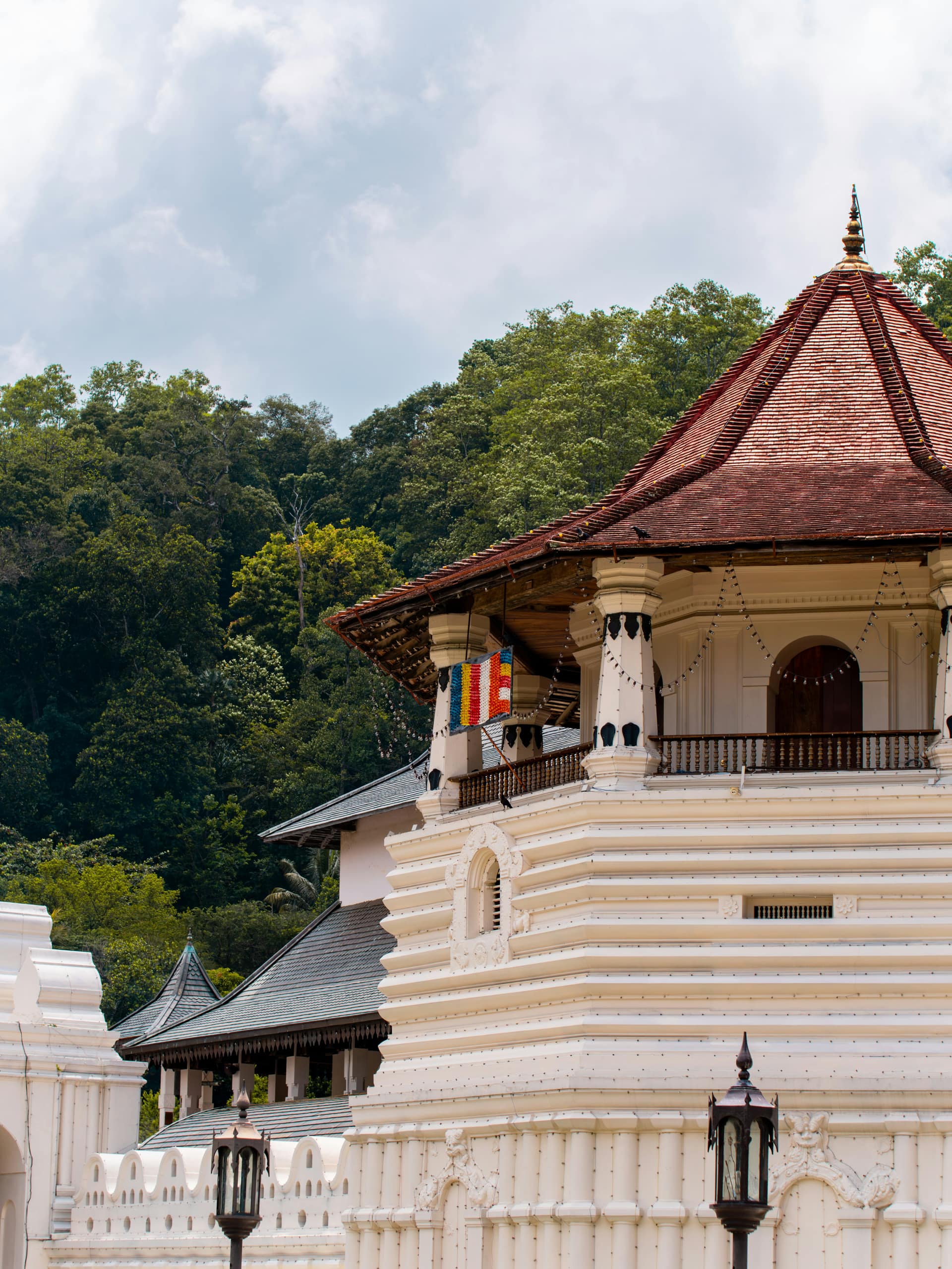
Quick answer
A private Temple of the Tooth visit on a luxury 7-day Sri Lanka itinerary takes place on the evening of day 3 in Kandy, with your own licensed guide. Arrive by about 5.45pm for the 6.30pm puja, when drummers play and the doors to the shrine holding the relic casket open for a short time. The temple cannot be closed for private visits. Cover shoulders and knees, remove shoes at the entrance, and expect to pay roughly US$7 to US$10 for a foreign adult ticket.
Key takeaways
- The Temple of the Sacred Tooth Relic, Sri Dalada Maligawa, stands beside Kandy Lake in the former royal palace complex.
- Tradition holds that the tooth relic of the Buddha reached Sri Lanka in the fourth century CE.
- Pujas are held three times daily, at about 5.30am, 9.30am and 6.30pm.
- The relic is kept inside a set of nested golden caskets and is not itself displayed to visitors.
- The Sacred City of Kandy has been a UNESCO World Heritage Site since 1988.
What the temple is
A private Temple of the Tooth visit on a luxury 7-day Sri Lanka itinerary starts with understanding the place. Sri Dalada Maligawa houses a relic believed to be a tooth of the Buddha, brought to the island in the fourth century CE. For centuries, possession of it conferred the right to rule.
The present buildings date largely from the Kandyan kingdom of the seventeenth and eighteenth centuries, with the octagonal tower added in the early 1800s. The complex was damaged by a bomb in 1998 and restored. Security checks at the entrance are a legacy of that event.
What a private visit can offer
The temple belongs to its worshippers, and no amount of money empties it. On an ordinary evening, several hundred people climb to the upper floor for the puja, and on poya days several thousand.
A private guide changes how you move through that crowd. A good one walks you through the lower halls first, explains the paintings and the tusks, and brings you upstairs at the right minute to stand with a view of the shrine door.
- →A licensed guide for your party alone.
- →Tickets bought in advance, so no queue at the counter.
- →A planned route and a place to stand for the puja.
The evening puja, minute by minute
The evening puja begins at about 6.30pm with drumming in the lower hall. Hewisi drummers and a horn player perform in front of the shrine while monks carry offerings up the stairs to the relic chamber.
Upstairs, a line forms and files past the open door of the inner room, where the golden casket is visible for a few seconds as you pass. The line moves slowly, and the whole ceremony lasts about an hour. Many visitors find the devotion of the families around them more moving than the casket.
- →5.45pm: enter, see the lower halls and the octagon.
- →6.15pm: move to the upper floor.
- →6.30pm: drums begin, and the shrine door opens soon after.
- →7.30pm: leave by the lake side.
Dress and conduct
Dress rules at the Temple of the Sacred Tooth Relic are enforced at the gate. Shoulders and knees must be covered, for men and women. Shoes and hats come off, and shoes are left at a counter for a small fee. The stone floors can be hot at midday and are cool by evening.
White or pale clothing is the custom for worshippers and is appreciated in visitors. Never pose for a photograph with your back to a Buddha image, and keep your voice low. Photography is allowed in most areas and not of the relic chamber at close range.
- →Cover shoulders and knees, and carry a scarf.
- →Leave shoes at the counter and keep the token.
- →Do not turn your back to a Buddha image for a photograph.
Making an offering
Buying flowers adds to the visit. Stalls outside the temple sell lotus blossoms, water lilies and jasmine for a small sum. Carry them in both hands, and place them on the long table in front of the shrine upstairs.
Nothing is asked of non-Buddhists beyond respect. If you would like a monk's blessing, with a white thread tied on the wrist, a guide can arrange it quietly at a smaller temple nearby, where it will mean more than in a queue.
Alternatives to the evening
The 6.30pm puja is the best-known ceremony and the busiest. The 5.30am puja is the same ritual with a fraction of the people, mostly local worshippers. It suits early risers and fits well before a morning departure for the hills.
Lankan Stays & Trails checks the calendar before fixing the visit. On poya days, during the Esala Perahera and on Sri Lankan public holidays, the temple is far more crowded, and the dawn puja becomes the better choice. On Wednesdays, a ritual bathing of the relic adds to the morning ceremony.
Frequently asked questions
Can you see the tooth relic in Kandy?
No. The relic is kept inside seven nested golden caskets in the inner chamber. During the pujas, the door opens and visitors file past to see the outermost casket. The relic itself is shown publicly only on rare occasions, years apart.
What time is the best time to visit the Temple of the Tooth?
During a puja, at about 5.30am, 9.30am or 6.30pm, when the shrine door is open. The evening ceremony is the most atmospheric and the most crowded. The dawn ceremony is quietest. Arrive 30 to 45 minutes before the start.
How much is the entrance fee for the Temple of the Tooth?
Foreign adults pay roughly US$7 to US$10, charged in rupees at the counter or online. The ticket includes the temple and its museums. Sri Lankan citizens enter free. There is a small separate charge for leaving shoes.
What should I wear to the Temple of the Tooth?
Clothing that covers shoulders and knees, for both men and women. White or light colours are traditional. Shoes and hats must be removed before entering. A scarf is useful for covering shoulders, and socks help on hot stone during the day.
How long do you need at the Temple of the Tooth?
About one and a half to two hours for the temple, the puja and a look at the museum and the audience hall. Add 20 minutes for security and shoe storage. Visiting outside puja times takes less time, but the shrine door is closed.
Do I need a guide for the Temple of the Tooth?
Not strictly, but it helps greatly. The complex has several buildings and little explanation in English, and the puja is confusing without someone to position you. Unofficial guides approach at the gate. A licensed guide booked in advance is the better option.