
Quick answer
A Sri Lanka digital nomad itinerary for Canadian travellers typically runs three to six weeks across two or three bases, most commonly a south-coast town like Weligama or Ahangama for surf-and-work cafes, and a hill-country base like Ella for cooler working conditions. Sri Lanka is roughly nine and a half hours ahead of Eastern time, which pushes a Canadian workday into the local evening; most nomads on this route work mornings for themselves and reserve afternoons or evenings for calls with Canadian colleagues.
Key takeaways
- Three to six weeks across two or three bases is typical, far longer per stop than a standard holiday itinerary.
- Sri Lanka sits roughly nine and a half hours ahead of Eastern Time and twelve and a half ahead of Pacific Time, meaning Canadian business hours fall in the Sri Lankan evening.
- Weligama and Ahangama on the south coast have the most developed co-working cafe and fast-wifi scene, largely driven by the surf-tourism economy.
- Monthly guesthouse or apartment rates, negotiated directly rather than booked night by night, are considerably cheaper than short-stay tourist pricing.
- A 30-day tourist ETA is the standard entry option; longer stays require checking current extension rules with the official immigration portal before travelling.
What a Sri Lanka digital nomad itinerary looks like
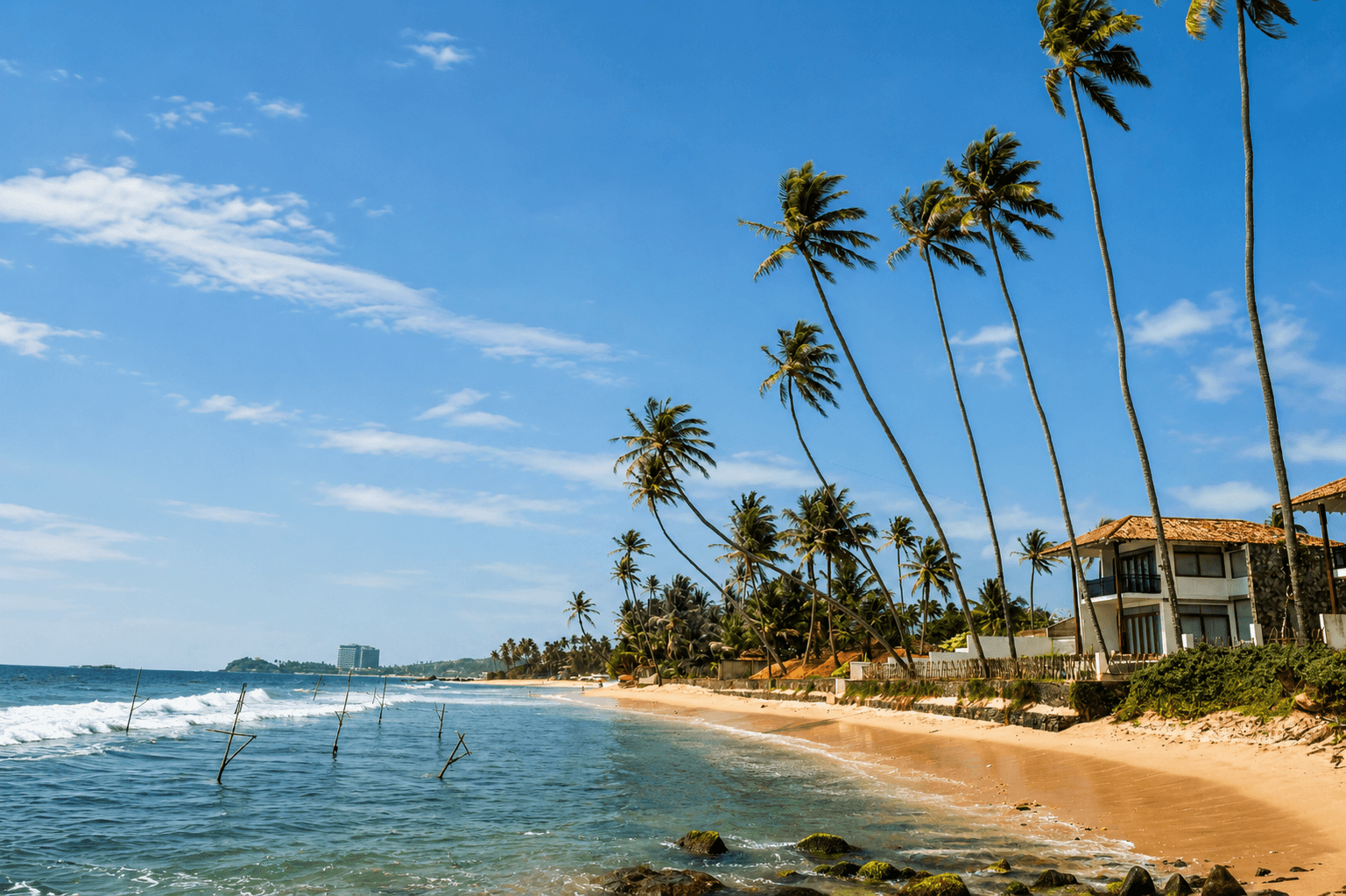
A digital nomad itinerary trades the region-hopping of a standard holiday for two or three bases held for two weeks or more each, with day trips and sightseeing fitted around a working schedule rather than the other way round. The south coast, particularly Weligama and Ahangama, has the country's most established remote-work infrastructure, with fibre-backed cafes and co-working spaces built largely around the surf-tourism crowd.
A second base in the hill country, commonly Ella, offers a cooler working environment and a change of scenery partway through a longer stay, though wifi reliability there is more variable between properties and worth confirming with a specific guesthouse before booking a long stay.
A sample five-week route
This sample balances two longer working bases with a shorter sightseeing block.
- →Weeks 1 to 2: Weligama or Ahangama, working from a co-working cafe with reliable fibre wifi, surf sessions before or after the working day.
- →Week 3: Cultural Triangle and Kandy, a shorter sightseeing block covering Sigiriya, Dambulla and the Temple of the Sacred Tooth Relic with minimal working days planned.
- →Weeks 4 to 5: Ella, working from a guesthouse or cafe with a cooler climate, hiking Little Adam's Peak or Ella Rock outside working hours.
Working around the time-zone gap
Sri Lanka is roughly nine and a half hours ahead of Eastern Time and twelve and a half ahead of Pacific Time, so a standard Canadian 9-to-5 workday falls across the Sri Lankan evening and into the night. Most Canadians on this route flip their schedule: mornings and early afternoons are used for independent work, sightseeing or surfing, and any real-time calls with Canadian colleagues are scheduled for the Sri Lankan evening.
Confirming wifi speed and reliability directly with a specific guesthouse or apartment before committing to a multi-week stay is worth the extra step, since advertised speeds and actual day-to-day reliability can differ meaningfully between properties even in the same town.
Visas, costs and staying long-term
The standard tourist ETA permits a 30-day stay; longer stays require checking the current extension process directly with Sri Lanka's Department of Immigration and Emigration before travelling, since rules and fees for extensions can change. Sri Lanka does not currently operate a dedicated long-term digital nomad visa in the way some Southeast Asian destinations do, so most remote workers extend a standard tourist entry rather than applying for a separate category.
Monthly guesthouse or apartment rates, negotiated directly with the property rather than booked night by night through a listing site, are considerably cheaper than short-stay tourist pricing and are worth asking about even at properties that primarily advertise nightly rates.
Planning your digital nomad itinerary
Two or three bases of two weeks or more, confirmed wifi at each, and a working schedule built around the Sri Lankan evening for Canadian overlap is the framework that makes a longer remote-work stay in Sri Lanka workable rather than exhausting. Sightseeing is better treated as a distinct, shorter block than woven into every working week.
Lankan Stays & Trails can arrange longer guesthouse and villa stays with confirmed wifi for Canadian remote workers, alongside a shorter driver-guided sightseeing block for the Cultural Triangle and hill country.
Frequently asked questions
Is Sri Lanka good for digital nomads?
Yes, particularly the south coast around Weligama and Ahangama, which has developed co-working cafes and reliable fibre wifi largely driven by the surf-tourism economy. Costs are low relative to Canada and the country is easy to navigate for a longer stay.
What time zone is Sri Lanka relative to Canada?
Sri Lanka is roughly nine and a half hours ahead of Eastern Time and twelve and a half ahead of Pacific Time, which pushes Canadian business hours into the Sri Lankan evening for anyone needing real-time overlap.
Does Sri Lanka have a digital nomad visa?
Not currently as a dedicated long-term category. Most remote workers enter on the standard 30-day tourist ETA and extend it, so it is worth confirming the current extension process with the official immigration portal before travelling.
Where is the best wifi in Sri Lanka for remote work?
Weligama and Ahangama on the south coast have the most established co-working cafe scene with reliable fibre connections. Reliability elsewhere, including Ella, varies more by specific property and is worth confirming before booking a long stay.
How long should a digital nomad stay be in Sri Lanka?
Three to six weeks across two or three bases is typical, long enough to settle into a working rhythm at each stop rather than treating the trip like a fast-paced holiday.
Is it cheaper to rent monthly in Sri Lanka than book nightly?
Yes, considerably. Monthly guesthouse or apartment rates negotiated directly with the property are typically much lower than short-stay tourist pricing, even at properties that primarily list nightly rates.