
Quick answer
In Sri Lanka, a private trip with a car and driver-guide is unusually affordable, so for two or more travellers the cost difference against a group tour is often small and sometimes favours the private option once meals and excursions are counted. Group tours suit solo travellers wanting company and a fixed price, and travellers who prefer not to make decisions. Private trips suit anyone with specific interests, families, and travellers who want to control pacing and departure times, which matters considerably in Sri Lanka's climate.
Key takeaways
- A car with a driver-guide in Sri Lanka is inexpensive by international standards.
- For two or more people the cost gap between group and private is often small.
- Group tours suit solo travellers wanting company and a single fixed price.
- Private trips give control over departure times, which matters greatly in the heat.
- Group tour itineraries are frequently paced too fast for Sri Lanka's slow roads.
The cost question, honestly
Sri Lanka is one of the few countries where private touring is genuinely competitive with group travel. The reason is straightforward: a car with a licensed driver-guide costs a fraction of the equivalent in Europe, Australia or North America, and drivers typically arrange their own accommodation and meals through hotel driver quarters, which most Sri Lankan hotels provide as standard.
For a solo traveller a group tour will almost always be cheaper, because the vehicle and driver cost is not shared. For two people the gap narrows considerably. For four or more, private touring frequently costs the same or less once you account for the meals and optional excursions that group tours often exclude and charge separately.
- →Driver-guide costs are low by international standards.
- →Drivers usually use hotel driver quarters, keeping costs down.
- →Solo travellers: group tours are almost always cheaper.
- →Four or more people: private touring often costs the same or less.
- →Compare like for like, including meals and excursions group tours exclude.
Pacing, and why it matters more here
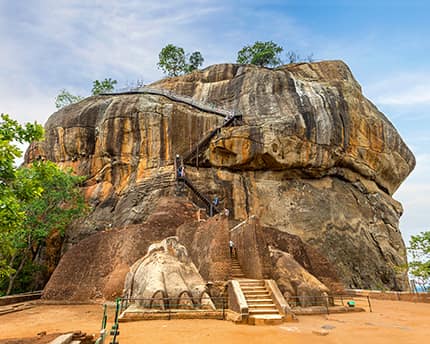
This is the strongest argument for private travel in Sri Lanka specifically. The climate rewards early starts: climbing Sigiriya at seven in the morning is a completely different experience from climbing it at eleven, and the difference between a dawn safari and a mid-morning one is measurable in sightings.
Group tours run on a schedule set for the coach, not for the light. Departures are typically after a hotel breakfast at eight, which puts you at Sigiriya's steps at the hottest and most congested hour. A private trip lets you leave at five thirty, climb in the cool, and have breakfast afterwards. Over a fortnight that difference compounds substantially.
- →Early starts matter enormously in Sri Lanka's heat and for wildlife sightings.
- →Group tours typically depart after breakfast, arriving at sites at the worst hour.
- →Private trips can start at five thirty and breakfast afterwards.
- →Roads are slow; group itineraries frequently underestimate transfer times.
When a group tour is the right choice
Solo travellers get the clearest benefit. A group tour removes the single supplement problem, provides company for two weeks, and gives a fixed total cost with no decisions to make. For a first-time solo traveller in Asia, that combination is genuinely valuable.
Group tours also suit people who actively do not want to make choices. If deciding where to eat every evening feels like work rather than pleasure, a fixed itinerary with everything arranged is the better holiday. Small group tours, typically twelve to sixteen people, are a reasonable middle ground with more flexibility than a full coach.
- →Solo travellers: company, fixed cost, no single supplement on shared rooms.
- →Travellers who find constant decisions tiring rather than enjoyable.
- →Small group tours of twelve to sixteen offer more flexibility than coaches.
- →Fixed departure dates suit people booking around limited leave.
When a private trip is the right choice
Anyone with a specific interest. A birder needs dawn starts at Sinharaja and a specialist guide, neither of which a general group tour provides. A photographer needs the light. A family with young children needs to stop when the children need to stop. A couple wanting three days on a beach in the middle of a cultural itinerary needs an itinerary that can accommodate that.
Private travel also suits anyone travelling outside standard dates, anyone wanting to include less-visited regions like the north or east, and anyone who finds coach travel unpleasant. Multi-generational family groups almost always do better privately, because pacing needs to accommodate both a six-year-old and a seventy-five-year-old.
- →Specific interests: birding, photography, archaeology, food, diving.
- →Families with young children, and multi-generational groups.
- →Itineraries including the north, east, or less-visited regions.
- →Anyone wanting to adjust the plan mid-trip based on weather or interest.
The third option: planning it yourself
Sri Lanka is entirely feasible independently. Trains, buses and tuk-tuks cover the country cheaply, accommodation is easy to book, English is widely spoken, and the tourist infrastructure is well developed. Backpackers do it constantly and enjoy it.
The trade-off is time and effort. You will spend a meaningful part of the trip organising the next part of it, buying train tickets in person, negotiating tuk-tuk fares and waiting at bus stands. That is either part of the appeal or the reason to hand it over. Reserved train seats in particular need booking well ahead, which is difficult from abroad.
- →Entirely feasible independently; trains, buses and tuk-tuks cover the country.
- →English is widely spoken and tourist infrastructure is well developed.
- →Costs the least and takes the most time and organisational effort.
- →Reserved train seats need booking well ahead and are difficult from abroad.
Questions to ask before booking either
For a group tour: how many people, what are the actual departure times each morning, what meals are included, which excursions cost extra, what is the vehicle, and how many hotel changes are there. A fourteen-day tour with eleven hotels is a coach holiday, not a trip.
For a private trip: what is included and excluded specifically, what is the policy on commission shop stops, is the driver a licensed chauffeur-guide, what vehicle and how old, and can the itinerary be adjusted during the trip. On shop stops in particular, an operator that permits them is telling you something.
- →Group: party size, actual departure times, meals, extras, hotel changes.
- →A fourteen-day tour with eleven hotel changes is a coach holiday.
- →Private: inclusions, shop stop policy, guide licensing, vehicle age.
- →Ask both about flexibility to change plans mid-trip.
Our recommendation
For two or more travellers, take the private option in Sri Lanka. The cost gap is unusually small, the control over timing is unusually valuable given the climate, and the ability to adjust for weather across a country with two monsoons is genuinely useful. For solo travellers, a small group tour is the sensible choice unless budget is not a constraint.
Lankan Stays & Trails builds private, driver-guided itineraries and does not run coach tours, which is a disclosure rather than a neutral position. If your circumstances point towards a group departure, we will say so.
Frequently asked questions
Is a private tour of Sri Lanka expensive?
Less than most travellers expect. A car with a licensed driver-guide costs a fraction of the equivalent elsewhere, and drivers typically use hotel driver quarters. For two people the gap against a group tour narrows considerably, and for four or more it often disappears entirely.
Should I book a group tour or a private trip in Sri Lanka?
For two or more people, private usually wins on cost-adjusted value and on control of timing, which matters greatly in Sri Lanka's heat. Solo travellers generally do better on a small group tour, which removes the single supplement and provides company.
Why does departure time matter so much in Sri Lanka?
Because the climate rewards early starts. Climbing Sigiriya at seven is a completely different experience from eleven, and a dawn safari produces measurably more sightings than a mid-morning one. Group tours typically depart after breakfast, which puts you at sites at the worst hour.
Can you travel Sri Lanka independently?
Yes, easily. Trains, buses and tuk-tuks cover the country cheaply, accommodation is straightforward to book, English is widely spoken and the tourist infrastructure is well developed. The trade-off is that you spend a meaningful part of the trip organising the next part of it.
What should I ask before booking a Sri Lanka group tour?
Party size, actual daily departure times, which meals are included, which excursions cost extra, the vehicle type, and how many hotel changes there are. A fourteen-day tour with eleven hotel changes is a coach holiday rather than a trip worth taking.
Are small group tours better than large ones in Sri Lanka?
Generally yes. Small group tours of twelve to sixteen people can use smaller vehicles, reach places coaches cannot, and move more quickly through sites and meals. They cost more per person than a full coach tour but offer meaningfully more flexibility.
What should I check before booking a private driver in Sri Lanka?
Whether the driver is a licensed chauffeur-guide, what is included and excluded specifically, the vehicle type and age, whether the itinerary can be adjusted mid-trip, and above all the operator's policy on commission shop stops. Permitting them tells you something important.