
Quick answer
For halal-observant Turkish travellers, the Maldives' local inhabited islands make halal food the default, since the population is overwhelmingly Muslim, while Sri Lanka's genuine halal availability is concentrated in cities such as Kandy, Colombo, and the east coast around Trincomalee. Maldives resort islands serve international buffet-style menus that are not automatically halal-certified, so it is worth confirming with the specific resort. Sri Lanka needs more active route-planning outside these hubs, but real halal options do exist there.
Key takeaways
- Maldives local inhabited islands are Muslim-majority, so halal food is the everyday default away from resort islands.
- Maldives resort islands generally serve international, multi-cuisine buffet menus that are not automatically halal-certified, so travellers should ask the resort directly before booking.
- Sri Lanka's Muslim community is concentrated in Kandy, Colombo, and the east coast (including Trincomalee and Kattankudy), where halal restaurants and butchers are straightforward to find.
- Outside Sri Lanka's cities and Muslim-majority towns, formal halal certification is inconsistent, though many restaurants can prepare a pork-free, alcohol-free meal on request.
- A private driver-guide touring Sri Lanka can route meals through halal-friendly towns each day, a level of daily planning a single Maldives resort stay does not require.
The short answer on halal food
Halal food in the Maldives and Sri Lanka works on almost opposite structures. The Maldives is a Muslim-majority country, so on its local inhabited islands halal is simply how food is prepared, no separate search required. Sri Lanka is a Buddhist-majority country with a genuine but geographically concentrated Muslim community, so halal food exists but has to be found rather than assumed.
Neither country is a poor choice for a halal-observant traveller. The difference is in how much planning each requires: the Maldives needs a check on the specific resort's kitchen, while Sri Lanka needs a route that passes through the right towns.
- →Maldives local islands: halal is the default, minimal planning needed.
- →Maldives resort islands: international menus, halal certification varies by property, confirm directly.
- →Sri Lanka cities and Muslim-majority towns (Kandy, Colombo, Trincomalee, Kattankudy): genuine halal restaurants and butchers.
- →Sri Lanka's smaller inland and hill-country towns: less consistent, but pork-free and alcohol-free requests are usually workable.
Halal food on Maldives local islands
Maldives local inhabited islands, as opposed to the private resort islands most tourists stay on, are populated almost entirely by Maldivian Muslims. Restaurants and guesthouses on these islands serve halal food as a matter of course, without needing to advertise it separately, since there is effectively no non-halal alternative on offer.
Guesthouse-style tourism on local islands has grown in the Maldives over the past decade, and it tends to suit halal-observant travellers well precisely because the food question resolves itself. Alcohol is also restricted or unavailable on these islands, which for many Turkish Muslim travellers is a related and welcome simplification rather than a limitation.
Halal food at Maldives resort islands
Maldives resort islands operate on a different model entirely. Each resort is typically a single private island with its own kitchens serving an international, multi-cuisine menu built for a global guest mix, and staffed by an international team rather than run according to local island norms.
Halal certification at resorts varies considerably by property and is not something to assume. Some resorts hold formal halal certification or offer a dedicated halal menu on request; others simply serve pork and alcohol alongside everything else without a halal option at all. Confirming this directly with the resort before booking, rather than relying on general assumptions about the Maldives, is the only reliable approach.
Given this, a Turkish traveller who wants a hassle-free halal resort stay is generally better served by researching specific properties in advance than by choosing the Maldives on the general assumption that a Muslim-majority country automatically means a halal resort kitchen.
Halal food in Sri Lanka's cities and Muslim areas
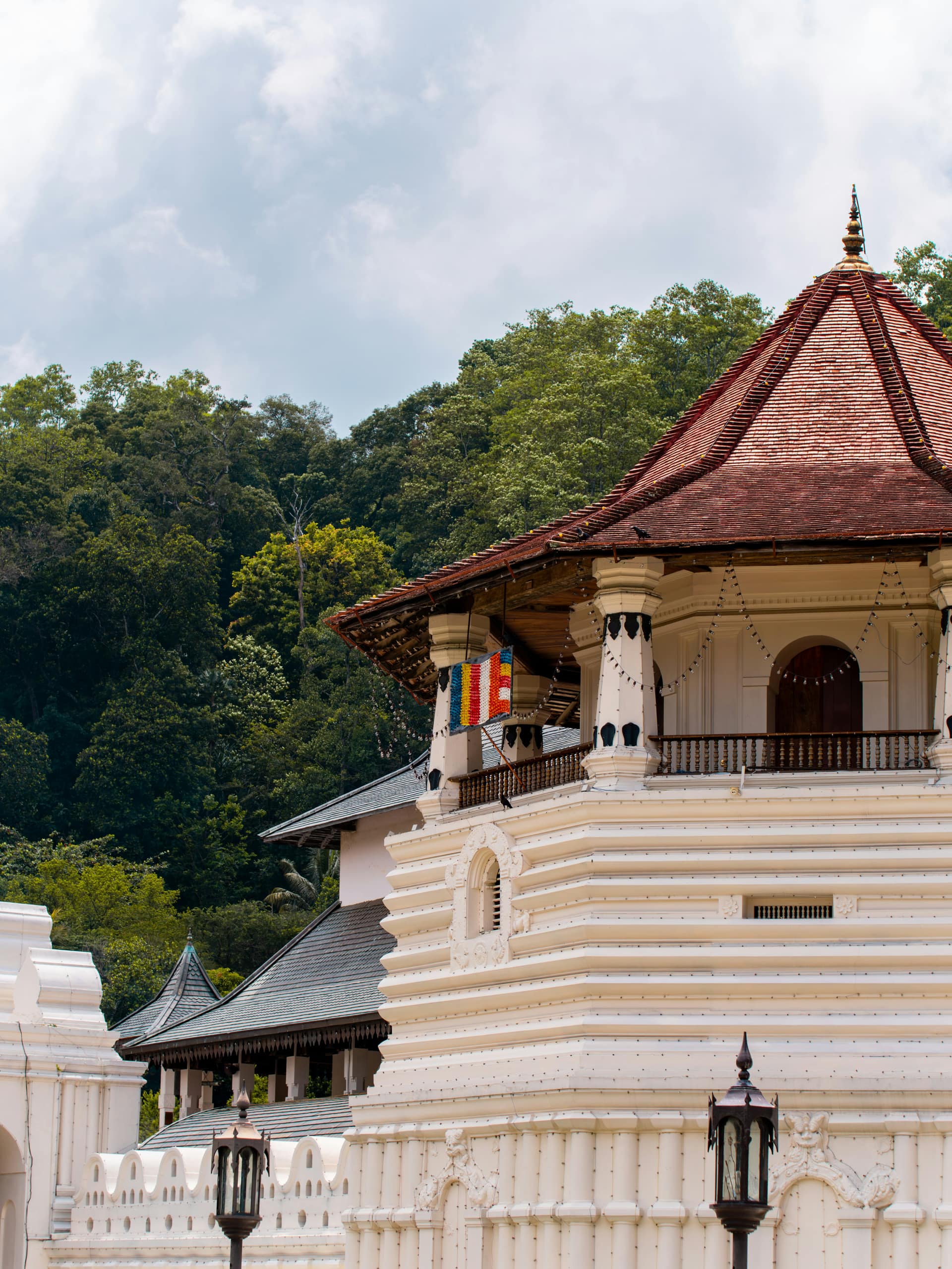
Sri Lanka's Muslim community, mostly Sri Lankan Moors, is well established in specific parts of the country, and halal food follows that geography closely. Kandy has a long-standing Muslim quarter with halal restaurants and butchers; Colombo, as the capital, has halal options across several neighbourhoods, including dedicated halal-certified restaurants; and the east coast, particularly around Trincomalee and Kattankudy, is strongly Muslim-influenced in its food culture.
In these areas, finding halal meat, biryani, and short-eats is not difficult and does not require advance research the way a Maldives resort stay does. Turkish travellers touring the Cultural Triangle and hill country with an overnight in Kandy, for example, will generally find halal food easily during that stop.
- →Kandy: established Muslim quarter, halal restaurants and butchers.
- →Colombo: halal-certified restaurants across several neighbourhoods.
- →Trincomalee and the east coast: strong Muslim food culture, halal easy to find.
- →Kattankudy near Batticaloa: a Muslim-majority town with halal as the local norm.
Halal food away from Sri Lanka's main hubs
Sri Lanka's hill country, national park areas, and smaller inland towns have a much smaller Muslim presence, and formal halal certification there is inconsistent. This does not mean halal-observant travellers go hungry; it means the approach shifts from finding a certified halal restaurant to communicating dietary requirements directly.
Most Sri Lankan restaurants and hotel kitchens can prepare a pork-free, alcohol-free meal built around vegetables, fish, rice, and curry on request, even without formal halal certification. A driver-guide who knows the route can also flag which towns along the way have genuine halal options, smoothing out the days spent outside the main hubs.
Practical guidance for halal-observant travellers
Practical planning differs by destination but follows a similar principle in both: confirm rather than assume. In the Maldives, that means contacting the specific resort about halal certification and menu options before booking, since two neighbouring resorts can differ significantly. In Sri Lanka, it means building the itinerary around towns known for halal availability and briefing the driver-guide on dietary requirements from day one.
Lankan Stays & Trails builds private, driver-guided Sri Lanka itineraries for Turkish travellers, and dietary planning, including halal-friendly meal stops, is a normal part of that conversation rather than an afterthought.
- →Maldives: email or message the resort directly to confirm halal certification before booking.
- →Sri Lanka: mention halal requirements when booking a driver-guide so the route accounts for it.
- →Both: pork-free, alcohol-free requests are generally workable even without formal certification.
- →Sri Lanka's east coast and Kandy are reliable stops for a fully halal meal without prior arrangement.
Frequently asked questions
Is it easy to find halal food in the Maldives?
It depends on the island type. Maldives local inhabited islands serve halal food as the default, since the population is Muslim-majority. Resort islands serve international menus that are not automatically halal-certified, so confirming with the specific resort before booking is the reliable approach.
Do Maldives resorts serve halal food?
Some do and some don't; it varies by property. Certain resorts hold formal halal certification or offer a halal menu on request, while others serve pork and alcohol alongside everything else with no halal option, so this needs confirming directly with each resort.
Is halal food available in Sri Lanka?
Yes, genuinely, though it is concentrated in specific areas. Kandy, Colombo, and the east coast around Trincomalee and Kattankudy have established halal restaurants and butchers, while smaller inland towns have less formal certification but can usually prepare pork-free, alcohol-free meals.
Which is easier for halal food, Sri Lanka or the Maldives?
The Maldives' local islands are easier, since halal is the unplanned default there. Maldives resorts and Sri Lanka both require some checking: resorts need confirming per property, while Sri Lanka needs an itinerary that passes through Muslim-majority towns like Kandy or Trincomalee.
Are Maldives local island restaurants halal by default?
Generally yes. Maldives local inhabited islands are populated almost entirely by Maldivian Muslims, so restaurants and guesthouses there serve halal food as standard practice, without a separate halal menu needing to be advertised or requested.
Can a driver-guide help find halal food in Sri Lanka?
Yes. A private driver-guide who knows the route can plan meal stops in towns with genuine halal availability, such as Kandy or the east coast, and communicate dietary requirements to restaurant kitchens along less Muslim-populated stretches of the trip.
Is alcohol served alongside halal food at Maldives resorts?
Usually yes on resort islands, where alcohol is widely available regardless of a property's halal food options. Maldives local inhabited islands are the opposite: alcohol is restricted or unavailable there, generally alongside a halal-by-default food culture.
Do I need to pre-book halal meals for a Sri Lanka tour?
It is not strictly necessary in Sri Lanka's Muslim-majority towns, but mentioning halal requirements when booking a driver-guided tour helps the route and meal stops account for it, particularly for days spent in hill country or national park areas with fewer certified options.