
Quick answer
The three places every first trip to Sri Lanka should include are Sigiriya, Kandy and one coast. Sigiriya covers the ancient Cultural Triangle and is the country's defining sight. Kandy covers living Buddhist practice at the Temple of the Sacred Tooth Relic and opens the hill country. One coast, usually on the south, provides the rest that makes the trip a holiday. Together they need roughly five days and cover the island's three distinct characters.
Key takeaways
- Sigiriya, Kandy and one coast are the three places that survive every cut to a first-trip itinerary.
- The three were chosen for covering distinct characters of the island, not for fame: ancient, sacred and coastal.
- Together they need roughly five days including transfers, which makes them viable even on a very short trip.
- Ella is the strongest fourth place, and a safari park the strongest fifth.
- Dambulla is effectively free alongside Sigiriya, sitting roughly twenty to thirty minutes away on the same base.
The test these three had to pass
Reducing Sri Lanka to three places is an artificial exercise, but it clarifies something useful: which stops are load-bearing and which are enrichment. The test applied here is not popularity. It is whether removing the place would leave a traveller with an incomplete picture of what Sri Lanka is.
By that test, Sri Lanka has three distinct characters that a first trip needs to touch. There is the ancient dry-zone island of vast reservoirs, rock citadels and ruined capitals. There is the sacred and upland island of temples, tea and cool air. And there is the tropical island of beaches, fishing harbours and the sea.
A trip that touches all three feels like Sri Lanka. A trip that covers two of them, however thoroughly, tends to feel like a fragment, and travellers notice this even when they cannot articulate why.
- →The test is completeness of picture, not fame or photogenic value.
- →Sri Lanka has three distinct characters: ancient dry zone, sacred uplands, tropical coast.
- →Touching all three is what makes a short trip feel whole.
- →Covering two thoroughly still leaves a trip feeling partial.
Why Sigiriya is the first non-negotiable
Sigiriya carries the ancient dry-zone character on its own, and it does so more efficiently than any alternative. The fifth-century citadel sits on a 200-metre granite monolith, surrounded by water gardens that are a significant piece of ancient hydraulic engineering in their own right.
The alternatives cannot match that efficiency. Anuradhapura needs a full day and a vehicle to cover ground; Polonnaruwa needs a morning and bicycles. Sigiriya delivers a comparable sense of ancient Sri Lanka in a half-day climb, and it is the image most travellers arrive holding in their heads.
Dambulla comes almost free alongside it, roughly twenty to thirty minutes away on the same base, adding painted cave temples and roughly 150 Buddha statues for about ninety minutes of trip time. In practice the first non-negotiable is really Sigiriya and Dambulla together.
- →A fifth-century citadel on a 200-metre granite monolith, climbed in roughly 1,200 steps.
- →Delivers the ancient character in a half-day, where the capitals need a full one.
- →Dambulla sits roughly twenty to thirty minutes away and shares the same base.
- →Two nights at Sigiriya or Habarana covers both comfortably.
Why Kandy is the second non-negotiable
Kandy is the least obvious of the three and the one most often questioned, because it is a congested working city rather than a scenic town. It earns its place on two counts that nothing else on the route provides.
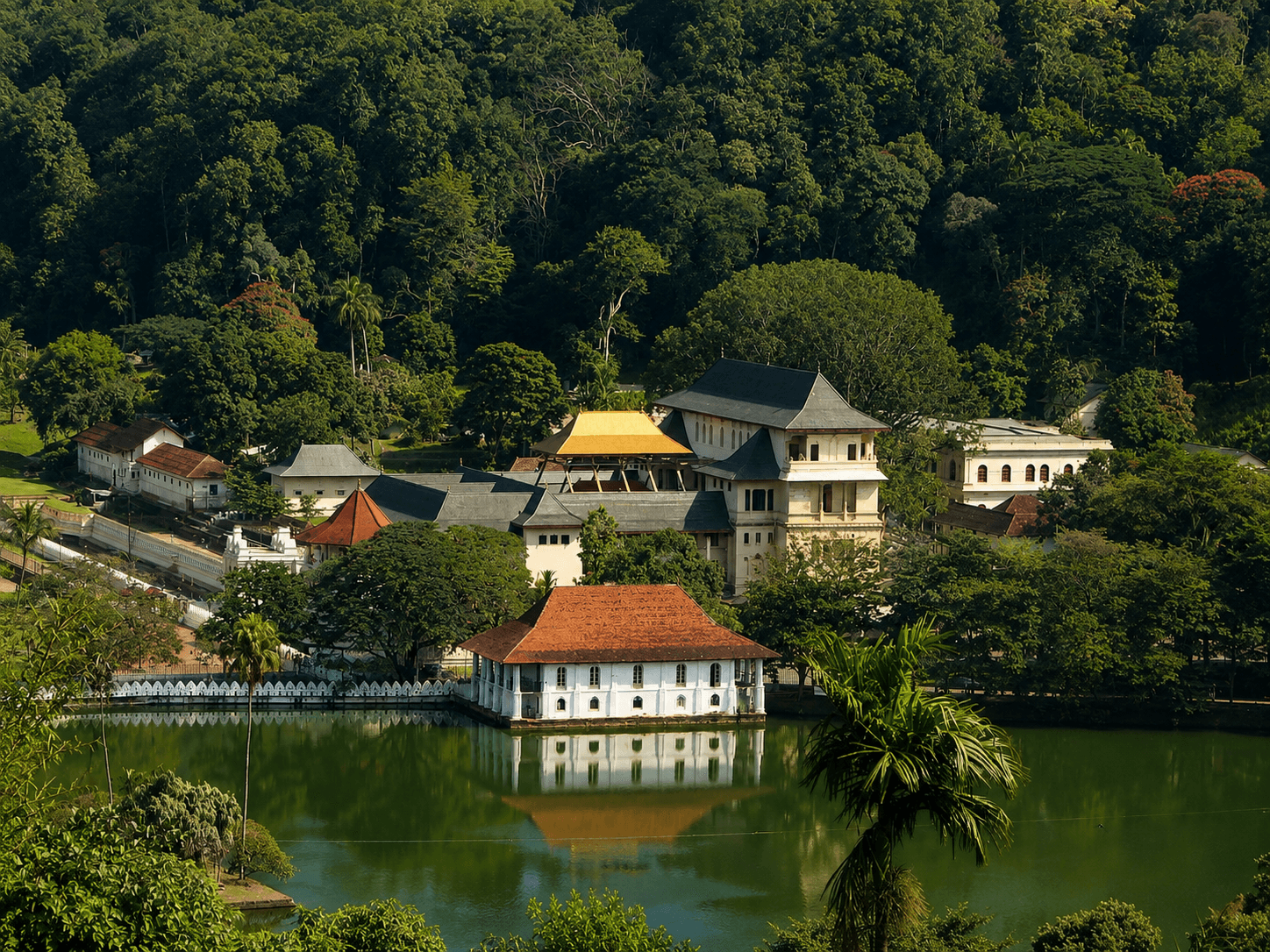
The first is the Temple of the Sacred Tooth Relic, which houses the most venerated Buddhist relic in Sri Lanka and remains an active pilgrimage site. Visiting during evening puja, with drummers in the corridors and pilgrims filing past the relic chamber, is the clearest encounter a first-time visitor gets with living Buddhist practice rather than its ruins.
The second is position. Kandy sits at the junction between the Cultural Triangle and the hill country, which means including it costs almost no additional driving. It also opens the tea country and the scenic rail line, so even a trip that goes no further has stood at the gateway.
- →Houses Sri Lanka's most venerated Buddhist relic, and remains an active pilgrimage site.
- →Evening puja is the clearest encounter with living Buddhist practice on the standard route.
- →Sits at the junction of the Cultural Triangle and the hill country, so costs little to include.
- →Was the capital of the last independent Sinhalese kingdom, which fell in 1815.
Why one coast is the third non-negotiable
The third place is deliberately not named as a specific beach, because which coast depends entirely on the season. Between roughly December and March that means the south or west: Mirissa, Unawatuna, Bentota or Tangalle. Between roughly May and September it means the east: Trincomalee or Nilaveli.
The coast is non-negotiable for a reason that has nothing to do with sightseeing. A first trip to Sri Lanka is physically demanding, with early starts, climbing and long transfers, and without a coastal stop it becomes a tour rather than a holiday. Travellers return tired rather than rested, and remember it accordingly.
Two nights is the minimum for this to work, and three is better. One night by the sea at the end of a busy itinerary delivers an evening and a checkout, which is not the same thing at all.
- →December to March: the south or west coast, such as Mirissa or Unawatuna.
- →May to September: the east coast, such as Trincomalee or Nilaveli.
- →The coast exists to make the trip restful, not to add another sight.
- →Two nights minimum; three is materially better.
What to add once the three are locked in
The strongest fourth place is Ella. It adds the hill country properly rather than as a glimpse from Kandy, with the Nine Arch Bridge, Little Adam's Peak and the scenic train arrival, and it sits conveniently between Kandy and the southern coast.
The strongest fifth is a safari park, usually Udawalawe for near-certain elephants or Yala for a realistic leopard chance. This adds the wildlife element, which is the most significant thing still missing from a three-place or four-place trip.
Beyond five, the additions become genuinely optional: Polonnaruwa or Anuradhapura for ancient history, Nuwara Eliya for tea estates, Galle for colonial architecture. All are excellent and none is load-bearing, which is precisely why they are the right things to add last and cut first.
- →Fourth: Ella, for the hill country and the scenic train.
- →Fifth: a safari park, Udawalawe for elephants or Yala for leopards.
- →Sixth onwards: Polonnaruwa, Nuwara Eliya and Galle, in roughly that order.
- →Everything past the fifth place is enrichment rather than structure.
Building outwards from three
The practical use of a three-place core is as a planning method rather than an itinerary. Lock Sigiriya, Kandy and one coast into the schedule first, with their nights protected, then add Ella, then a safari, then whatever the remaining days allow. Anything that would require cutting a night from the core does not go in.
This sounds obvious and is the reverse of how most first itineraries get built, which is by listing everything and then compressing. Lankan Stays and Trails plans first trips outwards from this core, which is why our proposals often look shorter than clients expect and why they tend to survive contact with the actual roads.
Frequently asked questions
What places should you always visit in Sri Lanka on a first trip?
Sigiriya, Kandy and one coast. Sigiriya covers the ancient Cultural Triangle, Kandy covers living Buddhist practice at the Temple of the Sacred Tooth Relic and opens the hill country, and one coast provides the rest that turns a demanding itinerary into a holiday.
What is the minimum itinerary for Sri Lanka?
Roughly five days covering Sigiriya, Kandy and one coast, including transfers. That is enough to touch the island's three distinct characters: the ancient dry zone, the sacred uplands and the tropical coast. Below five days, a single region works better than a loop.
Why is Kandy considered essential in Sri Lanka?
For the Temple of the Sacred Tooth Relic, which houses the country's most venerated Buddhist relic and remains an active pilgrimage site, and for its position between the Cultural Triangle and the hill country, which means including it adds almost no driving to the route.
Which beach should I choose on a short Sri Lanka trip?
It depends on the season. Roughly December to March suits the south and west, including Mirissa, Unawatuna and Bentota. Roughly May to September suits the east, including Trincomalee and Nilaveli. Sri Lanka has two monsoons, so there is almost always a good coast.
What is the fourth place to add to a Sri Lanka itinerary?
Ella, which adds the hill country properly with the Nine Arch Bridge, Little Adam's Peak and the scenic train arrival, and sits conveniently between Kandy and the south coast. A safari park at Udawalawe or Yala is the strongest fifth addition after that.
Do I need to visit both Sigiriya and Dambulla?
They work best together and effectively count as one stop. Dambulla sits roughly twenty to thirty minutes from Sigiriya, shares the same base, and takes about ninety minutes to visit, so including it costs very little once you are in the Cultural Triangle.
How many nights do the three essential places need?
Roughly five days in total: two nights at Sigiriya or Habarana, one at Kandy, and two on a coast. Adding a night to the coast is the single best use of a sixth day, ahead of adding any additional destination to the route.