
Quick answer
Wewurukannala Vihara is a Buddhist temple about 1.5 kilometres inland from Dikwella, roughly 22 kilometres east of Matara, famous for a seated Buddha of around 50 metres completed in the late 1960s. A building behind the statue has stairs leading up to the level of its head. The temple also has a hall of life-size figures showing the punishments of the Buddhist hells, and an older shrine with traditional murals. A visit takes about an hour, and a small entry fee applies. Modest dress is required.
Key takeaways
- Wewurukannala lies about 1.5 kilometres inland from Dikwella, roughly 22 kilometres east of Matara and 15 kilometres west of Tangalle.
- The seated Buddha is around 50 metres tall and was completed in the late 1960s.
- Stairs inside a building behind the statue lead to the level of its head, through floors of paintings.
- A hall of life-size figures shows the punishments of the Buddhist hells in graphic detail.
- The temple is about 5 minutes from Hiriketiya bay, making it an easy outing from Dikwella or Tangalle.
What Wewurukannala Vihara is
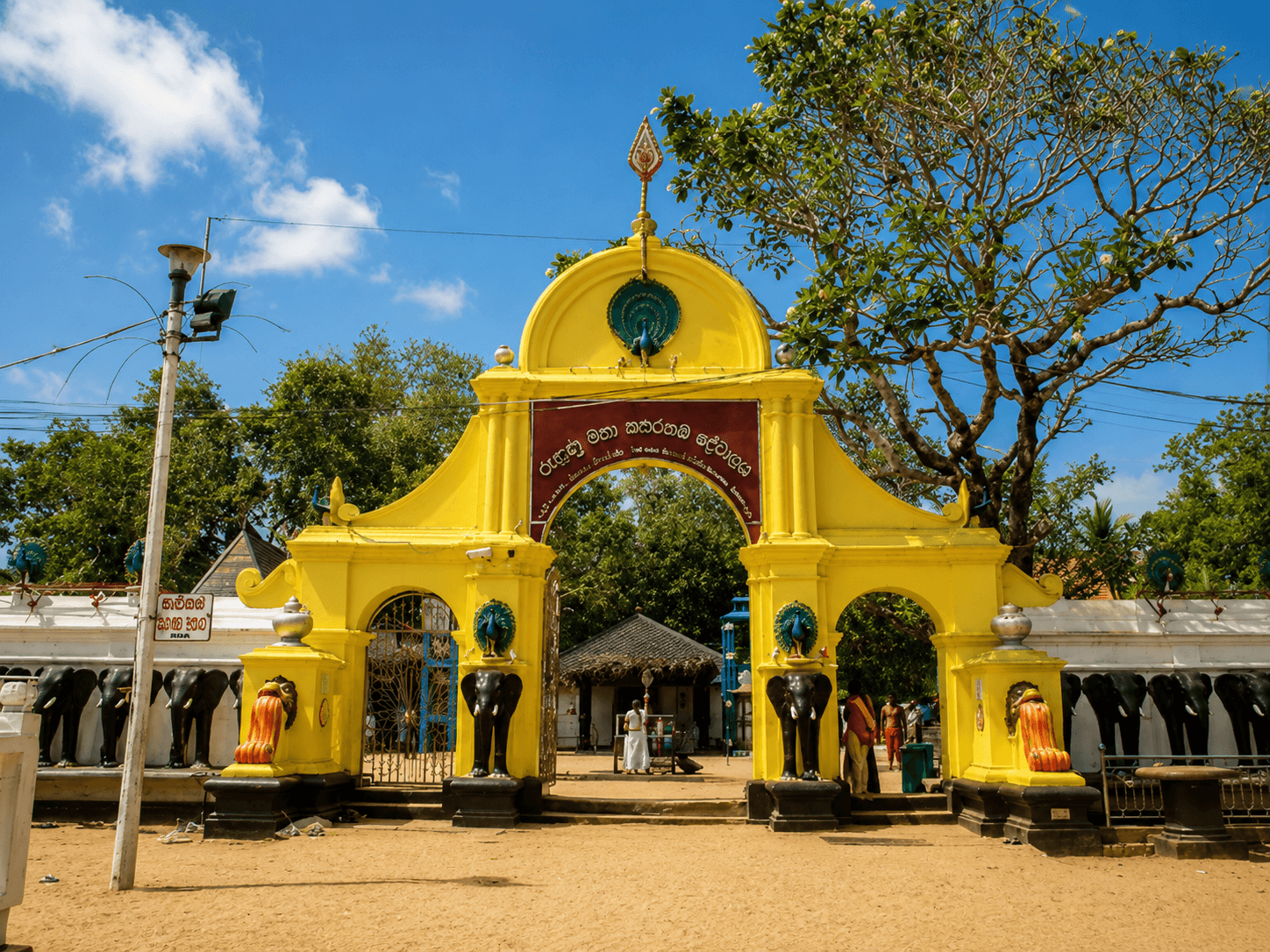
Wewurukannala Vihara is a Buddhist temple on the edge of Dikwella, a few minutes inland from the coast road. Its older shrine has been a place of worship for centuries, but the temple is famous for the giant seated Buddha added in the twentieth century, which towers over the compound and can be seen from the surrounding countryside.
Wewurukannala is a lively, devotional temple. Local families come to make offerings and light lamps, and school groups and pilgrims visit throughout the year. For foreign visitors it is a vivid introduction to popular Buddhism in the south.
The giant seated Buddha
The Wewurukannala Buddha is a seated figure of around 50 metres, completed in the late 1960s and among the largest seated Buddha statues in Sri Lanka. It sits in meditation with its back to a tall building, through which stairs climb to the level of the statue's head.
The climb takes 10 to 15 minutes and passes floors of paintings showing the life of the Buddha. From the top, visitors look across at the face of the statue and out over the paddy fields and palms towards the coast. The view is worth the stairs.
- →Height: around 50 metres.
- →Completed: late 1960s.
- →Climb: 10 to 15 minutes to the head level.
- →Paintings: life of the Buddha on each floor.
The hall of hell scenes
Wewurukannala's best-known curiosity is a tunnel-like hall of life-size painted figures showing the punishments of the Buddhist hells. Sinners are boiled, sawn, impaled and tormented by demons, with each scene matched to a wrong done in life, such as theft, lying or drinking alcohol.
The hall is meant as moral teaching and is taken seriously by local visitors, but its vivid, sometimes gruesome scenes surprise many foreigners. Parents with young children may want to look first and decide, or walk through quickly.
- →Theme: punishments matched to wrongdoing.
- →Style: life-size painted figures in vivid colours.
- →Suitability: older children and adults; preview for young children.
The older shrine and murals
Wewurukannala's older shrine is quieter and often overlooked. Its image house holds traditional murals in the southern style, with Jataka stories and scenes of the Buddha's life painted in earthy reds and ochres, along with older statues.
Wewurukannala's older shrine gives a sense of how the temple looked before the giant statue was built. Ask a monk or caretaker to show you if it is closed, and leave a donation in thanks.
Visiting Wewurukannala
Wewurukannala is about 1.5 kilometres inland from Dikwella on the road towards Beliatta, roughly 5 minutes from Hiriketiya, 25 minutes from Tangalle and 35 minutes from Mirissa. A small entry fee applies, usually a few US dollars. Allow about an hour for the statue, the hell hall and the old shrine.
Shoulders and knees must be covered, and shoes come off at the entrance. The stone floors heat up quickly, so mornings and late afternoons are more comfortable. Photography is generally allowed, but never pose with your back to the Buddha.
- →Time needed: about an hour.
- →Cost: a few US dollars.
- →Best time: early morning or after 3.30pm.
Fitting Wewurukannala into a south coast day
Wewurukannala fits naturally into a day around Dikwella and Tangalle, combined with the Hummanaya blowhole at Kudawella, about 15 minutes east, and a swim at Hiriketiya. From Mirissa, it pairs with Weherahena and Dondra Head on a temple and lighthouse loop.
Lankan Stays & Trails often places Wewurukannala on the drive between Mirissa and Tangalle, so the move between bases becomes a sightseeing day rather than a straight transfer.
Frequently asked questions
How tall is the Wewurukannala Buddha?
The seated Buddha at Wewurukannala Vihara is around 50 metres tall, often quoted as about 160 feet. It was completed in the late 1960s and is among the largest seated Buddha statues in Sri Lanka.
Where is Wewurukannala Vihara?
Wewurukannala Vihara is about 1.5 kilometres inland from Dikwella on Sri Lanka's south coast, on the road towards Beliatta. It is roughly 22 kilometres east of Matara, 15 kilometres west of Tangalle and about 5 minutes from Hiriketiya.
Can you climb the Wewurukannala Buddha?
You climb a building behind the statue, not the statue itself. Stairs lead through floors of paintings to the level of the Buddha's head, taking 10 to 15 minutes. From the top you see the statue's face up close and views over the countryside.
Is Wewurukannala suitable for children?
Mostly yes, though the hall of hell scenes shows graphic punishments that can frighten young children. Parents may want to look first or walk through quickly. The giant Buddha and the climb usually impress children of all ages.
How much is the entry fee at Wewurukannala?
There is usually a small fee for foreign visitors, a few US dollars, and donations are welcome. Fees change, so confirm locally. The ticket covers the giant Buddha, the climb and the hell hall.
How long do you need at Wewurukannala Vihara?
About an hour is enough to see the giant Buddha, climb to its head, walk through the hall of hell scenes and look at the older shrine. Add time if you want to sit quietly or talk with the monks.
Is Wewurukannala worth visiting from Mirissa?
Yes, especially combined with other stops. Wewurukannala is about 35 minutes from Mirissa, and works well with Weherahena, Dondra Head or the Hummanaya blowhole in a half-day loop. On its own, it is a long detour for an hour's visit.