
Quick answer
In December, whale watching in Sri Lanka is based in Mirissa on the south coast, where the season runs roughly from December to April. Early December trips are more often cancelled or cut short by swell, while late December usually has calmer seas and regular sailings. Blue whales are the main attraction, with sperm whales and spinner dolphins also seen. Trips last four to five hours from dawn. Choose a responsible operator. Trincomalee's season does not start until about March.
Key takeaways
- In December, whale watching is from Mirissa on the south coast.
- The season runs roughly from December to April.
- Early December trips are more weather-dependent.
- Blue whales are the main attraction; sightings are never guaranteed.
- Trincomalee's season starts around March.
The season in December
Blue whales feed in the deep, nutrient-rich water off Dondra Head, the southern tip of Sri Lanka, just a short distance from shore. From about December to April, when the north-east monsoon brings calm seas to the south coast, boats from Mirissa can reach them on most mornings.
In early December, the sea can still be rough after the inter-monsoon. Trips are sometimes cancelled or turned back, and those that go can be uncomfortable. By the second half of the month, the sea is usually calmer and sailings more regular, though weather is never certain.
Sightings of blue whales are common through the season, but they are never guaranteed. Planning two possible mornings in Mirissa gives you a second chance if the first trip is cancelled or unlucky.
- →Season: roughly December to April.
- →Early December: more cancellations.
- →Late December: calmer and more regular.
What you might see
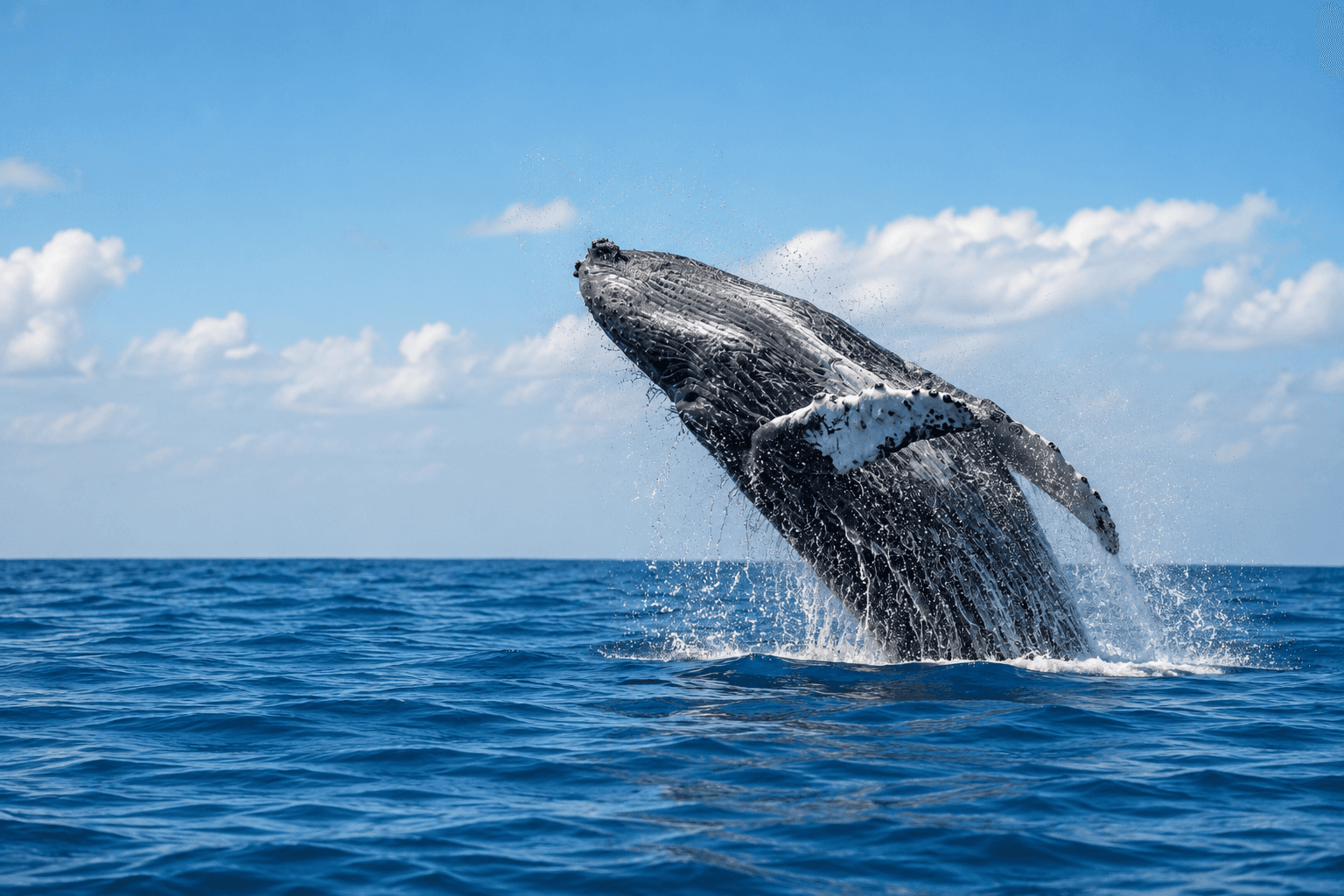
Blue whales, the largest animals on Earth, are the stars. They are usually seen surfacing to breathe, with a tall blow and a long glimpse of the back, and sometimes the tail as they dive. Sperm whales, with their angled blow, are also seen, sometimes in groups.
Spinner dolphins are frequent, often in large pods, leaping and spinning near the boats. Bryde's whales, fin whales, flying fish and sea turtles add to the variety on some trips.
The experience depends on the day: some trips see several whales close to the boat, others see distant blows or nothing. Patience and realistic expectations make it more enjoyable.
- →Blue whales.
- →Sperm whales.
- →Spinner dolphins.
What a trip is like
Boats leave Mirissa harbour at around 6 to 7 am and travel out to the deep water, which can take an hour or more. Trips last around four to five hours, including searching time. Breakfast and water are usually provided.
The sea can be lively, especially in early December, and seasickness is common. Take a seasickness tablet before departure, sit in the middle of the boat, look at the horizon and avoid a heavy breakfast. Bring a hat, sunscreen and a light jacket for the early start.
Larger boats are more stable, while smaller boats can be more flexible and less crowded. Both have advantages; what matters most is the operator's approach to the whales.
- →Departure around 6 to 7 am.
- →Four to five hours.
- →Seasickness tablets recommended.
Choosing a responsible operator
Sri Lanka has guidelines for whale watching, including keeping a minimum distance from whales and limiting the time boats spend near them. Some operators break these rules, crowding the whales with several boats or chasing them for photographs.
Choose an operator with a reputation for responsible practice, naturalist guides and smaller numbers of passengers. Ask how they approach whales, and avoid those that promise close encounters. The planners at Lankan Stays & Trails work with operators who follow the guidelines and brief guests on what to expect.
Reporting poor behaviour and supporting responsible operators helps protect the whales and the future of whale watching in Sri Lanka.
Planning whale watching in December
Plan whale watching for late December or later in the trip if you can, when the sea is usually calmest. Stay in Mirissa or nearby, such as Weligama or Talalla, for an early start, and keep a spare morning in case of cancellation.
Whale watching fits well at the end of a December route, after the Cultural Triangle, the hills and a safari in Yala or Udawalawe, with beach days in Mirissa or nearby.
Bring a camera with a zoom lens, as whales are often seen at a distance, and protect it from spray with a dry bag. Binoculars help with distant blows. Most importantly, keep expectations realistic: on some mornings the whales come close, on others they stay far away, and the sea itself is beautiful at dawn.
Frequently asked questions
Can you see whales in Sri Lanka in December?
Yes, from Mirissa on the south coast, where the season runs roughly from December to April. Early December trips are more often cancelled by swell, while late December usually has calmer seas. Blue whales are often seen, but sightings are never guaranteed.
Is December a good month for blue whales?
Late December is usually good, with calmer seas and regular sailings. Early December is more weather-dependent. January to April is the main season, with the most reliable conditions. Plan two possible mornings in Mirissa to improve your chances.
Where is whale watching in December?
From Mirissa on the south coast. Boats travel to the deep water off Dondra Head, where blue whales feed. Trincomalee on the east coast has its season from about March or April to August, so it is not an option in December.
How long is a whale-watching trip from Mirissa?
Around four to five hours, leaving at about 6 to 7 am. Travel to the deep water can take an hour or more, followed by searching time. Breakfast and water are usually provided. Bring a hat, sunscreen and a light jacket.
Is whale watching in December rough?
It can be, especially in early December when swell is larger. Seasickness is common. Take a tablet before departure, sit in the middle of the boat and look at the horizon. Late December is usually calmer.
How do I choose a responsible whale-watching operator?
Look for operators with naturalist guides, small passenger numbers and a reputation for following Sri Lanka's guidelines on distance and time near whales. Avoid those that promise close encounters or crowd the whales with several boats.
Can I see whales from Trincomalee in December?
No. Trincomalee's whale season runs from about March or April to August, when the east coast is calm. In December the east coast is rough and wet. Whale watching in December is from Mirissa on the south coast.