
Quick answer
On a 7-day Sri Lanka itinerary, wear light, breathable clothing with covered shoulders and knees for the Cultural Triangle and temples on days 1 to 3, adding white or light colours for the evening puja in Kandy. Bring a warm layer and long trousers for the train and Ella's cold dawns on days 4 and 5. Wear beachwear only at the beach on days 5 and 6, with a hat and cover-up on the whale boat, and modest light clothing for Galle Fort on day 7.
Key takeaways
- Shoulders and knees should be covered at the Dambulla Cave Temple and the Temple of the Sacred Tooth Relic.
- White or light colours are appreciated at the Temple of the Sacred Tooth Relic's evening puja.
- The hill-country train climbs to roughly 1,900 metres, and open windows make it cool; bring a warm layer.
- Ella at dawn is chilly, typically cool enough for a light jumper before the sun is up.
- Beachwear is for the beach only; cover up in towns, restaurants and Galle Fort.
The principles for dressing on a 7-day Sri Lanka itinerary
Three principles cover almost every day of a 7-day Sri Lanka itinerary. First, light, breathable fabrics for heat and humidity. Second, shoulders and knees covered at temples and sacred sites. Third, a warm layer for the hill country and early mornings.
Sri Lanka is a conservative country outside the beach resorts, and modest dress is appreciated in towns and villages as well as at temples. Beachwear belongs on the beach and by the pool.
A sarong or large scarf carried in the day bag solves most dress-code situations instantly, covering shoulders or legs as needed.
- →Light, breathable fabrics for the heat.
- →Shoulders and knees covered at temples.
- →A warm layer for the hills and dawns.
- →A sarong or scarf in the day bag.
Days 1 and 2: the flight, Sigiriya and Dambulla
On day 1, wear comfortable, loose clothing for the flight and the four- to five-hour drive to Sigiriya. The car will be air-conditioned, but stops are hot, so layers that can come off are ideal. Long sleeves and trousers in the evening also help against mosquitoes around the Sigiriya tanks.
On day 2, the Sigiriya climb calls for light trousers or knee-length shorts, a breathable top, a hat, sunglasses and walking shoes with grip. Although Sigiriya is not an active temple, modest clothing is sensible. For the Dambulla Cave Temple in the afternoon, shoulders and knees must be covered, shoes and hats come off, and thin socks help on the hot rock.
- →Day 1: loose, layered travel clothing.
- →Day 2 morning: light trousers or knee-length shorts, hat, grippy shoes.
- →Day 2 afternoon: shoulders and knees covered for Dambulla; socks for hot floors.
Day 3: Kandy and the Temple of the Sacred Tooth Relic
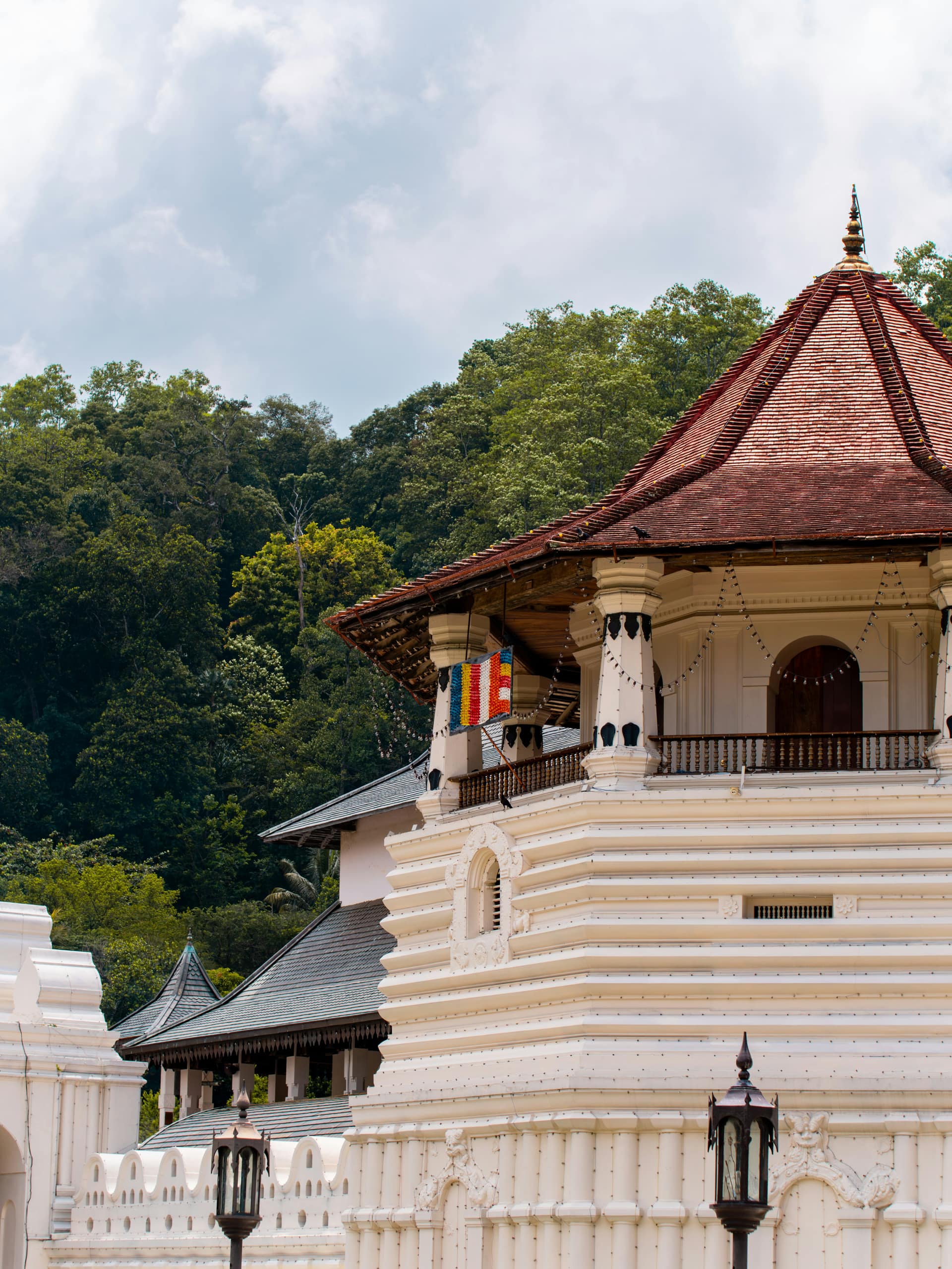
Kandy is milder than the Cultural Triangle, sitting at roughly 500 metres, and the evenings can be pleasantly cool. For the evening puja at the Temple of the Sacred Tooth Relic, wear clothing that covers shoulders and knees, ideally in white or light colours, which are traditional and appreciated.
Shoes and hats are removed at the entrance, and the temple's security checks are thorough, so keep bags small. Sarongs are sometimes available at the entrance for visitors who arrive underdressed, but it is better to come prepared.
Avoid clothing with images or slogans that could be seen as disrespectful to religion, and in particular any tattoos, prints or clothing depicting the Buddha, which can cause serious offence and have led to visitors being refused entry or worse. Covering such tattoos is strongly advised.
- →Shoulders and knees covered, ideally in white or light colours.
- →Shoes and hats off at the entrance.
- →Keep bags small for security checks.
- →Cover any tattoos or clothing depicting the Buddha.
Days 4 and 5: the train and Ella
The Kandy to Ella train climbs to roughly 1,900 metres near Pattipola, and the air through the open windows gets cool, sometimes cold, particularly on misty days. Wear long trousers and bring a warm layer and a compact rain jacket, even if Kandy was warm that morning.
Ella at dawn, for the Nine Arch Bridge and Little Adam's Peak, is chilly before the sun rises, typically cool enough for a light jumper, and warms up quickly by mid-morning. Layers are ideal. Walking shoes with grip are needed for the paths, which can be muddy after rain.
The drive down to the coast in the afternoon of day 5 drops from roughly 1,000 metres to sea level, and the temperature rises sharply. Change into lighter clothing before leaving Ella.
- →Train: long trousers, a warm layer and a rain jacket.
- →Ella at dawn: layers and grippy shoes.
- →Afternoon drive: change into lighter clothes before leaving the hills.
Day 6: the south coast and the whale boat
On the south coast, beachwear is fine on the beach and by the pool, but cover up with a shirt, sarong or cover-up in restaurants, shops and towns. Topless sunbathing is not acceptable in Sri Lanka. A rash vest is useful for snorkelling and surf lessons, protecting against both sun and board.
For a whale-watching trip from Mirissa, wear light, quick-drying clothing, a hat that will not blow away, sunglasses and plenty of sunscreen, since shade on deck is limited. Bring a light layer for the early morning departure, and non-slip shoes or sandals.
- →Beachwear on the beach and by the pool only.
- →Cover up in restaurants, shops and towns.
- →Whale boat: quick-dry clothing, secure hat, light layer, non-slip shoes.
Day 7: Galle Fort and the flight home
Galle Fort is a living town with churches, a mosque and residents' homes, and modest, light clothing is appropriate. The ramparts have little shade, so a hat and sunscreen are important in the morning. Comfortable sandals or walking shoes work for the streets, which are paved but uneven in places.
Bring a change into travel clothes for the flight home, either at the hotel before checkout or at an expressway rest area on the way to the airport.
Long-haul cabins are cool, so keep the warm layer from the hill country in your hand luggage rather than packing it away. After a week of heat, many travellers find the flight colder than expected.
Packing for the week's wardrobe
A day-by-day plan makes packing for a 7-day Sri Lanka itinerary much simpler: a handful of light tops and long trousers or skirts for most days, one warm layer for days 4 and 5, beachwear for days 5 and 6, and a sarong for every temple.
Lankan Stays & Trails briefs guests on dress codes before each temple visit, and our drivers carry spare sarongs for anyone caught out. The site's general guide to what to wear in Sri Lanka covers longer trips and the east coast.
Frequently asked questions
What should I wear to Sigiriya?
Light trousers or knee-length shorts, a breathable top, a hat, sunglasses and walking shoes with good grip for the roughly 1,200 steps. Sigiriya is not an active temple, but modest clothing is sensible, and the upper staircases are exposed to the sun.
What is the dress code for the Temple of the Tooth?
Shoulders and knees must be covered, and white or light colours are traditional and appreciated. Shoes and hats are removed at the entrance. Sarongs are sometimes available at the entrance, but it is better to arrive dressed appropriately.
Is it cold on the Kandy to Ella train?
It can be. The line climbs to roughly 1,900 metres near Pattipola, and the air through the open windows is cool, sometimes cold on misty days. Wear long trousers and bring a warm layer and a compact rain jacket.
What should I wear in Ella?
Layers. Ella at dawn, for the Nine Arch Bridge and Little Adam's Peak, is chilly before the sun is up and warms quickly by mid-morning. Walking shoes with grip are needed, since the paths can be muddy after rain.
Can I wear shorts in Sri Lanka?
Yes, on the beach, in resorts and for activities such as the Sigiriya climb, though knee-length is more respectful. At temples, shoulders and knees must be covered, and in towns and villages modest clothing is appreciated.
What should I wear whale watching in Mirissa?
Light, quick-drying clothing, a hat that will not blow away, sunglasses and plenty of sunscreen, since shade on deck is limited. Bring a light layer for the early departure and wear non-slip shoes or sandals for the wet deck.