
Quick answer
Day 5 of this 12-day Alps-to-beach itinerary rides the Kandy-to-Ella scenic railway, a line that runs roughly six to seven hours in full, though this particular route covers only the partial stretch as far as Nanu Oya before a short transfer to Nuwara Eliya. It climbs through tea estates, pine forest and misty ridgelines, and while Swiss travellers often compare it to the Glacier Express, it is shorter on this leg, considerably slower overall, far less costly, and does not run glass-roof observation carriages as standard.
Key takeaways
- The full Kandy-to-Ella line runs roughly six to seven hours; this itinerary uses the partial stretch, alighting at Nanu Oya after a shorter portion of the journey.
- Reserved seats on this line sell out well in advance in peak season, so booking through a local operator weeks to months ahead is standard practice, not an optional precaution.
- Unlike Switzerland's Glacier Express or Bernina Express, standard carriages on this line do not have panoramic glass roofs, and the ride is markedly slower and rougher over some sections of track.
- Ticket prices on this line are a small fraction of a comparable Swiss scenic rail journey, though standard carriages are also considerably less comfortable and less climate-controlled.
- Nanu Oya station sits roughly 30 minutes by road from Nuwara Eliya, the short final leg of the day's journey after disembarking the train.
Boarding the Kandy-to-Ella line
Day five begins at Kandy railway station, generally with an early departure to make the most of the day's rail journey and daylight for the views. The full Kandy-to-Ella line runs roughly six to seven hours end to end, but this particular 12-day itinerary uses only the partial stretch as far as Nanu Oya, the stop closest to Nuwara Eliya, rather than continuing all the way to Ella on this leg (Ella itself is reached later in the route, by road, on day seven).
The train climbs steadily out of Kandy, passing through small stations, tea estate villages and increasingly dramatic terrain as altitude builds. Reserved seats on this line sell out well in advance during peak season, so tickets need to be secured weeks to months ahead through a local operator rather than left until arrival in Sri Lanka.
Platforms at Kandy station can be busy, particularly on a morning when several trains are scheduled close together, so arriving with time to spare rather than cutting it fine is worth building into the day. Carriage classes vary, and reserved second-class seating with a fan is the most commonly booked option for this leg, offering a reasonable balance of comfort and authenticity for a first-time rider.
What the ride actually looks like
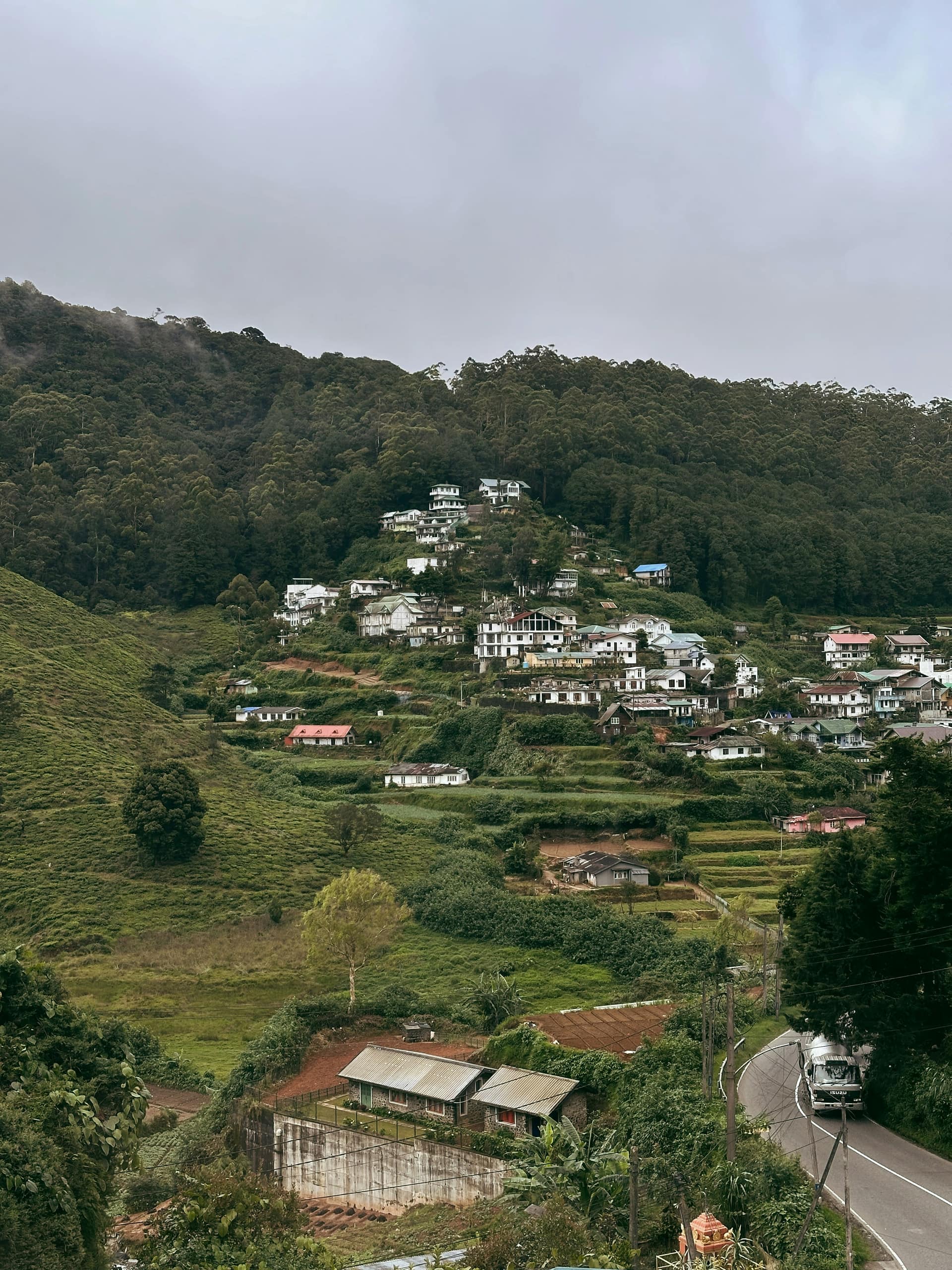
The scenery along this stretch moves through tea estates draped over steep hillsides, patches of pine forest, and ridgelines that are frequently wrapped in mist, particularly in the morning. Small stations along the way, some barely more than a platform and a sign, add to the sense of travelling through a working landscape rather than a purely scenic corridor built for tourists, with schoolchildren, farmers and local commuters boarding alongside the visitors riding purely for the view.
Windows generally open on standard carriages, and many travellers spend part of the journey standing near open doorways for photographs, something worth doing cautiously given the train's age and the terrain outside. The pace is unhurried by design, part of the appeal rather than a drawback, though it does mean the journey takes considerably longer than the distance covered would suggest.
- →Scenery includes tea estates, pine forest and mist-wrapped ridgelines, especially in the morning.
- →Standard carriages have opening windows; observation-style glass-roof carriages are not the norm on this line.
- →Small halt stations along the route add to the sense of a working rural railway rather than a tourist-only line.
A comparison point for Swiss rail travellers
Swiss travellers who know the Glacier Express or the Bernina Express naturally reach for the comparison, and there is a genuine kinship in spirit: both are scenic mountain railways that turn the journey itself into the destination. But the comparison only goes so far, and it is worth being honest about where it breaks down, since setting expectations correctly beforehand makes the actual ride easier to enjoy on its own terms.
This partial stretch of the Kandy-to-Ella line is considerably shorter than a full Glacier Express run, the ride is slower and rougher on some sections of older track, and standard carriages do not come with the panoramic glass roofs that define the Swiss trains. What the Sri Lankan line offers instead is a fraction of the cost, a genuinely different cultural texture, tea pickers visible in the fields, local passengers boarding at rural halts, and a landscape that, while sometimes likened to the Alps in mist and colour, is tropical hill country rather than anything geologically or architecturally similar.
- →Shorter (on this partial leg) and slower than a comparable Swiss scenic railway journey.
- →Standard carriages lack the panoramic glass roofs typical of the Glacier Express or Bernina Express.
- →Considerably lower ticket cost, offset by less comfort and less climate control than Swiss equivalents.
Arriving at Nanu Oya and the final stretch
Nanu Oya station sits roughly 30 minutes by road from Nuwara Eliya, and this short final transfer completes day five's journey after disembarking the train. The road climbs a little further still, and the change in air temperature from Kandy is noticeable almost immediately, cooler and, particularly if arriving in mist or light rain, considerably damper too.
Luggage transfer is generally arranged in advance by a driver-guide meeting the train at Nanu Oya, since managing bags through a moving train and a station platform is not something most travellers want to handle alone after a long rail journey.
The short drive up to Nuwara Eliya passes more tea estates and a scattering of small vegetable farms, since the surrounding region grows a considerable share of the country's cool-climate produce alongside its tea. It is a gentle final stretch after several hours on the train, and most travellers are glad to stretch their legs a little before settling into a vehicle again.
- →Nanu Oya to Nuwara Eliya transfer: roughly 30 minutes by road.
- →Air temperature drops noticeably on this final stretch compared with Kandy.
- →Luggage handling at the station is generally pre-arranged by a driver-guide.
Settling into Nuwara Eliya
Nuwara Eliya sits at an elevation of roughly 1,868 metres, and the change from the Cultural Triangle and even Kandy is immediate: daytime highs generally run roughly 16 to 20°C, and evenings can drop noticeably cooler, sometimes near or below 10°C, particularly between December and February. A warmer layer packed for exactly this stretch of the trip earns its place in the suitcase here.
Arrival evening is generally kept simple, checking in, a warm dinner, and settling in to the noticeably different climate and atmosphere after the long rail day. Day six brings a full day around Nuwara Eliya itself, including tea estate visits and an optional early excursion to Horton Plains.
Many properties in Nuwara Eliya have fireplaces or heaters, a genuinely useful feature rather than a novelty at this elevation, particularly for anyone travelling in the cooler months. It is worth confirming this detail when booking accommodation for this stretch, since not every property is equipped for it in the same way.
Practical notes for the rail day
Book seat reservations well ahead of time, ideally through a local operator who can track current timetables and availability, since schedules and available carriage classes do change from year to year. Pack snacks and water for the journey, since onboard catering is limited, and bring a light jacket even for the train itself, since temperatures drop noticeably as the altitude increases.
Lankan Stays & Trails books this rail leg separately from the road transfers that make up most of the itinerary, coordinating luggage handling at Nanu Oya so the change from train to road feels seamless rather than logistically stressful.
A power bank is worth carrying for the journey, since outlets are not standard on older carriages, and a phone or camera used constantly for photographs over several hours can run low well before the final stretch into Nanu Oya.
Frequently asked questions
How long is the Kandy-to-Ella train journey?
The full line runs roughly six to seven hours, though this 12-day itinerary uses only the partial stretch to Nanu Oya, a shorter portion of the full journey, before a short road transfer on to Nuwara Eliya.
Is the Sri Lankan scenic railway like the Glacier Express?
There is a similarity in spirit, both are scenic mountain railways, but the Sri Lankan line is slower, rougher on some track sections, and standard carriages do not have panoramic glass roofs. It is also considerably less costly than a comparable Swiss journey.
Do you need to book train tickets in advance for this route?
Yes, reserved seats on the Kandy-to-Ella line sell out well ahead in peak season, so booking weeks to months in advance through a local operator is standard practice rather than something to leave until arrival.
How far is Nanu Oya from Nuwara Eliya?
Roughly 30 minutes by road. Nanu Oya is the nearest railway station to Nuwara Eliya, and a driver-guide typically meets the train there to complete the short final transfer.
What should you pack for the scenic railway day?
A light jacket for the cooler temperatures at altitude, snacks and water since onboard catering is limited, and a camera, since the tea estate and ridgeline views are a highlight of the journey.
Is the train ride comfortable?
Standard carriages are basic by Swiss rail standards, with opening windows rather than climate control, and the ride can be rough on some sections of older track. It is a genuinely scenic journey, but comfort expectations should be adjusted accordingly.
How cold does it get in Nuwara Eliya after the train ride?
Daytime highs typically run roughly 16 to 20°C, and evenings can drop near or below 10°C, especially from December to February. It is a noticeable change from the Cultural Triangle and Kandy, worth packing a warmer layer for specifically.