
Quick answer
Day 6 of this 12-day Alps-to-beach itinerary is spent around Nuwara Eliya: a working tea factory visit and a walk through the surrounding estate rows, with an optional early dawn excursion to Horton Plains National Park, roughly 1.5 to 2 hours each way, for the walk out to World's End viewpoint at roughly 2,100 to 2,300 metres elevation. Nuwara Eliya's real historical nickname, earned from its British colonial architecture and layout, is 'Little England', a factual aside distinct from any comparison to the Alps.
Key takeaways
- A working tea factory tour typically covers the plucking, withering, rolling and drying process, usually finishing with a tasting, and takes roughly 45 minutes to an hour.
- Horton Plains National Park sits at roughly 2,100 to 2,300 metres elevation, and the walk out to World's End viewpoint and back typically takes 3 to 4 hours at an easy pace.
- Reaching Horton Plains for clear views generally requires a very early departure, roughly 1.5 to 2 hours each way from Nuwara Eliya, since cloud typically rolls in by mid-morning.
- Nuwara Eliya's historical nickname, 'Little England', reflects its British colonial architecture, a golf course and a racecourse built during the colonial tea-planting era, a factual naming distinct from any Alps comparison.
- Temperatures at Horton Plains before sunrise can drop close to or below 10°C, considerably colder than Nuwara Eliya itself, so warm layers matter even more for this excursion.
A full day based in Nuwara Eliya
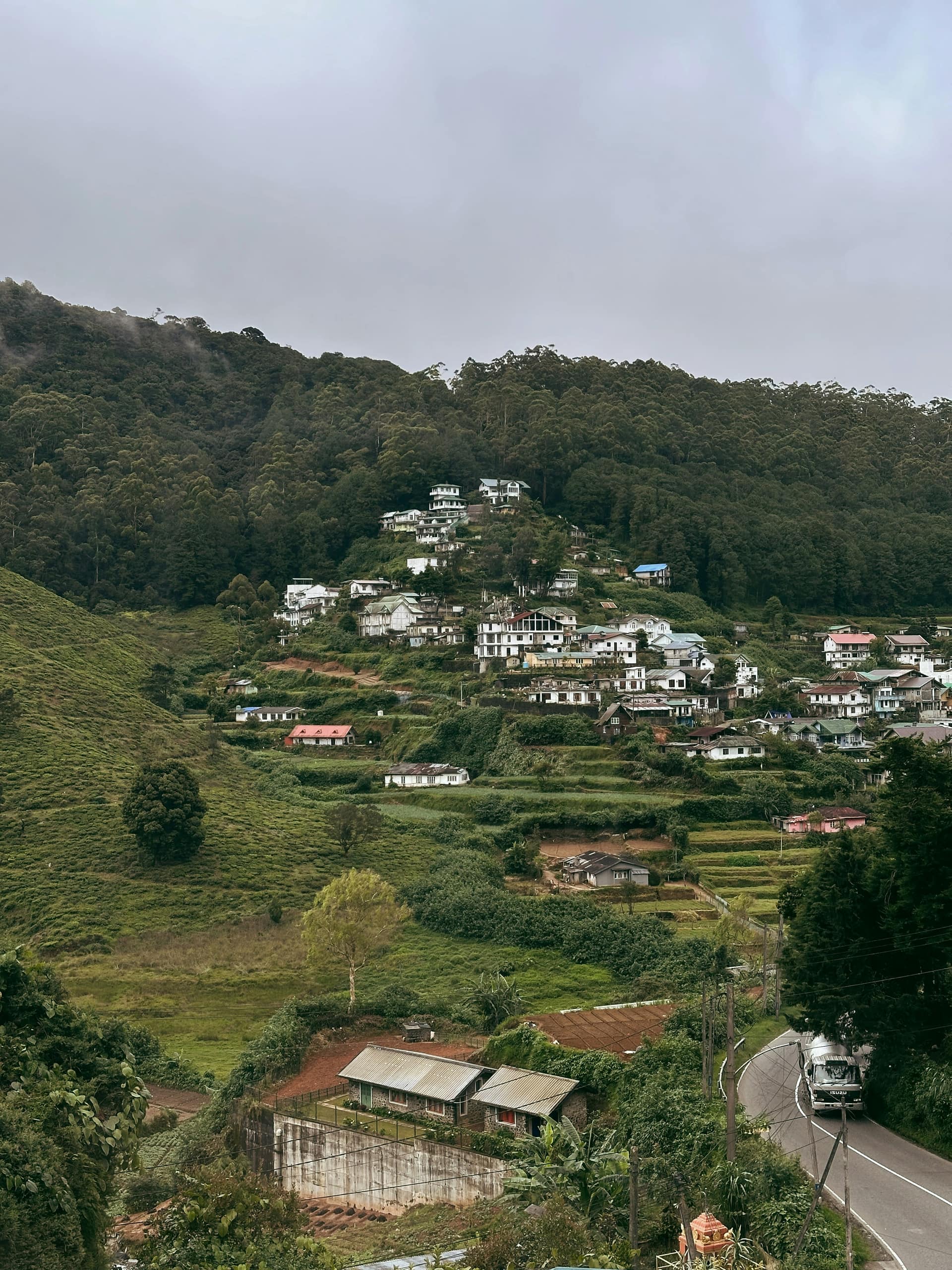
Day six has no transfer to another town, giving the itinerary its first genuinely settled full day since arrival, spent entirely in and around Nuwara Eliya. The town sits at roughly 1,868 metres elevation, surrounded by tea estates that carpet the hillsides in every direction, and the day's pace can flex depending on whether the Horton Plains excursion is included.
For travellers who skip the early Horton Plains start, the day opens at a normal hour with the tea factory visit and estate walk making up a relaxed morning or afternoon, followed by free time to explore the town itself, its colonial-era buildings, golf course and small parks.
This is also the only stop on the whole route where the itinerary spends two consecutive nights in the same place, which makes day six feel noticeably less rushed than most of the days either side of it. Nothing here needs to be packed into a tight window, and the schedule can be rearranged around weather, since Nuwara Eliya's mist and light rain showers are common even outside the wetter months.
The tea factory visit and estate walk
A working tea factory tour typically walks visitors through the full process, plucking, withering, rolling, fermenting and drying the leaves, ending with a tasting of the estate's own tea. The tour itself usually runs roughly 45 minutes to an hour, and factories in the Nuwara Eliya area are generally set up for visitors with English-speaking guides as standard.
The estate walk that usually accompanies the factory visit takes visitors through the tea rows themselves, rolling green terraces that climb the hillsides, often with tea pickers visible at work depending on the time of day and season. It is an easy, mostly flat walk suited to any fitness level, a contrast to the physical demands of Sigiriya earlier in the trip.
The region around Nuwara Eliya sits within the broader zone that produces Ceylon high-grown tea, generally considered among the more delicately flavoured grades produced in the country, a fact worth knowing before the tasting at the end of the factory tour. Buying a small packet of tea directly from the factory shop is a common, easily packed souvenir that also supports the estate directly.
- →Factory tour: roughly 45 minutes to an hour, covering the full tea production process.
- →Estate walk: easy, mostly flat terrain through the tea rows.
- →Tea pickers are often visible at work, depending on timing and season.
The optional dawn excursion to Horton Plains
Horton Plains National Park, a highland plateau at roughly 2,100 to 2,300 metres elevation, is home to the walk out to World's End, a sheer escarpment with views that, on a clear morning, stretch for a considerable distance across the southern lowlands. Reaching it typically takes roughly 1.5 to 2 hours by road each way from Nuwara Eliya, and the excursion generally requires departing well before dawn.
The reason for the very early start is straightforward: cloud typically rolls in across the plateau by mid-to-late morning, obscuring the view entirely, so travellers hoping to actually see anything at World's End need to be on the trail at first light. The walk itself, out to World's End and back via Baker's Falls, typically takes 3 to 4 hours at an easy pace over relatively flat, open ground.
The plateau is also a rare habitat for Sri Lanka's cloud forest ecosystem, home to plant and animal life not found at lower elevations, including sambar deer that are frequently spotted grazing near the trail in the early morning. This adds a genuine wildlife-watching element to what is otherwise mainly a scenic walk, worth keeping a camera or binoculars ready for.
- →Horton Plains elevation: roughly 2,100 to 2,300 metres, noticeably higher and colder than Nuwara Eliya itself.
- →Round-trip transfer: roughly 1.5 to 2 hours each way from Nuwara Eliya.
- →Walking loop (World's End and Baker's Falls): typically 3 to 4 hours at an easy pace.
Nuwara Eliya's real nickname: 'Little England'
Nuwara Eliya carries a genuine historical nickname, 'Little England', earned during the British colonial era when planters built the town around a golf course, a racecourse and Tudor-style architecture that still stands today, a deliberate attempt to recreate a piece of home at altitude. This is a factual, well-documented naming, distinct from and unrelated to any comparison with Switzerland or the Alps.
Walking through the town's older streets, past the Hill Club, the golf course and various colonial-era guesthouses, the British influence is visible and specific: it reflects English colonial planning, not Alpine scenery or architecture. Any sense that the cool air, mist and green terraces evoke the Alps is purely a matter of atmosphere and light, not a claim this guide makes about the town's built character.
Several of these colonial-era buildings still function as they originally did, the racecourse holds occasional events, the golf course remains active, and the Hill Club retains its old-world dress code for its dining room, a small but genuine window into how the planting community once lived at this elevation.
Practical notes for the day
Warm layers matter more for the Horton Plains excursion than almost anywhere else on the route, since pre-dawn temperatures on the plateau can drop close to or below 10°C, considerably colder than Nuwara Eliya itself feels at the same hour. Sturdy walking shoes, a hat and sun protection are worth carrying too, since the plateau is exposed once the sun is up.
Entry fees apply at Horton Plains, and current pricing and any seasonal closures (the park occasionally closes for maintenance periods) are worth confirming before travel. Travellers who prefer a slower morning can skip Horton Plains entirely without missing anything essential to the rest of the route, since the tea factory and estate walk stand on their own as a satisfying day.
A flask of hot tea or coffee for the pre-dawn drive is a small comfort worth arranging with accommodation the night before, since nothing is open along the road at that hour. Some travellers also bring a headlamp for the last stretch of the walk in low pre-sunrise light, though most of the loop is walked in daylight once the sun clears the horizon.
- →Pack warm layers specifically for the pre-dawn Horton Plains excursion.
- →Confirm current entry fees and any seasonal closures at Horton Plains before travel.
- →Skipping Horton Plains is a reasonable choice; the tea factory and estate walk work well as a standalone day.
What follows on day 7
Day seven brings a shorter transfer, roughly 1.5 to 2 hours, on to Ella, with an afternoon walk to either the Nine Arch Bridge or Little Adam's Peak on arrival. Whether or not Horton Plains was included on day six, a reasonably early night is worth aiming for again, since the following day involves both a transfer and a walk.
Frequently asked questions
Is Horton Plains worth the early start?
For most travellers, yes, since cloud typically rolls in by mid-morning and obscures the World's End viewpoint. Departing well before dawn, roughly 1.5 to 2 hours each way from Nuwara Eliya, is generally necessary to see the view clearly.
How long is the walk at Horton Plains?
The loop out to World's End and back via Baker's Falls typically takes 3 to 4 hours at an easy pace, over relatively flat, open terrain at roughly 2,100 to 2,300 metres elevation.
Is Nuwara Eliya called Little Switzerland?
No, that is not an accurate nickname. Nuwara Eliya's genuine historical nickname is 'Little England', reflecting its British colonial architecture, golf course and racecourse, unrelated to any comparison with Switzerland or the Alps.
What happens on a tea factory tour in Nuwara Eliya?
A typical tour, roughly 45 minutes to an hour, walks visitors through the plucking, withering, rolling and drying stages of tea production, usually finishing with a tasting of the estate's own tea.
How cold does it get at Horton Plains?
Pre-dawn temperatures on the plateau can drop close to or below 10°C, noticeably colder than Nuwara Eliya itself at the same hour, so warm layers are worth packing specifically for this excursion.
Can you skip Horton Plains on this itinerary?
Yes, it is entirely optional. The tea factory visit and estate walk make for a satisfying day on their own, and skipping the early Horton Plains excursion means a more relaxed morning instead.
Is Nuwara Eliya walkable on its own?
Yes, the town centre, its golf course, colonial-era buildings and small parks are easily explored on foot, making it a reasonable way to fill free time on day six alongside the tea factory visit.