
Quick answer
A 5-day wildlife itinerary for May to September spends two nights at Habarana and two at Trincomalee. At Habarana, take afternoon drives at Minneriya, Kaudulla or Hurulu, where the elephant gathering usually builds roughly July to October. At Trincomalee, snorkel at Pigeon Island and try a whale trip, as blue whales are sometimes seen roughly May to September. Yala often closes for part of September; Udawalawe stays open.
Key takeaways
- The route is Habarana 2 nights and Trincomalee 2 nights.
- The elephant gathering usually builds roughly July to October.
- The east coast is dry and calm from May to September.
- Whales off Trincomalee are possible but less predictable than off Mirissa.
- Yala often closes for part of September; Udawalawe and Wilpattu are alternatives.
Why these months
From May to September the south-west monsoon brings rain to the west and south coasts and rough seas off Mirissa, but the north-central plains and the east coast are dry. Wildlife follows: elephants gather at the shrinking reservoirs of Minneriya and Kaudulla, and the sea off Trincomalee is calm for snorkelling and boats.
It is also the dry season at Wilpattu, which some prefer for its quiet roads. Udawalawe remains good all year.
The trade-off is heat in the north-central plains and the chance of Yala's closure late in the season.
- →Gathering: roughly July to October.
- →East coast: calm and dry.
- →Wilpattu: dry season.
Day by day
Day one drives from the airport to Habarana, roughly 4 to 4.5 hours, arriving for a rest. Day two is Sigiriya or Polonnaruwa in the morning if you wish, then an afternoon drive at Minneriya, Kaudulla or Hurulu, wherever the herds are.
Day three is a second park in the morning or late afternoon, then the drive to Trincomalee, roughly 2 to 2.5 hours. Day four is Pigeon Island snorkelling from Nilaveli in the morning and, in the right conditions, an afternoon or dawn whale or dolphin trip.
Day five drives back to the airport, roughly 5 to 6 hours.
Habarana makes a practical base in these months because Minneriya, Kaudulla and Hurulu are all within roughly 30 to 60 minutes, so your driver can choose the park on the day. Many hotels there have pools and gardens, which are welcome in the midday heat between drives.
- →Day 1: airport to Habarana.
- →Day 2: elephant drive.
- →Day 3: second drive, to Trincomalee.
- →Day 4: Pigeon Island, whales.
- →Day 5: Trincomalee to the airport.
The gathering
As the dry season advances, the reservoirs at Minneriya and Kaudulla shrink and fresh grass grows on their exposed beds. Elephants from the surrounding forests come to graze, and on good evenings dozens or more can be seen together, with calves, juveniles and adults.
The herds move between parks, so local drivers check daily which is best. Late-afternoon drives are usually most rewarding. Keep a respectful distance and ask your driver not to crowd the herd.
Lankan Stays & Trails works with drivers who know where the herds are each week.
- →Late afternoon is best.
- →Herds move between parks.
- →Respectful distance.
Pigeon Island and the sea
Pigeon Island National Park, a short boat ride from Nilaveli, has a reef with corals, reef fish and sometimes blacktip reef sharks and turtles. Go early, do not touch coral and follow the park's rules.
Whales are sometimes seen off Trincomalee roughly May to September, along with dolphins. Sightings are less predictable than off Mirissa in its season, so treat a whale trip as a bonus.
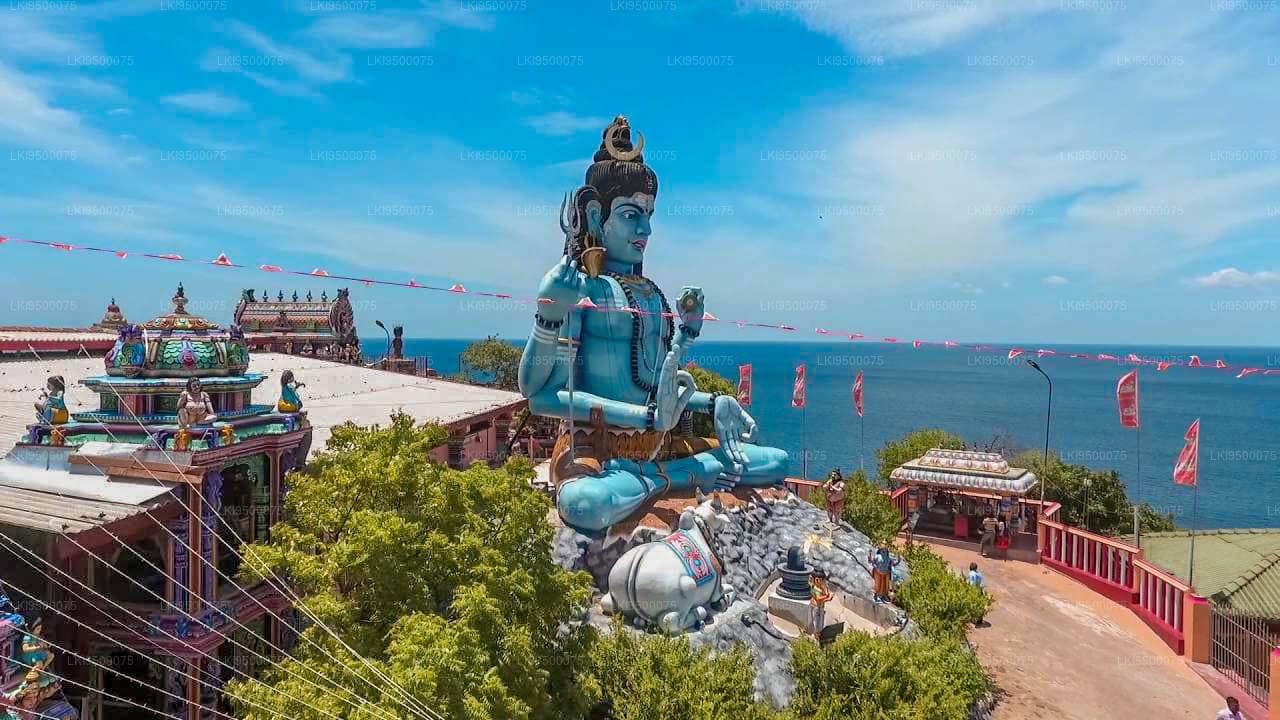
Trincomalee itself adds culture to the second half: Koneswaram Temple on Swami Rock at the evening puja, Fort Frederick with its spotted deer, and the busy harbour town. An evening there balances a day on and under the water.
- →Pigeon Island: early morning.
- →Do not touch coral.
- →Whales: a bonus.
Alternatives within the season
Wilpattu and Anuradhapura make an excellent alternative in these months, with the park's dry season concentrating animals at the villus. Udawalawe is also reliable all year and can be combined with the hill country.
Yala often closes for part of September and October, so plans for late summer that include it should confirm dates. Kumana and Arugam Bay are at their best in these months for travellers who want the south-east.
Who this route suits
Families travelling in the school holidays, elephant lovers, snorkellers and anyone who wants wildlife and a calm beach in the northern summer are the route's natural audience.
Travellers set on blue whales should note that Mirissa's season is roughly December to April, and plan another trip for that.
Frequently asked questions
When is the elephant gathering in Sri Lanka?
The elephant gathering at Minneriya and Kaudulla usually builds roughly July to October, in the dry season, as the reservoirs shrink and grass grows on their beds. The peak varies each year with rainfall, so ask your driver which park is best that week.
Can you see whales in Sri Lanka in summer?
Whales are sometimes seen off Trincomalee on the east coast roughly May to September, along with dolphins, though sightings are less predictable than off Mirissa in its December to April season. Treat a summer whale trip as a bonus rather than a certainty.
Is Yala open in summer?
Yala is usually open in May, June, July and August, though it is hot and dry. It often closes for part of September and October, usually for several weeks; confirm dates for your year. Udawalawe and Wilpattu are good alternatives.
Is Pigeon Island good for snorkelling in summer?
Pigeon Island is best for snorkelling roughly May to September, when the east coast sea is calm and clear. Go early to avoid the busiest boats, do not touch coral and follow the park's rules. Confirm current entry arrangements locally.
How hot is the Cultural Triangle in summer?
The Cultural Triangle is hot from May to September, often above 30 °C by day. Plan game drives and sightseeing for the early morning and late afternoon, rest at midday and drink plenty of water. Hotels with pools make the heat easier.
Can I combine this route with a beach?
Yes. Trincomalee's beaches at Nilaveli and Uppuveli are calm in this season, so the second half of the route already includes a beach. Pasikudah, further south, is another calm option with a shallow bay.
Is Udawalawe good from May to September?
Udawalawe is good from May to September, with elephants seen in almost every drive. The south-west monsoon brings some rain to the area, but far less than to the west coast. It makes a reliable alternative if you prefer the south to the north-central parks.