
Quick answer
The Gathering is the largest annual congregation of Asian elephants in the world, occurring when the Minneriya tank in Sri Lanka's Cultural Triangle recedes during the dry season and exposes fresh grass on the lake bed. It runs broadly from about July to September, though timing is water-driven rather than fixed, and the herds move between Minneriya, Kaudulla and Hurulu Eco Park depending on where the grazing is best. Late afternoon drives are best, from a base at Habarana or Sigiriya.
Key takeaways
- The Gathering is the largest annual congregation of Asian elephants anywhere in the world.
- It runs broadly from July to September, but timing is driven by water levels rather than the calendar.
- Herds move between Minneriya, Kaudulla and Hurulu Eco Park depending on grazing.
- The Minneriya tank was built in the third century CE and is still in use for irrigation.
- Late afternoon is the best time; herds come out to the grass before dusk.
Why the Gathering happens
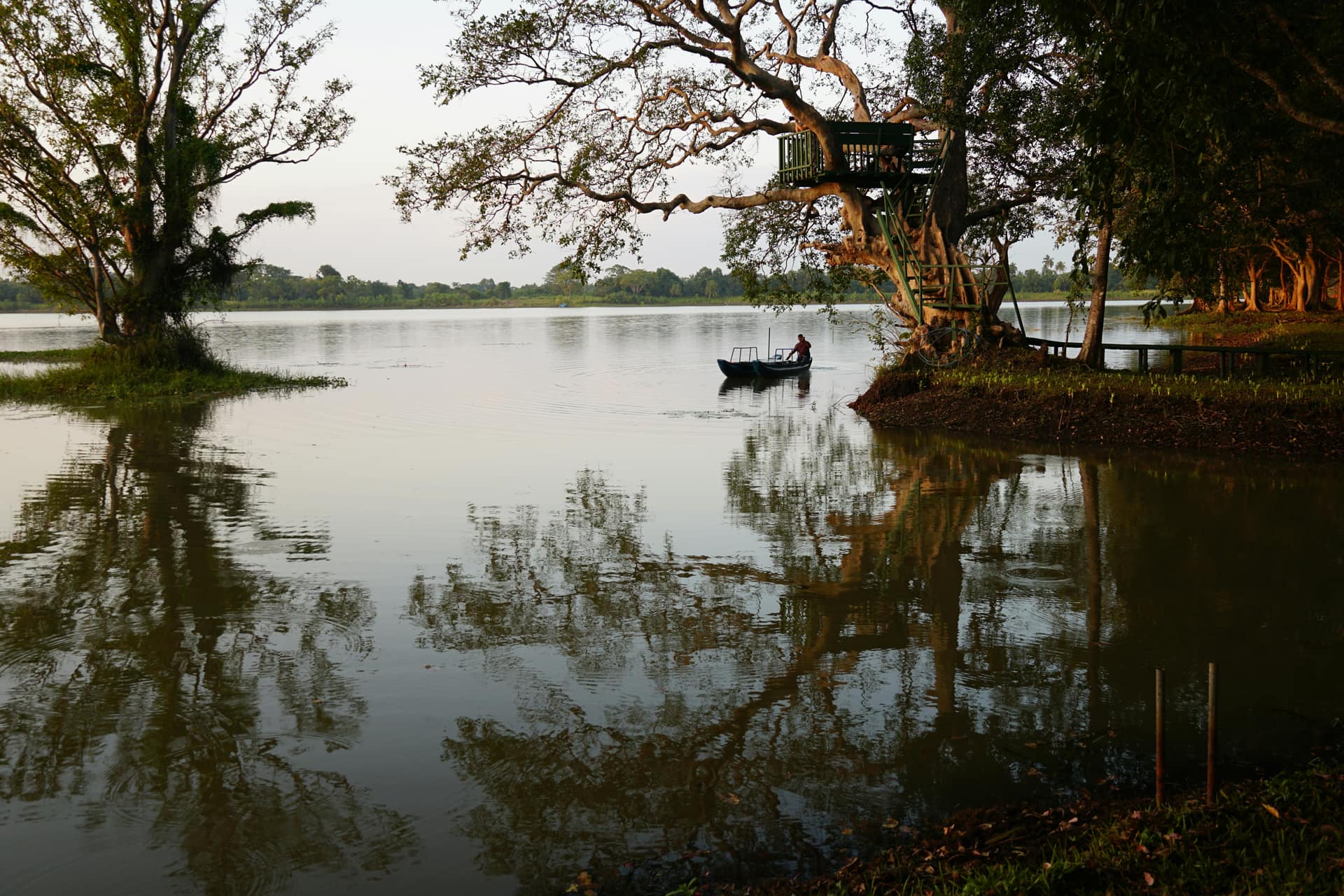
The Minneriya tank is an irrigation reservoir built in the third century CE, attributed to King Mahasen, and it is still functioning as part of the ancient hydraulic system that made dry-zone civilisation possible. Through the dry season its water level drops, and as it does it exposes a broad ring of lake bed that quickly grows fresh, nutritious grass.
Elephants across the surrounding forest respond to this. Herds that spend the rest of the year dispersed across a wide area converge on the exposed grazing, and once there they do what elephants do: family groups meet, young animals play, males assess one another, and social bonds are renewed. The feeding brings them; the socialising keeps them.
- →The Minneriya tank dates from the third century CE and is still in use.
- →Receding water exposes lake bed that grows fresh grass.
- →Dispersed herds converge on the grazing from surrounding forest.
- →The gathering is as much social as nutritional once the herds arrive.
When it happens
The season is usually described as July to September, and that is broadly right, but it is important to understand that the Gathering is a response to water levels rather than a date in a calendar. A wetter than usual year delays it; a drier one brings it forward or extends it.
In practice this means booking Minneriya by name in August is not the same as seeing the Gathering. What you want is a guide who checks where the herds actually are in the week you arrive, and who is willing to drive to a different park if that is where they have moved.
- →Broadly July to September, but water-driven rather than calendar-driven.
- →Wetter years delay it; drier years bring it forward or extend it.
- →Booking a park by name is less useful than checking where the herds are.
- →Ask your operator directly which park is currently holding the herds.
Minneriya, Kaudulla and Hurulu
Three parks in the same area function as one system for this purpose. Minneriya is the original and the one the Gathering is named for. Kaudulla, adjacent to the north, has its own tank and frequently holds the herds when Minneriya does not, particularly earlier or later in the season. Hurulu Eco Park, part of a larger biosphere reserve, often takes over later in the year.
The elephants move between them freely along traditional corridors. From a visitor's point of view they are interchangeable: what matters is which one currently has the animals. A good operator will tell you honestly and will not sell you a Minneriya ticket when the herds are at Kaudulla.
- →Minneriya: the original park and the one the Gathering is named for.
- →Kaudulla: adjacent, with its own tank, often holds herds earlier or later.
- →Hurulu Eco Park: frequently takes over later in the season.
- →Elephants move freely between all three; treat them as one system.
What a drive is actually like
Jeeps enter and drive down onto the dry lake bed, which is open grassland with the shrinking water on one side and forest on the other. Visibility is excellent, which is the great advantage of this landscape over the dense scrub of other parks: you can see a very long way and watch behaviour rather than glimpse an animal crossing a track.
Herds arrive from the treeline through the afternoon and build. Expect to see family groups with calves of several ages, bachelor groups of young males, and occasionally a large tusker. The soundscape is part of it: rumbling, trumpeting, the tearing of grass. Two hours passes very quickly.
- →Jeeps drive onto the open lake bed with long sightlines in every direction.
- →Herds emerge from the treeline through the afternoon and build steadily.
- →Family groups with calves, bachelor groups and occasional large tuskers.
- →Allow two to three hours; late afternoon is when the numbers peak.
Timing your drive
Late afternoon is the answer, unusually for Sri Lankan safari. Most parks are best at dawn, but the Gathering builds through the afternoon as herds come out to feed before dusk, so an entry around three or four in the afternoon puts you on the lake bed as the numbers are increasing.
The light is also better: low, warm and behind or beside you depending on where you position, rather than the flat overhead light of midday. Sunset over the tank with elephants in the foreground is the photograph everyone wants, and it requires being there at the right hour rather than any particular skill.
- →Enter around 3 to 4pm rather than at dawn.
- →Numbers build through the afternoon towards dusk.
- →Low afternoon light is far better for photography than midday.
- →Parks close at set times; confirm the last entry with your operator.
Watching responsibly
The Gathering attracts a lot of jeeps into a relatively small area of open ground, and the behaviour of drivers matters enormously. Vehicles should never position themselves between a herd and the water, should never approach family groups with young calves closely, and should never surround or encircle animals.
Elephants signal discomfort clearly: ears out, head shaking, a mock charge, a raised trunk testing the air. A good driver reads these and backs off. A bad one holds position for the photograph. Ask your operator before booking what their approach distance policy is and whether they will move away if a herd shows stress. Never encourage a driver closer, and never tip for it.
- →Never position between a herd and the water, or approach calves closely.
- →Vehicles should not surround or encircle animals.
- →Ears out, head shaking and mock charges are clear signals to back off.
- →Ask about approach policy before booking; never encourage a closer approach.
Practicalities
Base yourself at Habarana or Sigiriya, both 30 to 60 minutes from the park entrances, which also puts you in position for Sigiriya, Dambulla and Polonnaruwa. Park entry fees plus jeep hire are payable, usually in cash, and booking a private jeep rather than a shared one gives you control over how sightings are handled.
Bring water, sun protection and something for dust, which is considerable on an open lake bed in the dry season. A zoom lens helps but is not essential; the whole point of this landscape is that you do not need to be close. Late afternoon drives return around dusk, so keep the evening free.
- →Base at Habarana or Sigiriya, 30 to 60 minutes from the entrances.
- →Park fees and jeep hire payable in cash; private jeeps give you control.
- →Bring water, sun protection and something for dust.
- →Drives return around dusk; do not schedule anything immediately after.
Fitting it into an itinerary
The Gathering slots perfectly into a Cultural Triangle stay: Sigiriya at dawn, rest through the heat, and the elephants in the late afternoon. That is one of the strongest single days available anywhere in Sri Lanka, and it requires only that you are here between roughly July and September.
Lankan Stays & Trails checks which park is holding the herds in the week of your visit rather than booking one by name, and works with drivers who will move away from a stressed herd. Occasionally that costs a closer sighting, and it is the right call.
Frequently asked questions
When is the elephant Gathering in Sri Lanka?
Broadly July to September, though it is driven by water levels rather than the calendar. As the Minneriya tank recedes it exposes fresh grass and herds converge. A wetter year delays it and a drier one extends it, so check where the herds actually are in your travel week.
What is the Minneriya Gathering?
The largest annual congregation of Asian elephants in the world, occurring when the third-century Minneriya tank recedes during the dry season and exposes fresh grazing on the lake bed. Hundreds of elephants converge from the surrounding forest to feed and to socialise.
How many elephants can you see at the Gathering?
On a good evening in peak season you may see well over two hundred elephants in a single sweep of the open lake bed. Numbers vary considerably with water levels and the specific week, and the open terrain means you can see very long distances in every direction.
Minneriya or Kaudulla, which park should I visit?
Whichever currently holds the herds. Minneriya, Kaudulla and Hurulu Eco Park function as one system, with elephants moving freely between them along traditional corridors. A good operator checks where the animals actually are that week rather than selling a park by name.
What time of day is best for the Gathering?
Late afternoon, which is unusual for Sri Lankan safari. Enter around three or four in the afternoon, as herds come out from the treeline to feed through the afternoon and numbers peak towards dusk. The low light is also far better for photography than midday.
Where should I stay for the Minneriya Gathering?
Habarana or Sigiriya, both 30 to 60 minutes from the park entrances. This also puts you in position for Sigiriya, Dambulla and Polonnaruwa, allowing a strong single day of a dawn rock climb followed by a late-afternoon elephant drive.
Is the Gathering ethical to visit?
It can be, and it depends entirely on the operator. Jeeps should never position between a herd and the water, approach calves closely, or encircle animals. Ask about approach policy before booking, and never encourage a driver closer or tip for a close approach.