
Quick answer
A 7-day Sri Lanka itinerary with Nuwara Eliya instead of Ella drives from Kandy to Nuwara Eliya in roughly three hours via a tea estate, spends the hill-country night there at around 1,900 metres, and uses the following dawn for Horton Plains and World's End before driving roughly five to six hours to the south coast. It suits travellers who prefer quiet tea country and cool air to Ella's busier village, though it means a longer drive to the beach.
Key takeaways
- Nuwara Eliya sits at roughly 1,900 metres, about 900 metres higher than Ella, and nights can be cold.
- Kandy to Nuwara Eliya takes roughly three hours by road, with tea estates and factories along the way.
- Horton Plains and World's End are best at dawn, before cloud rolls in, typically by mid-morning.
- Nuwara Eliya to Mirissa takes roughly five to six hours, around an hour longer than from Ella.
- The swap loses the Nine Arch Bridge and Little Adam's Peak but gains Horton Plains and a quieter base.
Why swap Ella for Nuwara Eliya
Ella has grown quickly into a busy village of cafes and guesthouses, and its main sights, the Nine Arch Bridge and Little Adam's Peak, are crowded from mid-morning. Travellers who came to Sri Lanka to escape crowds sometimes find it the least satisfying stop of the week.
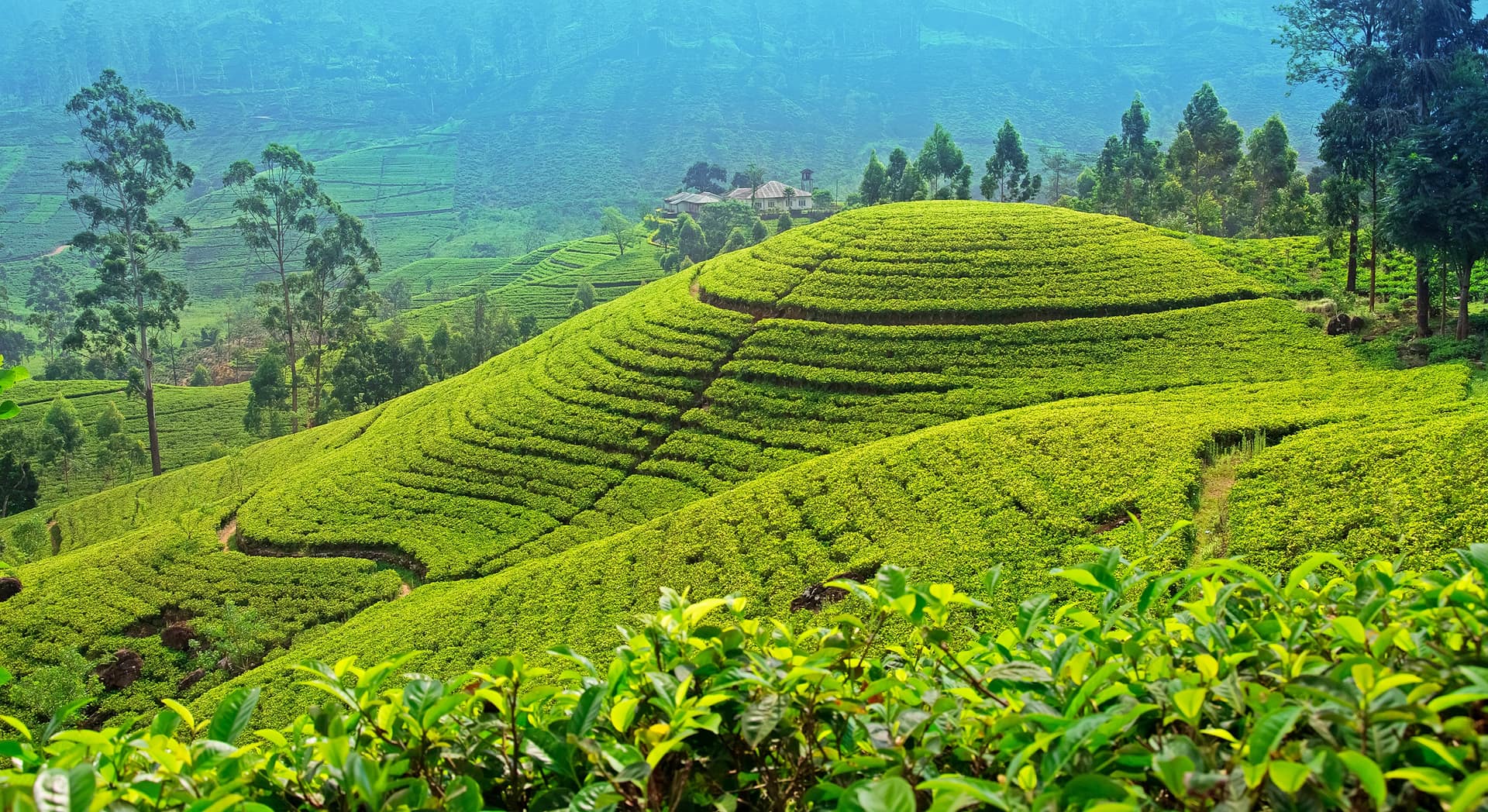
Nuwara Eliya is a different kind of hill station: a colonial-era town at roughly 1,900 metres surrounded by tea estates, with a racecourse, a lake, red-brick post office and Tudor-style hotels. It is busy with domestic visitors, especially in April, but has far fewer backpackers and a slower, cooler feel.
The strongest reason to choose it is Horton Plains National Park, a high plateau of grassland and cloud forest roughly an hour away, where the World's End escarpment drops sharply towards the lowlands. It is one of the most distinctive landscapes on the island and cannot easily be reached from Ella in a short trip.
- →Ella: warmer, livelier, the Nine Arch Bridge and Little Adam's Peak.
- →Nuwara Eliya: cooler, colonial, surrounded by tea estates.
- →Horton Plains: the decisive reason to choose Nuwara Eliya.
The Nuwara Eliya version, day by day
Days 1 to 3 follow the classic route through Sigiriya, Dambulla and Kandy. Day 4 changes: instead of the full train to Ella, drive from Kandy to Nuwara Eliya via a tea estate. If you want the train experience, the short stretch from Nanu Oya towards Ella and back is not practical, so this version is primarily a road route in the hills.
Day 5 starts before dawn for Horton Plains, then descends to the south coast in the afternoon. It is the longest day of the week, but the scenery on the way down, through Haputale or Ella and across the plains, is superb.
- →Days 1 to 3: as in the classic route.
- →Day 4: Kandy to Nuwara Eliya, roughly three hours, with a tea factory visit.
- →Day 5: Horton Plains at dawn, then roughly five to six hours to Mirissa.
- →Day 6: Mirissa and the south coast.
- →Day 7: Galle Fort and the airport.
The drive from Kandy to Nuwara Eliya
The road from Kandy to Nuwara Eliya climbs steeply through the Ramboda Pass, with tea estates on every slope and several waterfalls close to the road. It takes roughly three hours without stops, and a tea factory visit adds an hour or so.
Several large estates on this road offer factory tours and tastings, showing the process from withering and rolling to drying and grading. It is the best single way to understand Ceylon tea, and far more rewarding than the shops that sell it along the roadside.
- →Roughly three hours through the Ramboda Pass.
- →A tea factory tour and tasting: around an hour.
- →Ramboda Falls and other waterfalls sit close to the road.
Horton Plains and World's End at dawn
Horton Plains National Park lies roughly an hour's drive from Nuwara Eliya on a plateau above 2,000 metres. The loop walk to World's End and Baker's Falls is roughly nine kilometres and takes around three to four hours on a well-trodden trail over grassland and through cloud forest.
The timing matters. On many days cloud fills the valley below World's End by mid-morning, leaving visitors looking at a white wall. Leaving Nuwara Eliya around 5am and starting the walk at opening is the way to see the view. Confirm current opening hours, fees and any walking restrictions locally.
Mornings on the plateau are cold, sometimes near freezing in January and February. Warm layers, a waterproof, and sturdy shoes are essential, and plastic is restricted inside the park.
- →Loop walk: roughly nine kilometres, three to four hours.
- →Leave Nuwara Eliya around 5am to beat the cloud.
- →Pack warm layers and a waterproof; mornings can be near freezing.
- →Confirm opening hours and fees locally before going.
From Horton Plains down to the coast
After Horton Plains, the route descends to the south coast via Haputale or Ella and the southern plains, taking roughly five to six hours from Nuwara Eliya. Starting from Horton Plains around 10am puts you on the coast in the late afternoon.
Haputale's Lipton's Seat viewpoint, where Thomas Lipton is said to have surveyed his estates, is a detour on this road for those with energy left, though after an early start most travellers are happy simply to watch the tea country give way to palms.
Who should choose Nuwara Eliya
Choose the Nuwara Eliya version if you dislike crowds, enjoy walking in cool air, want to see a tea factory properly, or are drawn by Horton Plains. It suits keen walkers and photographers, and travellers who have seen Ella's crowds in photographs and been put off.
Keep Ella if the Kandy to Ella train is a priority, if you travel with young children who will struggle with a 5am start and a nine-kilometre walk, or if you prefer a lively village with cafes. Ella is also warmer, which matters to those who dislike cold nights.
- →Choose Nuwara Eliya for Horton Plains, cool air and fewer backpackers.
- →Keep Ella for the full train journey and the Nine Arch Bridge.
- →Keep Ella with young children or anyone who dislikes cold nights.
Planning the Nuwara Eliya week
Nuwara Eliya's hotels range from colonial-era grand hotels to converted tea planters' bungalows and simple guesthouses, and many have fireplaces, which are genuinely used. April, when domestic visitors come for the Sinhala and Tamil New Year season, is the busiest month; book well ahead then.
Lankan Stays & Trails arranges the Horton Plains dawn with a driver who knows how early to leave for the season, and our Soul of Sri Lanka tour includes Nuwara Eliya for travellers who can spare an extra day to see both it and Ella.
Frequently asked questions
Is Nuwara Eliya or Ella better for one night?
Ella is better for a lively village, the Nine Arch Bridge and the end of the scenic train. Nuwara Eliya is better for cool, quiet tea country and a dawn walk at Horton Plains. For a one-night stop on a short trip, choose Nuwara Eliya only if Horton Plains appeals.
How cold is Nuwara Eliya?
Cool by day and cold at night, since the town sits at roughly 1,900 metres. Daytime temperatures are often in the high teens Celsius, and nights can drop to single figures, especially from December to February. Horton Plains at dawn can be close to freezing.
Can I do Horton Plains on a 7-day trip?
Yes, if you stay in Nuwara Eliya rather than Ella. Leave around 5am, walk the roughly nine-kilometre World's End loop in three to four hours, and drive to the south coast in the afternoon. It makes a long day, but it is realistic.
How long is the drive from Nuwara Eliya to Mirissa?
Roughly five to six hours via Haputale or Ella and the southern plains, about an hour longer than from Ella. Leaving Horton Plains around 10am puts you on the coast in the late afternoon.
Can I still take the train if I stay in Nuwara Eliya?
You can take the train from Kandy to Nanu Oya, the station for Nuwara Eliya, which takes roughly four hours and covers some good scenery. The most celebrated stretch, from Nanu Oya to Ella, is lost, so train enthusiasts are better keeping Ella.
Is Nuwara Eliya worth visiting?
For tea country, colonial atmosphere, cool air and Horton Plains, yes. It is busy with domestic visitors in April and some find the town itself less charming than its surroundings. The estates and plateau around it are the real reasons to go.