
Quick answer
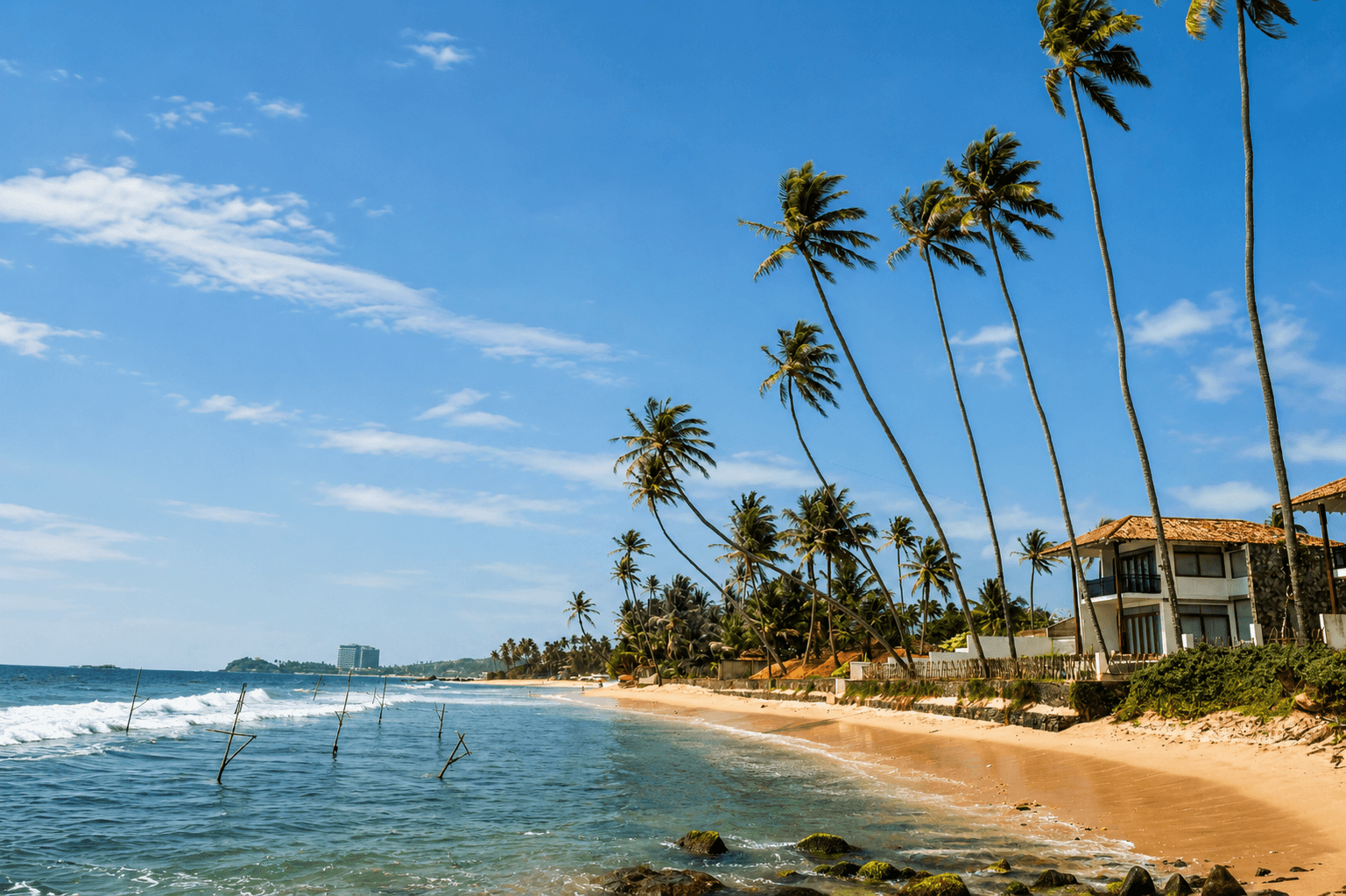
A beachfront resort in Sri Lanka is a full-service hotel built directly on the sand, typically offering multiple restaurants, a spa, a pool and daily activities on site, distinct from a smaller boutique hotel or a self-contained private villa. They cluster most densely along the west coast around Bentota and the south coast around Unawatuna and Mirissa. Unlike the Caribbean, Mexico or Cuba, Sri Lankan resorts are much less commonly sold as all-inclusive; most operate a la carte dining and activities, so couples should confirm what is and is not bundled before booking.
Key takeaways
- A beachfront resort typically offers multiple restaurants, a spa and a pool on site, distinguishing it from a smaller boutique hotel of under twenty rooms or a self-contained private villa.
- Bentota on the west coast and the Unawatuna-to-Mirissa stretch on the south coast hold Sri Lanka's densest concentrations of full-service beachfront resorts.
- All-inclusive pricing is far less standard in Sri Lanka than in the Caribbean, Mexico or Cuba; most resorts here price rooms separately from meals and activities on an a la carte basis.
- A small number of Sri Lankan beachfront resorts do offer all-inclusive or half-board packages, so it is worth confirming this specifically rather than assuming it by default as a Caribbean traveller might.
- The south and west coasts run calmest and driest from roughly December to March, which is also when beachfront resorts see their highest occupancy and require the earliest booking.
What a full-service beachfront resort actually offers
A beachfront resort in Sri Lanka is generally a larger property than a boutique hotel, built directly on or immediately behind the sand, with multiple restaurants, a spa, at least one pool and often a programme of daily activities such as yoga, cooking demonstrations or water sports arranged through the hotel itself. This model suits couples who want variety and convenience without planning each day's meals or entertainment in advance.
The scale that makes this convenience possible also means less of the individual character a smaller boutique property offers; a resort with a hundred or more rooms will feel more like a hotel than a private retreat, which is a fair trade for many couples but worth being clear-eyed about before booking.
Resort versus boutique hotel versus private villa
The three main stay categories for couples in Sri Lanka, a full-service resort, a boutique hotel and a private villa, sit on a spectrum from most to least shared facilities. A resort offers the widest range of on-site amenities and the least personal, individual character; a boutique hotel offers a smaller, more design-led stay with fewer facilities; a villa offers no shared facilities at all but complete privacy and a self-contained pace.
Choosing between them comes down to what a couple actually wants from their days rather than budget alone, since all three categories exist across a range of price tiers. A couple wanting spontaneity, multiple dining options and other guests around for atmosphere generally leans resort; a couple wanting seclusion leans villa; a couple wanting character without full self-catering leans boutique.
- →Resort: widest range of on-site facilities, multiple restaurants, least individual character.
- →Boutique hotel: fewer facilities, stronger design identity, generally under twenty rooms.
- →Private villa: no shared facilities, complete privacy, self-contained pace with a private cook.
Which coasts suit which resort style
Bentota on the west coast has one of Sri Lanka's longest-established beachfront resort traditions, generally calmer, more sheltered water and a slightly more formal resort atmosphere, often paired with river-safari access on the nearby Bentota river. The stretch through Unawatuna, Weligama and Mirissa on the south coast offers a livelier beach-town setting, with resorts positioned closer to independent restaurants, shops and Mirissa's whale-watching harbour.
The east coast around Trincomalee has a smaller number of beachfront resorts, generally suiting couples travelling in its own roughly May to September season rather than the December to March window that suits the south and west coasts.
- →Bentota: established, calmer resort atmosphere, river-safari access nearby.
- →Unawatuna to Mirissa: livelier beach-town setting, closer to independent restaurants and whale watching.
- →Trincomalee: a smaller resort cluster, suited to its own May to September season.
Why Sri Lanka is not all-inclusive by default
Canadian couples familiar with the Caribbean, Mexico, Cuba or the Dominican Republic often assume a beachfront resort automatically means an all-inclusive package covering meals, drinks and activities in one price, and this is a genuinely important expectation to reset before booking Sri Lanka. Most Sri Lankan beachfront resorts price rooms separately, with breakfast commonly included but lunch, dinner and drinks charged a la carte at the hotel's restaurants or, quite often, at independent restaurants nearby.
A smaller number of Sri Lankan resorts do offer all-inclusive or half-board packages, generally at the larger, more internationally branded end of the market, so a couple specifically wanting that model should search for it directly rather than assume it is the default. Many couples end up preferring the a la carte model once they experience it, since it encourages eating at independent restaurants beyond the resort gate, part of Sri Lanka's appeal as a destination rather than a walled-off resort experience.
Who a beachfront resort suits best
A full-service resort suits couples who want convenience and variety without planning, particularly on a first visit to Sri Lanka or as a restful bookend to a busier cultural and hill-country leg earlier in the trip. It also suits couples wanting the option of company and activity at the pool or bar, in contrast to a villa's complete privacy.
Couples wanting a quieter, more design-led stay or genuine seclusion are generally better served by a boutique hotel or private villa instead, and might reserve a resort stay for the final, most relaxed leg of a longer itinerary.
Booking and fitting a resort stay into a trip
A beachfront resort stay works well as the final few nights of a broader itinerary, following a Cultural Triangle, Kandy or hill-country stretch, since the appeal of unwinding by the water tends to land better after a more active first half of a trip. Booking four to eight weeks ahead is generally sufficient even in peak season, though earlier is safer for a couple with specific room-type preferences.
Lankan Stays & Trails pairs a beachfront resort stay with the rest of a couple's itinerary and confirms exactly what is and is not included at the specific property before booking, since the meal-plan question matters more here than a Caribbean traveller might expect.
Frequently asked questions
Are Sri Lanka resorts all-inclusive?
Generally no. Most Sri Lankan beachfront resorts price rooms separately from meals and activities, unlike the default all-inclusive model common in the Caribbean, Mexico or Cuba. A smaller number of larger properties do offer all-inclusive packages, so confirm this directly when booking.
What is the difference between a resort and a boutique hotel in Sri Lanka?
A resort is typically a larger property with multiple restaurants, a spa and a full activity programme on site, while a boutique hotel generally has fewer than twenty rooms and a stronger individual design identity with fewer shared facilities.
Which coast has the best beachfront resorts in Sri Lanka?
Bentota on the west coast and the Unawatuna-to-Mirissa stretch on the south coast hold Sri Lanka's densest concentrations of full-service beachfront resorts, each with a slightly different, calmer or livelier atmosphere.
Is breakfast included at Sri Lankan beachfront resorts?
Breakfast is commonly included, though lunch, dinner and drinks are usually charged separately at most Sri Lankan resorts. Confirm the specific meal plan at booking, since it varies by property and is less standardised than in Caribbean all-inclusive resorts.
Should we choose a resort or a private villa in Sri Lanka?
A resort suits couples wanting convenience, variety and other guests around; a villa suits couples wanting complete privacy and a self-contained pace. Both exist across a range of price tiers, so the choice depends on preferred atmosphere rather than budget alone.
When is the best time to book a beachfront resort in Sri Lanka?
December to March is peak season for the south and west coasts, and booking four to eight weeks ahead is generally sufficient, though earlier is safer for specific room-type preferences. The east coast around Trincomalee instead runs roughly May to September.
Do Sri Lanka resorts have spas and pools?
Most full-service beachfront resorts include at least one pool and an on-site spa, alongside multiple restaurants, distinguishing them from smaller boutique hotels that may offer fewer facilities. Confirm specific spa and pool details directly with the property.