
Quick answer
On a first luxury trip to Sri Lanka, the places where the upper tier changes most are the hill country, where tea estate bungalows put you on a working plantation, Galle Fort, where restored Dutch houses sit inside the walls, and the safari parks, where tented camps and private naturalists transform the wildlife experience. Kandy and Colombo are where paying substantially more tends to buy the least.
Key takeaways
- Tea estate bungalows in the hill country are the clearest case where the upper tier changes the experience, not just the room.
- Staying inside Galle Fort rather than outside it is worth more than any other single upgrade on the south coast.
- Luxury tented camps near the safari parks place you closer to the gate and make dawn drives far easier.
- Kandy and Colombo are city stops where a higher tier buys comfort rather than a different experience.
- A private driver-guide across the whole route is the single highest-value upgrade on a first trip.
Where the upper tier changes the experience
The useful test for luxury spending in Sri Lanka is whether the property gives access to something rather than merely a better version of a room. By that test, three stops stand out, and they happen to be the three where the setting is inseparable from the accommodation.
The hill country is the clearest. Tea estate bungalows are colonial-era planters' houses on working plantations, typically with a handful of rooms, a resident cook and estate walking from the door. Staying in one is not an upgraded hotel night; it is a different activity, and it removes the need to drive anywhere during the stay.
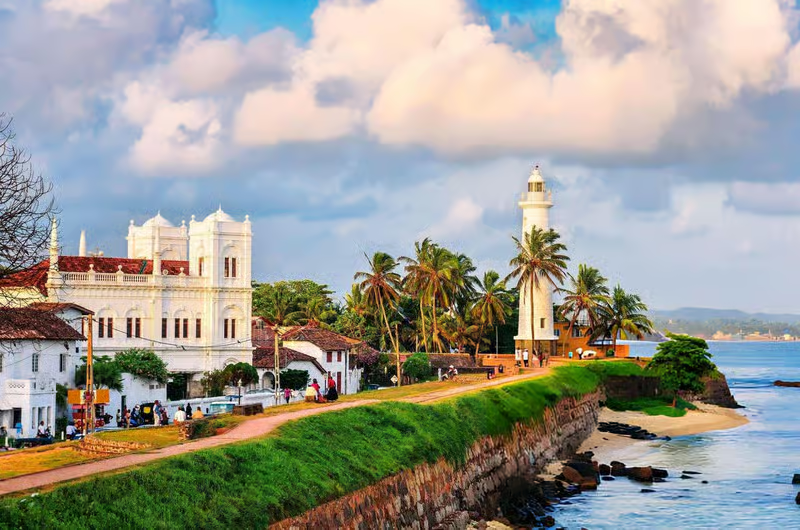
Galle Fort is the second. A small hotel in a restored Dutch house inside the walls gives access to the fort at its best, early in the morning and after five in the afternoon when day visitors leave. A larger hotel outside the walls, however comfortable, does not.
- →Test whether the property gives access to something, not just a better room.
- →Tea estate bungalows put you on a working plantation with walking from the door.
- →A Galle Fort house gives the fort at dawn and after five, which outside hotels cannot.
- →In both cases the setting and the accommodation are inseparable.
Safari, where the difference is largest
The safari stop is where higher-tier spending produces the most measurable difference, for two reasons that have nothing to do with comfort. The first is proximity: camps closer to the park gate make a dawn start considerably less brutal, and dawn is when wildlife activity concentrates.
The second is the guiding. A private naturalist who works patiently, waits rather than chases radio calls, and can read tracks and alarm calls changes what a drive produces. At Yala in particular, where crowding around sightings is a genuine problem, a driver willing to sit quietly away from a scrum rather than join it is the difference between a good morning and an unpleasant one.
Tented camps near Yala, Wilpattu and Udawalawe offer this combination. Note that no operator can guarantee a leopard, and any who does is making a promise about driver behaviour rather than about wildlife, which is worth treating as a warning sign rather than a selling point.
- →Camps near the gate make the dawn start materially easier.
- →A private naturalist who waits rather than chases changes what a drive produces.
- →At Yala, a driver who avoids the scrum is worth more than the vehicle.
- →Treat any guaranteed sighting as a warning sign about driving practice.
The coast at the upper tier
The south coast has the widest range of higher-tier options in Sri Lanka, and the most important variable is not the hotel standard but the beach it sits on. Mirissa's central strip is busy and loud in high season regardless of how good the property is.
Talalla and Tangalle are where the upper tier works best on this coast, because quiet is the thing being bought and those beaches supply it. Private villas with a cook are also strong here, particularly for groups, and often compare well with equivalent hotel rooms.
The one caution is seasonal. No amount of spending changes sea conditions during the south-west monsoon between roughly May and September, when swimming is often unsafe on this coast. A high-end beach stay in July on the south coast is the clearest example of money not solving a problem.
- →The beach matters more than the property standard on the south coast.
- →Talalla and Tangalle supply the quiet that upper-tier coastal stays are for.
- →Private villas with a cook work well, particularly for groups.
- →Spending does not change monsoon sea conditions; the season still decides.
Where paying more buys less
Kandy is the clearest case. It is a congested working city, and the experience of visiting the Temple of the Sacred Tooth Relic at evening puja is identical regardless of where you slept. A higher-tier hotel in the hills above the city buys a view and a quieter night, which is worth something but not a transformation.
Colombo is similar. It has genuinely good hotels, but the reasons to be in Colombo are restaurants, galleries and shopping, all of which are equally available from a mid-range base. The upper tier buys comfort rather than access.
The Cultural Triangle sits in between. A good property with grounds and a pool matters here because the evenings are hotel evenings, but the sites themselves are experienced identically by every visitor. Spend enough to have somewhere pleasant to return to in the afternoon heat, and stop there.
- →Kandy: the temple experience is identical regardless of where you stay.
- →Colombo: restaurants, galleries and shopping are equally accessible from mid-range.
- →The Cultural Triangle: grounds and a pool matter, but the sites do not vary.
- →Spend where the property gives access, not where it only gives comfort.
The upgrade that matters most
On a first trip, the single highest-value upgrade is not a hotel at all. It is a private vehicle with an experienced driver-guide for the whole route, which changes every day of the itinerary rather than the nights in one place.
What it buys is flexibility: leaving at first light without negotiating, stopping at a viewpoint or a roadside stall, changing the order of a day when weather turns, and having someone who knows which gate at a site is quieter. On slow winding roads across a fortnight, that compounds.
It also solves the problem specific to first visits, which is not knowing what is reasonable. A driver-guide removes a layer of small decisions that a first-time visitor to an unfamiliar country does not need on top of everything else that is new.
- →A private driver-guide affects every day, not just the nights in one place.
- →It buys flexibility on timing, stops and reordering a day around weather.
- →Local knowledge of quieter gates and hours is worth more than it sounds.
- →It removes the decision load that first-time visitors find most wearing.
Shaping a first luxury trip
A well-weighted upper-tier first trip spends most heavily on the hill country bungalow, the Galle Fort house, the safari camp and the driver-guide, and takes a comfortable but unremarkable property in Kandy and the Cultural Triangle. That distribution produces a noticeably better trip than spreading the same budget evenly.
Lankan Stays and Trails builds higher-tier itineraries around that principle, and will say plainly where we think an upgrade adds little. The commonest advice we give is to move budget from a Kandy city hotel into a second night at a tea estate, which changes the trip rather than the room.
Frequently asked questions
Where is luxury worth paying for in Sri Lanka?
The hill country, where tea estate bungalows sit on working plantations; Galle Fort, where restored Dutch houses inside the walls give access to the fort at its quietest; and the safari parks, where tented camps near the gate and private naturalists change the wildlife experience.
Are tea estate bungalows worth it in Sri Lanka?
Yes, and they are the clearest case where the upper tier changes the experience rather than the room. They are colonial-era planters' houses on working estates, typically with a handful of rooms, a resident cook and walking directly from the door.
Should I stay inside Galle Fort?
If the budget allows, yes. Staying within the walls is what gives access to the fort early in the morning and after five in the afternoon, when day visitors leave and the town is at its best. Room numbers inside are limited, so book well ahead.
Do luxury safari camps make a difference in Sri Lanka?
Considerably, for two reasons: proximity to the gate makes dawn drives easier, and a private naturalist who waits patiently rather than chasing radio reports changes what a drive produces. At Yala this matters more than anywhere else, given the crowding at sightings.
Where is luxury not worth paying for in Sri Lanka?
Kandy and Colombo. Both are city stops where the reasons to visit, the temple in Kandy and the restaurants and galleries in Colombo, are experienced identically regardless of where you sleep. A higher tier buys comfort rather than different access.
What is the best upgrade on a first Sri Lanka trip?
A private vehicle with an experienced driver-guide for the whole route. It affects every day rather than the nights at one property, buying flexibility on timing, stops and reordering around weather, plus local knowledge of which gates and hours are quieter.
Can money fix a bad season on the Sri Lankan coast?
No. Sea conditions during the south-west monsoon, roughly May to September, make swimming on the south coast often unsafe regardless of the property. In that window the answer is to move the coastal stop east to Trincomalee, not to spend more.