
Quick answer
The best beaches in Sri Lanka for a first trip are Unawatuna and Mirissa for sheltered swimming with facilities, Talalla and Tangalle for quiet, and Nilaveli and Uppuveli near Trincomalee on the east coast. The south and west are in season roughly December to March, the east roughly May to September. Lifeguard cover is limited everywhere, so sea conditions should be taken seriously rather than judged by appearance.
Key takeaways
- The south and west coasts are in season roughly December to March; the east coast roughly May to September.
- Unawatuna is the most sheltered of the main south coast bays, which makes it the safest general swimming option.
- Talalla and Tangalle offer the quietest well-known beaches, roughly an hour east of Mirissa.
- Nilaveli and Uppuveli on the east coast have calmer water in season than the south coast reaches at any time.
- Lifeguard cover is limited across Sri Lanka and rip currents are common outside the sheltered bays.
The rule that governs every beach decision
Sri Lanka's two monsoons put the coasts on opposite calendars, and this single fact governs every beach decision on a first trip. The south-west monsoon affects the south and west roughly May to September; the north-east monsoon affects the north and east roughly November to February.
The practical outcome is that the south and west, including Unawatuna, Mirissa, Tangalle and Bentota, are at their best roughly December to March, and the east, including Nilaveli, Uppuveli and Pasikudah, is at its best roughly May to September.
For a beach-led trip this is liberating rather than restrictive. There is almost always a coast in good condition somewhere in Sri Lanka, which is not true of most tropical destinations. The mistake is choosing a beach first and checking the season afterwards.
- →South and west: best roughly December to March.
- →East: best roughly May to September.
- →There is almost always one coast in good condition.
- →Choose the dates, then the coast, then the specific beach.
The south coast beaches
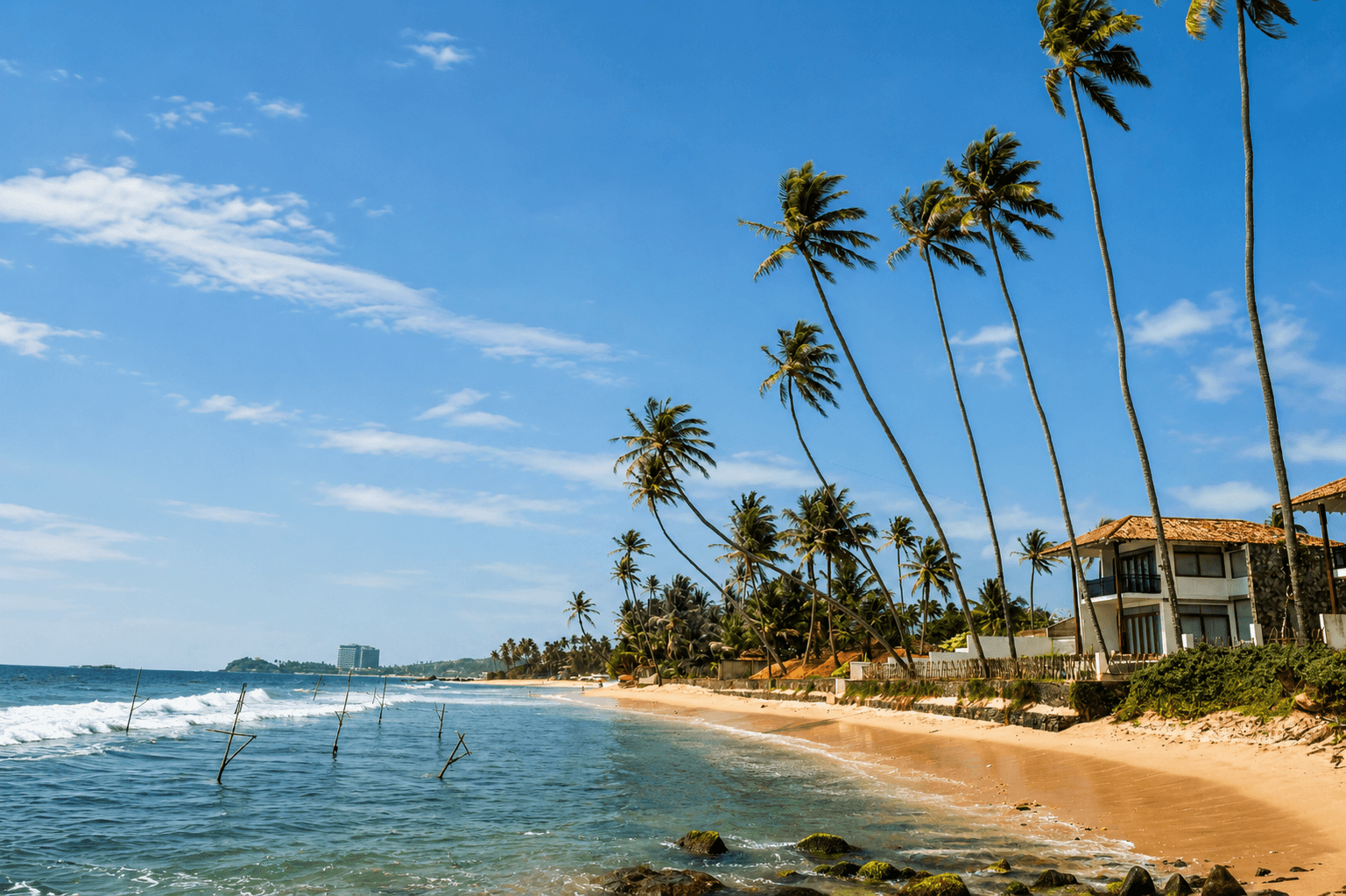
Unawatuna is the most sheltered of the main south coast bays, curved and protected enough that swimming is generally comfortable through the season. It sits roughly fifteen to twenty minutes from Galle Fort, which makes it the practical choice for travellers wanting both beach and evenings out.
Mirissa is the busier option, a crescent between two headlands with good swimming in season and the blue whale trips that run roughly November to April. The central strip is loud into the night in high season; the eastern end near Coconut Tree Hill and the western end near the harbour are noticeably calmer.
Talalla and Tangalle, roughly an hour further east, are where the coast quietens. Talalla is a long crescent with very little development. Tangalle has a series of wide bays, though swimming safety varies sharply between them and some are genuinely unsafe, so local advice matters more here than elsewhere.
- →Unawatuna: the most sheltered bay, roughly fifteen to twenty minutes from Galle.
- →Mirissa: good swimming in season plus whale trips roughly November to April.
- →Talalla: long, quiet crescent with very little development.
- →Tangalle: wide bays, but swimming safety varies sharply; take local advice.
The east coast beaches
Nilaveli and Uppuveli, north of Trincomalee, are the headline east coast beaches and in season they are calmer than the south coast manages at any point in its own season. They are also considerably emptier, with less development behind them.
Pigeon Island National Park, a short boat ride off Nilaveli, offers the most accessible snorkelling in Sri Lanka, with reef close to shore and reef sharks frequently seen. Visitor numbers are capped and the reef has suffered from bleaching and visitor pressure, so early visits and staying off the coral both matter.
Arugam Bay, further south on the east coast, is the surf destination rather than a swimming one. Its season runs roughly the same window, and it has a distinct and much more informal atmosphere than the Trincomalee beaches.
- →Nilaveli and Uppuveli: calmer in season than the south coast ever gets.
- →Pigeon Island: the most accessible snorkelling in Sri Lanka, with capped numbers.
- →Arugam Bay: a surf destination, with a more informal atmosphere.
- →The east is generally emptier, with less development behind the sand.
Sea safety, which is undersold
Lifeguard cover in Sri Lanka is limited, and it is absent on many beaches entirely. Rip currents are common outside the sheltered bays, and the conditions that produce them are not always visible from the sand. This is the most important practical point on this page.
Conditions also change with the season rather than the weather on any given day. A calm-looking sea in July on the south coast can still carry a strong rip, because the swell driving it is generated far offshore. Sunshine is not an indicator of safe swimming.
The sensible approach is to ask locally, swim at beaches known to be sheltered such as Unawatuna or Nilaveli, avoid swimming alone, and treat any beach with warning flags or no other swimmers as a signal rather than an opportunity. Hotels will generally give honest advice about their own stretch.
- →Lifeguard cover is limited and often absent entirely.
- →Rip currents are common outside sheltered bays and are not always visible.
- →Calm-looking water out of season can still carry a strong rip.
- →Ask locally, avoid swimming alone, and treat an empty beach as information.
Building a beach-led first trip
A beach-led trip should still include some of the interior, because a first visit to Sri Lanka that sees only the coast misses what distinguishes the country from other tropical destinations. The compromise that works is one inland block rather than a full loop.
A practical shape is two nights in the Cultural Triangle covering Sigiriya and Dambulla, one night at Kandy, one night at a safari park, and six or seven nights split between two coastal bases. That keeps most of the trip on the sand while still touching the ancient and hill country characters.
Splitting the coastal time between two beaches on the same coast is generally better than staying at one, and better than crossing to the other coast. Galle and Tangalle, roughly two hours apart, feel genuinely different from each other while sharing a season.
- →Include one inland block; a coast-only first trip misses what distinguishes Sri Lanka.
- →Two nights in the Cultural Triangle plus a safari night covers the essentials.
- →Split six or seven coastal nights between two bases on the same coast.
- →Galle and Tangalle are roughly two hours apart and feel quite different.
Planning a beach-focused first trip
The planning order matters more here than for any other kind of trip: dates first, then coast, then beaches. Every common disappointment with Sri Lankan beaches traces back to reversing that order and arriving at a famous beach in the wrong month.
Lankan Stays and Trails moves the coastal element between the south and the east according to the month, and will say plainly when a requested beach does not suit the requested dates. The two-monsoon pattern means there is nearly always a good answer, but it is often not the beach people had in mind when they asked.
Frequently asked questions
What is the best beach in Sri Lanka for a first trip?
Unawatuna for sheltered swimming with Galle Fort nearby, Mirissa for beach life and whale trips, Talalla or Tangalle for quiet, and Nilaveli or Uppuveli on the east coast. Which is available depends on the month, since the two coasts run opposite seasons.
When is the best time for beaches in Sri Lanka?
Roughly December to March for the south and west coasts, and roughly May to September for the east coast. Sri Lanka has two monsoons on opposite schedules, so there is almost always one coast in good condition somewhere on the island.
Which beach in Sri Lanka is safest for swimming?
Unawatuna is the most sheltered of the main south coast bays, and Nilaveli on the east is calm in its own season. Lifeguard cover is limited across Sri Lanka and rip currents are common elsewhere, so ask locally and avoid swimming alone.
Which is the quietest beach in Sri Lanka?
Talalla is the quietest of the well-known south coast options, a long crescent with very little development roughly an hour east of Mirissa. On the east coast, the beaches north of Trincomalee are generally emptier than any southern equivalent.
Is it safe to swim in Sri Lanka during the monsoon?
Often not, on the affected coast. Rip currents are common and the swell driving them is generated far offshore, so calm-looking water can still be dangerous. Move to the coast that is in season rather than judging conditions by how the sea looks.
Can I spend a whole trip to Sri Lanka on the beach?
You can, but a first trip that sees only the coast misses what distinguishes Sri Lanka from other tropical destinations. A workable compromise is two nights in the Cultural Triangle, one at Kandy and one at a safari park, with six or seven coastal nights.
Where is the best snorkelling in Sri Lanka?
Pigeon Island National Park, a short boat ride off Nilaveli on the east coast, where reef sits close to shore and reef sharks are frequently seen. Visitor numbers are capped and the reef has suffered from pressure, so go early and never stand on coral.