
Quick answer
Choose the south coast between roughly December and March, and Trincomalee between roughly May and September. Sri Lanka has two monsoons, so the two coasts are rarely good at the same time. The south coast sits roughly three to four hours from Bandaranaike International Airport on the Southern Expressway; Trincomalee sits roughly five to six hours away, which makes the east a longer commitment at the end of a trip.
Key takeaways
- The south coast is at its best roughly December to March; Trincomalee roughly May to September.
- Trincomalee sits roughly five to six hours from the airport, against three to four for the south coast.
- Trincomalee sits roughly three to three and a half hours from the Cultural Triangle, which makes it a natural spur.
- Pigeon Island, off Nilaveli, offers some of the most accessible snorkelling in Sri Lanka in season.
- Whale watching runs off Mirissa roughly November to April and off Trincomalee roughly May to October.
The calendar decides this, not preference
Sri Lanka has two monsoon systems affecting different halves of the island. The south-west monsoon brings rain and rough seas to the south and west roughly between May and September. The north-east monsoon brings rain to the north and east roughly between November and February.
The practical effect is that the south coast, including Mirissa, Unawatuna, Galle and Tangalle, is at its best roughly December to March. Trincomalee and the east coast, including Nilaveli, Uppuveli and Pasikudah, are at their best roughly May to September.
For most travel dates this makes the decision straightforward. A January trip should take the south; a July trip should take Trincomalee. Only the inter-monsoon periods, roughly October to November and April, leave genuine room for preference, and in those months neither coast is reliable.
- →South and west: best roughly December to March.
- →East, including Trincomalee: best roughly May to September.
- →October to November and April are variable on both coasts.
- →For most dates the season makes the choice rather than taste.
What the south coast offers
The south coast is the standard first-trip finish, and it carries more variety than the east. Galle provides a walled Dutch fort and an evening of architecture and restaurants; Mirissa provides beach life and blue whale trips; Unawatuna provides a sheltered bay close to Galle; Tangalle and Talalla provide genuine quiet.
It also connects better. The Southern Expressway returns the south coast to Bandaranaike International Airport in roughly three to four hours, and the safari parks at Yala and Udawalawe sit on the road between the hill country and the coast, so the whole sequence flows without detours.
Blue whale watching off Mirissa runs roughly November to April, which overlaps the south coast season neatly. That overlap is part of why the December to March window is so heavily favoured for first trips.
- →More variety: Galle for architecture, Mirissa for whales, Tangalle for quiet.
- →Roughly three to four hours from the airport on the Southern Expressway.
- →Sits naturally after the safari parks on the standard loop.
- →Blue whale season off Mirissa runs roughly November to April.
What Trincomalee offers
Trincomalee has one of the finest natural harbours in the world and a coastline of wide, calm beaches at Nilaveli and Uppuveli that are generally quieter and emptier than their southern equivalents. In season the sea here is noticeably calmer than the south coast ever gets.
Pigeon Island National Park, a short boat ride off Nilaveli, is the standout. It offers some of the most accessible snorkelling in Sri Lanka, with reef close to shore and reef sharks frequently seen. Visitor numbers are capped and the reef has suffered from pressure, so going early and staying off the coral both matter.
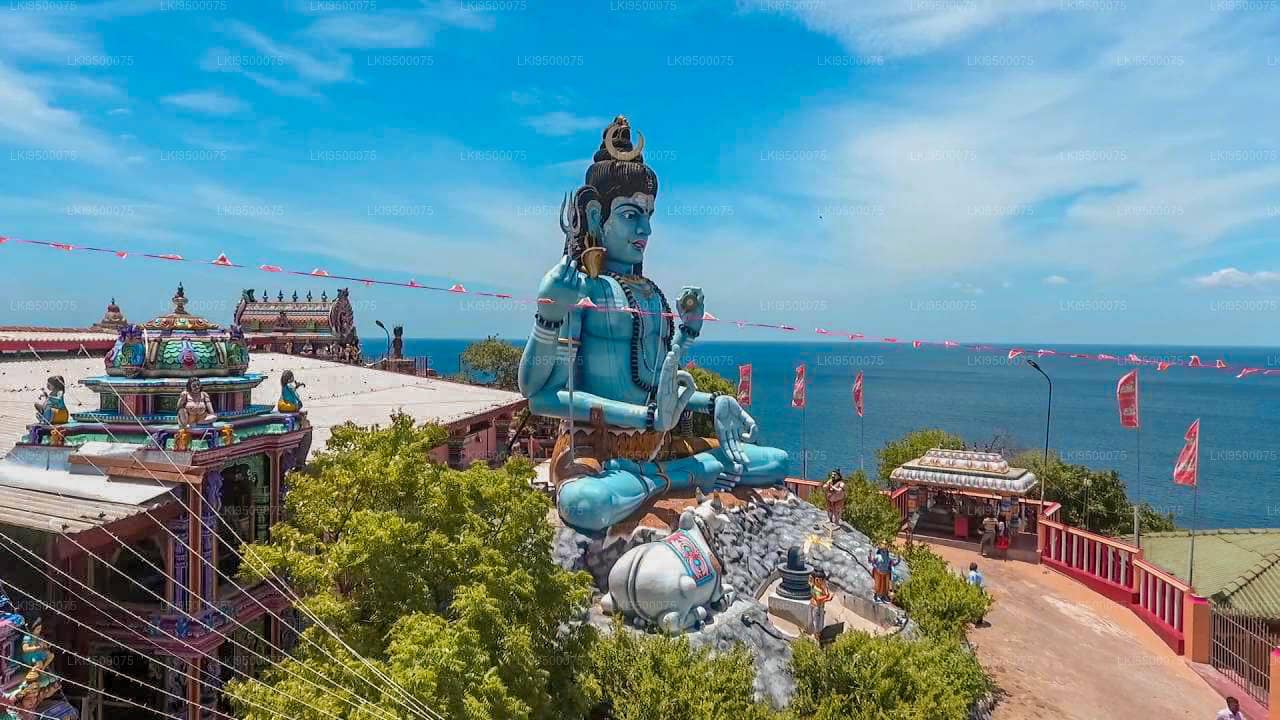
Trincomalee town itself holds the Koneswaram temple on Swami Rock, a Hindu site of real significance perched above the sea, which gives the east coast a cultural dimension the southern beaches largely lack.
- →Wide, calm beaches at Nilaveli and Uppuveli, generally quieter than the south.
- →Pigeon Island offers accessible snorkelling with reef close to shore.
- →Koneswaram temple on Swami Rock adds a cultural element.
- →Whale watching off Trincomalee runs roughly May to October.
The transfer cost of choosing the east
The main practical argument against Trincomalee on a first trip is distance from the airport. It sits roughly five to six hours away, against three to four for the south coast on the expressway, which means the final transfer needs a day of its own rather than a morning.
Trincomalee does sit conveniently close to the Cultural Triangle, at roughly three to three and a half hours from Sigiriya or Habarana. That makes it a natural spur from the Cultural Triangle rather than the end of a full loop, and this is often the cleanest way to include it.
The alternative shape for an east coast trip is to run the loop in reverse: airport, Cultural Triangle, Trincomalee, back through the hill country, and finish nearer the airport. It works, but it involves more backtracking than the standard southern loop does.
- →Trincomalee to the airport: roughly five to six hours, needing its own day.
- →Trincomalee to the Cultural Triangle: roughly three to three and a half hours.
- →Including it as a spur from the Cultural Triangle is usually cleanest.
- →A reversed loop works but involves more backtracking.
What we would actually recommend
For trips between December and March, take the south coast without hesitation. The east will be under the north-east monsoon, and there is no version of that trip where Trincomalee is the better choice.
For trips between May and September, take Trincomalee, and build it as a spur from the Cultural Triangle rather than as the final stop before flying. Two or three nights at Nilaveli with a Pigeon Island morning is a strong addition, and the south coast in that window is often genuinely disappointing.
For April and October, keep the coastal stop short and flexible on either coast, and weight the itinerary towards the Cultural Triangle and hill country, both of which are far less affected by the inter-monsoon unpredictability than the beaches are.
- →December to March: south coast, no real argument for the east.
- →May to September: Trincomalee, built as a spur from the Cultural Triangle.
- →April and October: keep the coastal stop short and weight the trip inland.
- →Never plan an east coast stop in January or a south coast stop in July by preference alone.
Fitting the choice into a first trip
The planning order that works is dates first, then coast, then the specific beach. Choosing Mirissa because of a photograph and then discovering the trip falls in July is the most common version of this going wrong, and it is entirely avoidable.
Lankan Stays and Trails moves the coastal stop between the south and the east according to the month, which is one of the genuine advantages of Sri Lanka over destinations with a single wet season. There is almost always a coast in good condition; the work is in routing the rest of the trip around it.
Frequently asked questions
Should I visit Trincomalee or the south coast?
The south coast between roughly December and March, and Trincomalee between roughly May and September. Sri Lanka has two monsoons affecting opposite sides of the island, so for most travel dates the season makes this decision rather than personal preference.
When is Trincomalee in season?
Roughly May to September, when the south-west monsoon is affecting the other side of the island and the east is dry with calm seas. This is also when Pigeon Island snorkelling is most reliable and when whale watching operates off the east coast.
How far is Trincomalee from Colombo airport?
Roughly five to six hours by road, compared with three to four from the south coast on the Southern Expressway. Trincomalee sits much closer to the Cultural Triangle, at roughly three to three and a half hours from Sigiriya or Habarana.
Is Pigeon Island worth visiting?
Yes, in season. It offers some of the most accessible snorkelling in Sri Lanka, with reef close to shore and reef sharks frequently seen. Visitor numbers are capped and the reef has suffered from pressure, so go early and never stand on the coral.
Can I go whale watching from Trincomalee?
Yes, roughly May to October, which is the reverse of the Mirissa season of roughly November to April. Blue whales and sperm whales are both seen off the east coast. As anywhere, no sighting can be guaranteed and operator choice matters for the animals.
Is the south coast bad in July?
Often, yes. The south-west monsoon brings rain and rough seas between roughly May and September, swimming is frequently unsafe, and whale trips from Mirissa largely stop. Trincomalee and the east coast are the better choice in that window.
How should I include Trincomalee in a first-trip itinerary?
As a spur from the Cultural Triangle rather than the final stop before flying, since it sits roughly three to three and a half hours from Sigiriya but five to six from the airport. Two or three nights at Nilaveli with a Pigeon Island morning works well.