
Quick answer
Between May and September, the best places in Sri Lanka are the Cultural Triangle, the east coast around Trincomalee and Nilaveli, and Minneriya or Kaudulla for the elephant Gathering. The south-west monsoon affects the south and west coasts and the hill country, so the coastal stop moves east where the season is reversed. Sigiriya, Dambulla, the ancient capitals and the safari parks all remain fully reliable.
Key takeaways
- The south-west monsoon affects the south, west and hill country roughly May to September, while the east stays dry.
- Trincomalee, Nilaveli and Pigeon Island are at their best in this window, with calmer seas than the south ever gets.
- The Minneriya and Kaudulla elephant Gathering is generally strongest roughly June to September.
- Yala is in its stronger leopard window until roughly July, with Block 1 typically closing around September and October.
- Visitor numbers and rates are lower than in the December to March peak, and the ancient sites are noticeably quieter.
What the south-west monsoon actually changes
The south-west monsoon runs roughly May to September and brings rain to the south coast, the west coast and the hill country. It does not bring rain to the whole island, and it does not mean continuous downpours in the affected areas either.
What it reliably changes is the sea. Swell and rip currents along the south and west coasts make swimming often unsafe, and whale watching from Mirissa largely stops. This is the single genuine loss of the season, and it is not a small one if a beach holiday was the plan.
Inland, the effect is milder. The Cultural Triangle sits in the dry zone and is barely affected. The hill country gets cloud and showers, which mainly costs viewpoints rather than access, and rain tends to arrive as afternoon downpours after a clear morning.
- →Rain affects the south, west and hill country, not the whole island.
- →The reliable loss is sea conditions on the south and west coasts.
- →Whale watching from Mirissa largely stops in this window.
- →The Cultural Triangle is in the dry zone and barely affected.
The east coast, which is the whole point
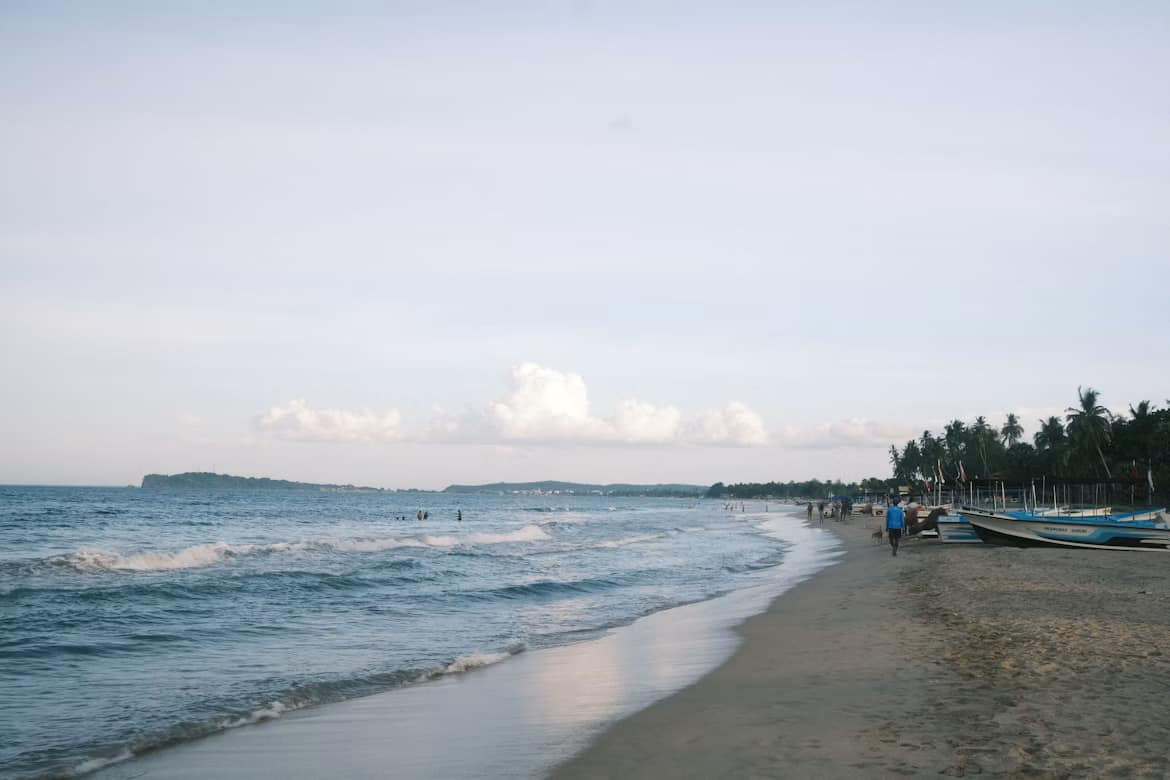
Trincomalee, Nilaveli, Uppuveli and Pasikudah are at their best precisely when the south is at its worst, and this is the substitution that keeps a first trip intact. The beaches here are wide and calm, and in season the sea is noticeably gentler than the south coast ever gets.
Pigeon Island National Park, a short boat ride off Nilaveli, is the standout attraction. It offers some of the most accessible snorkelling in Sri Lanka, with reef close to shore and reef sharks frequently seen. Visitor numbers are capped and the reef has suffered from pressure, so go early and never stand on the coral.
Arugam Bay, further south on the east coast, has its surf season in roughly the same window and is the main draw for surfers. Trincomalee also runs its own whale watching season, roughly May to October, which mirrors the Mirissa calendar.
- →Nilaveli and Uppuveli offer wide, calm beaches, quieter than southern equivalents.
- →Pigeon Island gives accessible snorkelling with reef close to shore.
- →Arugam Bay surf season falls in roughly the same window.
- →Whale watching off Trincomalee runs roughly May to October.
The elephant Gathering
The strongest wildlife argument for these months is the Gathering at Minneriya and Kaudulla, near the Cultural Triangle. As the dry season advances and reservoir water recedes, large numbers of elephants congregate on the exposed grassland at the water's edge.
It is generally strongest in the drier months from roughly June to September, though it depends entirely on rainfall and is never guaranteed. Which of the two parks is better on a given day varies with water levels, and local guidance on the day is worth more than any advance assumption.
The practical advantage is that this costs nothing in itinerary terms. Minneriya and Kaudulla sit roughly an hour from a Sigiriya or Habarana base, so an afternoon drive attaches to a Polonnaruwa morning without adding a night.
- →Elephants congregate at receding reservoir edges as the dry season advances.
- →Generally strongest roughly June to September; dependent on rainfall.
- →Whether Minneriya or Kaudulla is better varies with water levels on the day.
- →Roughly an hour from a Sigiriya or Habarana base, so it needs no extra night.
The quiet, which is undersold
The ancient sites in these months are considerably quieter than in the December to March peak. Sigiriya, Polonnaruwa and Anuradhapura all carry far fewer visitors, which changes the experience of each more than the weather does.
The same applies to Ella, where the Nine Arch Bridge crowds thin noticeably, and to Galle, where the fort remains pleasant in rain and is genuinely peaceful once the coach groups stop arriving. Galle is the one south coast stop that holds up well in this season.
Accommodation rates are also lower across the south and hill country, and availability is easier at short notice. For travellers whose dates are fixed and who would rather trade beach conditions for space and value, this is a reasonable bargain rather than a compromise.
- →Sigiriya, Polonnaruwa and Anuradhapura are markedly quieter than in peak season.
- →The Nine Arch Bridge crowds thin noticeably at Ella.
- →Galle Fort works well in rain and is peaceful without coach groups.
- →Rates are lower and short-notice availability is easier across the south and hills.
How to adapt the standard route
The cleanest adaptation is to keep the inland route unchanged and move the coastal stop east. Run the Cultural Triangle, Kandy and the hill country as normal, then attach Trincomalee as a spur rather than a finish, since it sits roughly three to three and a half hours from Sigiriya but five to six from the airport.
A common shape is airport, Cultural Triangle for three nights, Trincomalee for three nights, back through Kandy and the hill country, then a final night near the airport. It involves more backtracking than the southern loop, which is the price of the east coast in season.
Travellers who would rather not reshape the route can keep the south coast and treat Galle rather than Mirissa as the beach stop, accepting that swimming will be limited. That works better than most guides suggest, provided the expectation is architecture and atmosphere rather than sea time.
- →Keep the inland route; move the coastal stop east to Trincomalee or Nilaveli.
- →Attach Trincomalee as a spur from the Cultural Triangle, not as the final stop.
- →Expect more backtracking than the standard southern loop.
- →If keeping the south, favour Galle over Mirissa and plan around the fort.
Planning a May to September first trip
The mistake to avoid is planning this season as though it were a compromised version of December to March. It is a different trip: east coast rather than south, the Gathering rather than blue whales, quieter ruins rather than perfect beaches.
Lankan Stays and Trails builds these months around the Cultural Triangle and the east, and we say plainly when a client's fixed dates and beach expectations do not match. Sri Lanka's two monsoons mean there is nearly always a coast worth visiting, but it is rarely the one people picture before they ask.
Frequently asked questions
Is Sri Lanka worth visiting in July or August?
Yes, with the east coast rather than the south. The south-west monsoon affects the south, west and hill country, but Trincomalee, Nilaveli and Pigeon Island are in season, the Minneriya elephant Gathering peaks, and the ancient sites are far quieter than in peak season.
Where should I go in Sri Lanka in June?
The Cultural Triangle, the east coast around Trincomalee and Nilaveli, and Minneriya or Kaudulla for the elephant Gathering, which is generally strongest from roughly June to September. Yala is also still in its stronger leopard window until around July.
Does it rain all day in Sri Lanka during the monsoon?
Rarely. Rain usually arrives as heavy afternoon or evening downpours lasting an hour or two, with clear mornings before them. This is why sightseeing in Sri Lanka is built around early starts regardless of season, which mitigates most weather disruption.
Is the south coast of Sri Lanka bad in the monsoon?
For swimming, often yes: swell and rip currents make the sea frequently unsafe and whale trips from Mirissa largely stop. Galle is the exception, as the fort remains pleasant in rain and is considerably quieter without the peak-season coach groups.
When is the Minneriya elephant Gathering?
Generally strongest in the drier months from roughly June to September, when receding reservoir water draws elephants onto the exposed grassland. It depends on rainfall and is never guaranteed, and whether Minneriya or Kaudulla is better varies with water levels.
Is Sri Lanka cheaper in the off season?
Generally yes across the south coast and hill country, with lower rates and easier short-notice availability than the December to March peak. The east coast runs its own high season in these months, so rates around Trincomalee follow the opposite pattern.
How do I adapt a Sri Lanka itinerary for the monsoon?
Keep the inland route unchanged and move the coastal stop east. Attach Trincomalee as a spur from the Cultural Triangle, since it sits roughly three to three and a half hours from Sigiriya but five to six hours from the airport.