
Quick answer
Between December and March, all ten of Sri Lanka's best-known places are in good condition, and the south coast is at its best. Sigiriya, Dambulla, the ancient capitals, Kandy, Nuwara Eliya, Ella and the safari parks are all reliable, and Galle and Mirissa have calm seas with blue whale trips running roughly November to April. This is peak season, so accommodation, train seats and the Sigiriya climb all reward early starts and early booking.
Key takeaways
- The north-east monsoon leaves the south and west dry, so the standard anticlockwise route needs no substitutions.
- Blue whale watching off Mirissa runs roughly November to April, overlapping this window almost exactly.
- This is peak season, so reserved train seats on the Kandy to Ella line sell out well ahead.
- Yala is in its stronger leopard window from roughly February onwards as conditions dry out.
- The east coast, including Trincomalee, is under the north-east monsoon and should be avoided in these months.
Why December to March is the standard window
Between December and March the north-east monsoon affects the north and east of Sri Lanka, leaving the south, west and hill country comparatively dry. Since the standard first-trip loop runs through exactly those areas, the whole route lines up in good condition at once.
That alignment is the reason this period carries the highest visitor numbers, the highest accommodation rates and the busiest sites. It is genuinely the most reliable window, and the crowding is the price of that reliability rather than an accident of scheduling.
For travellers arriving from the northern-hemisphere winter, the appeal is straightforward: daytime temperatures on the coast are warm, humidity is lower than in the inter-monsoon months, and the sea on the south coast is at its calmest.
- →The north-east monsoon affects the north and east, leaving the standard route dry.
- →The highest visitor numbers and accommodation rates of the year.
- →Lower humidity than the inter-monsoon months.
- →The south coast sea is at its calmest in this window.
The south coast at its best
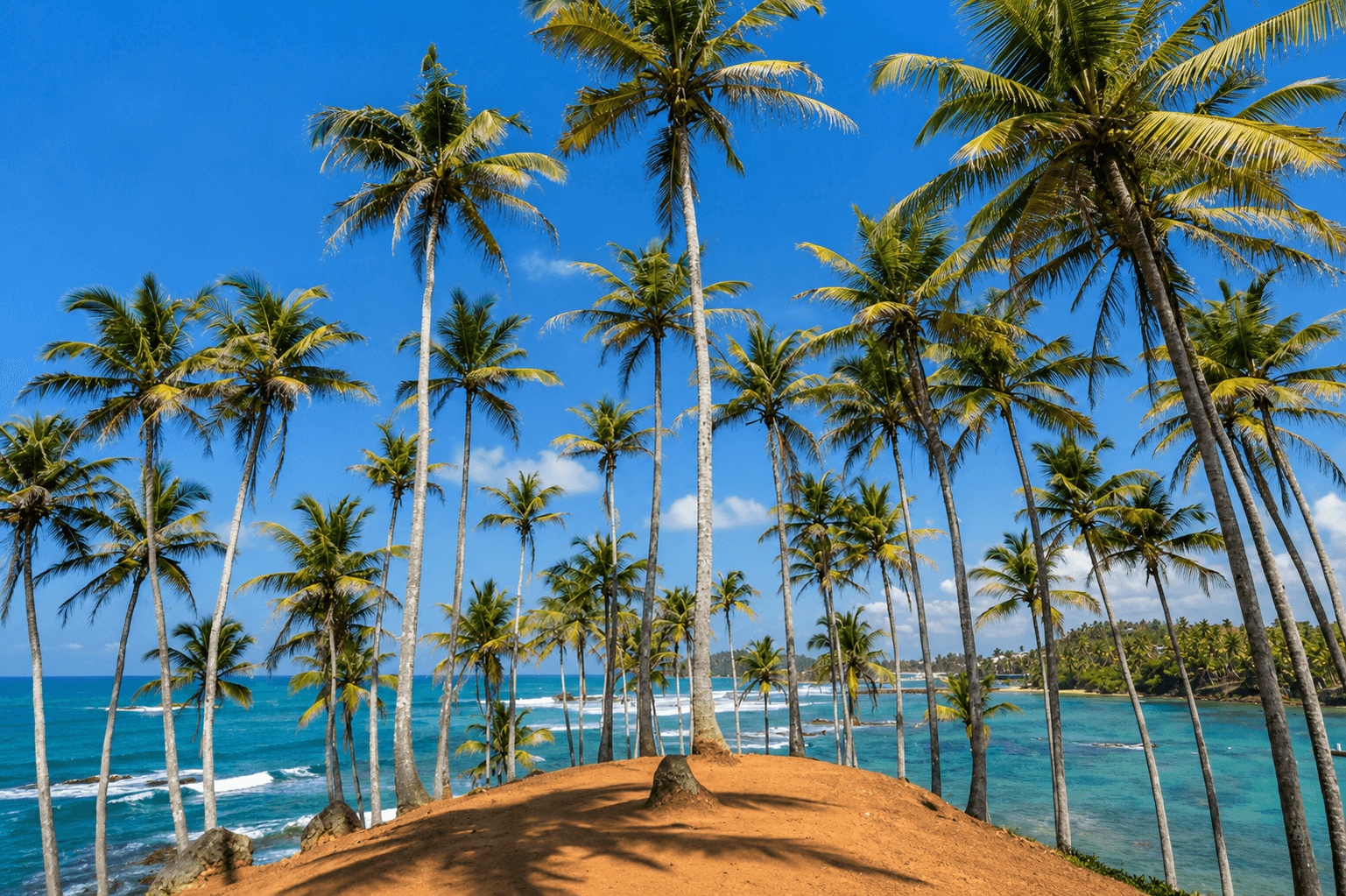
This is the window in which Galle, Unawatuna, Mirissa, Talalla and Tangalle all deliver what the photographs promise. Seas are calm enough for comfortable swimming, and the beaches are at their widest before the monsoon swell reshapes them.
Blue whale watching off Mirissa runs roughly November to April, overlapping this window almost exactly. Boats typically leave around six in the morning and trips run three to five hours. Seasickness is common even in calm conditions, so take precautions the night before rather than on the boat.
The trade-off is company. Mirissa in January is a busy beach with a loud central strip, and the fort at Galle carries coach groups through the middle of the day. Both problems are solved by timing: the ends of Mirissa beach and the fort after five in the afternoon are quite different places.
- →Calm seas and wide beaches from Galle through to Tangalle.
- →Blue whale season off Mirissa runs roughly November to April.
- →Whale boats typically leave around six in the morning; trips last three to five hours.
- →Crowding is real but largely solved by visiting early or late in the day.
Inland in the peak window
The Cultural Triangle is reliable throughout, with the caveat that it is hot. Sigiriya at opening, typically around seven in the morning, is the difference between a pleasant climb and a hard one, and this matters more as the window progresses towards March.
The hill country is at its clearest in these months, which is significant for Horton Plains. The World's End view depends on getting there before cloud fills the valley, and the drier air of January and February gives better odds than the monsoon months do. It still requires a start well before dawn.
Nuwara Eliya is genuinely cold at roughly 1,900 metres, and this is the coldest part of the year there, with overnight temperatures capable of falling into single figures Celsius. Most hotels have no heating. A warm layer is worth packing even for a trip that is otherwise tropical.
- →The Cultural Triangle is reliable but hot; climb Sigiriya at opening.
- →The hill country is at its clearest, giving better odds at World's End.
- →Horton Plains still needs a start well before dawn to beat the cloud.
- →Nuwara Eliya is at its coldest; pack a warm layer and expect unheated rooms.
Wildlife in this window
Yala enters its stronger period from roughly February onwards, as conditions dry and wildlife concentrates around remaining waterholes. December and January are still productive but slightly less predictable than the February to July stretch.
Udawalawe is reliable throughout the year for elephants, and it remains the better choice for families and for anyone who would rather have near-certain sightings than a leopard attempt.
Minneriya and Kaudulla near the Cultural Triangle are at their weakest in this window. The elephant Gathering is generally strongest in the drier months from roughly June to September, so travellers in January should not build expectations around it.
- →Yala strengthens from roughly February as waterholes concentrate wildlife.
- →Udawalawe delivers reliable elephant sightings year-round.
- →Minneriya and Kaudulla are at their weakest; the Gathering peaks roughly June to September.
- →No operator can guarantee a leopard; treat any guarantee as a warning sign.
What to book early in peak season
Three things sell out in this window and cause genuine disruption when missed. Reserved seats on the Kandy to Ella train are the most commonly underestimated: they go well ahead in high season, and unreserved carriages can be standing room only for six or seven hours.
Accommodation inside Galle Fort is the second. The number of rooms within the walls is limited, and the fort is at its best precisely when day visitors have left, which requires staying there.
The third is anything falling over Christmas and the New Year, when both international and domestic demand peak. Rates rise sharply and availability tightens across the south coast in particular. Book that period considerably further ahead than you would otherwise.
- →Reserved train seats on the Kandy to Ella line sell out well ahead.
- →Rooms inside Galle Fort are limited in number and book out early.
- →Christmas and New Year see the sharpest rates and tightest availability.
- →Whale trips can be cancelled for weather, so allow a spare morning at Mirissa.
Planning a peak season first trip
In this window the planning work is not about choosing destinations, since all ten are available, but about timing within each day and booking ahead. Early starts at Sigiriya, the Nine Arch Bridge and Horton Plains do more for the quality of a December to March trip than any change to the route would.
Lankan Stays and Trails runs the standard anticlockwise loop through this window without substitution, and concentrates the planning effort on scheduling sites at their quietest hours. It is the one season where the itinerary writes itself and the timetable does all the work.
Frequently asked questions
Is December to March the best time to visit Sri Lanka?
It is the most reliable window for the standard route, with the south and west coasts and hill country all dry. All ten of the best-known places are in good condition. It is also the busiest and most expensive period, so book accommodation and train seats early.
Where should I go in Sri Lanka in January?
The standard anticlockwise loop works exactly as written: Sigiriya and Dambulla, an ancient capital, Kandy, the hill country at Nuwara Eliya or Ella, a safari at Yala or Udawalawe, and the south coast at Galle or Mirissa. Avoid the east coast in this window.
Can you see blue whales in Sri Lanka in February?
Yes. Blue whale watching off Mirissa runs roughly November to April, so February falls well within the season. Boats typically leave around six in the morning for trips of three to five hours. No sighting can be guaranteed and weather cancellations happen.
Is Trincomalee good in December?
No. Trincomalee and the east coast sit under the north-east monsoon roughly November to February, which brings rain and rough seas. In this window the south coast is the correct choice, with the east becoming better from roughly May onwards.
How cold is Nuwara Eliya in January?
This is the coldest part of the year there. At roughly 1,900 metres, overnight temperatures can fall into single figures Celsius, and most hotels have no heating. Pack a warm layer, long trousers and closed shoes even though the rest of the trip is tropical.
Do I need to book the Kandy to Ella train in advance?
Yes, particularly in this window. Reserved seats sell out well ahead in high season, and unreserved carriages can be standing room only for six or seven hours. Book as early as practical and confirm timings locally, as timetables shift.
Is Sri Lanka crowded in peak season?
The main sites are, particularly the Nine Arch Bridge from mid-morning and Galle Fort through the middle of the day. Most of the crowding is solved by timing rather than avoidance: sites visited at opening or after five in the afternoon are far quieter.