
Quick answer
The best places to visit in Sri Lanka during an Australian cricket tour are the ones closest to the grounds: Galle Fort, Unawatuna and Mirissa around the Galle Test; Kandy, the Temple of the Tooth and the hill country near Pallekele; Colombo's Galle Face Green and Pettah between white-ball games; Sigiriya and Dambulla near the Dambulla stadium; and Yala National Park near Hambantota. A rest day of about 24 to 48 hours is enough for any of them.
Key takeaways
- Galle International Stadium sits beside Galle Fort, so a Test trip doubles as a stay in a UNESCO-listed Dutch fort town.
- Pallekele International Cricket Stadium is roughly 30 to 40 minutes from Kandy and the Temple of the Tooth.
- Rangiri Dambulla International Stadium is roughly 20 km from Sigiriya, close enough for a dawn climb before an afternoon game.
- The Hambantota stadium at Sooriyawewa is roughly an hour from Tissamaharama and the gates of Yala National Park.
- Australian tours have fallen either mid-year (June to September) or early in the year (January to March), and the season decides which coasts are at their best.
Where Australia plays in Sri Lanka, and what is next to each ground
Australian tours of Sri Lanka use a small set of international grounds, and each one sits beside a different part of the island. Galle International Stadium, the most regular Test venue for Australian tours, is on the south coast next to Galle Fort. Pallekele International Cricket Stadium is in the hills east of Kandy. The R Premadasa Stadium and the Sinhalese Sports Club are in Colombo.
Rangiri Dambulla International Stadium is in the dry zone near the Dambulla cave temple and Sigiriya, and the Mahinda Rajapaksa International Cricket Stadium at Sooriyawewa is inland from Hambantota, near Yala and the far south coast. Few cricket tours anywhere put a fan this close to a rock fortress, a leopard reserve and a colonial fort within one series.
Fixtures, formats and venues change every tour, so check the schedule from Sri Lanka Cricket and Cricket Australia before you book anything. The grounds themselves rarely change, and that is what makes it possible to plan the sightseeing around them.
- →Galle International Stadium: Galle Fort, Unawatuna, Jungle Beach and the south coast.
- →Pallekele: Kandy, the Temple of the Tooth, Peradeniya and the hill country.
- →R Premadasa and the SSC: Colombo's Galle Face Green, Pettah, Gangaramaya and the museums.
- →Dambulla: the Dambulla cave temple, Sigiriya, Pidurangala and Minneriya.
- →Hambantota: Yala, Bundala, Tissamaharama and Tangalle.
Galle and the south coast for the Tests
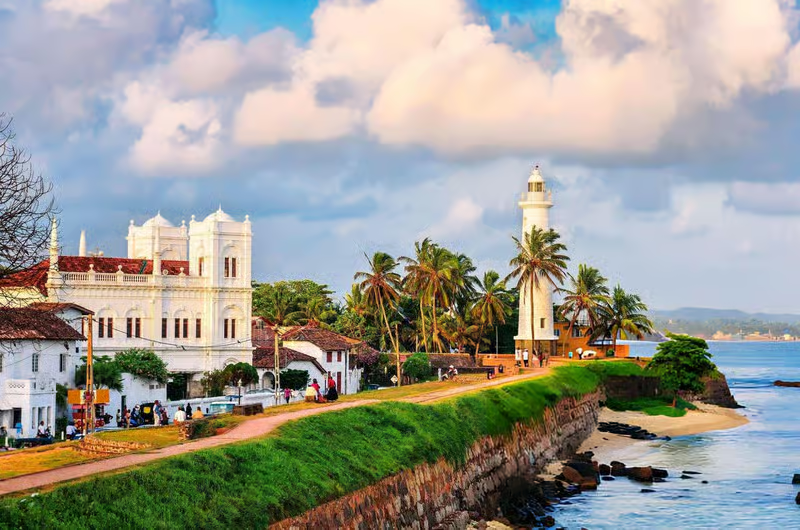
Galle and the south coast are the heart of most Australian Test trips to Sri Lanka. The stadium sits between the fort and the bus stand, and the Dutch fort, with its ramparts, lighthouse, churches and small museums, is a five-minute walk from the gate. Many fans stay inside the fort and walk to the cricket each morning.
Galle's beaches and villages are close by. Unawatuna is about 15 minutes east, Jungle Beach and the Rumassala headland are next to it, and Koggala, Ahangama and Weligama follow along the coast road. Mirissa, the whale-watching harbour, is about an hour away, which makes it a realistic rest-day trip during an early-year series.
The Galle ramparts are a viewing point in their own right. Fans have watched Tests from the walls above the ground for decades, and the walk round the fort at sunset is the natural end to a day's play.
- →Galle Fort: ramparts, lighthouse, Dutch Reformed Church and Maritime Museum.
- →Unawatuna and Jungle Beach: swimming and snorkelling in the calmer months.
- →Mirissa: whale-watching from roughly November to April.
Kandy and the hill country around Pallekele
Kandy and the surrounding hills are the base for any match at Pallekele International Cricket Stadium, which lies roughly 30 to 40 minutes east of the city. Kandy is Sri Lanka's last royal capital and home to the Temple of the Sacred Tooth Relic, one of the most important Buddhist sites in the world.
Around Kandy, the Royal Botanic Gardens at Peradeniya, the lake walk, the Udawattakele forest and the evening Kandyan dance shows fill a rest day easily. With two or three spare days, the train from Kandy into the tea country towards Nuwara Eliya and Ella is one of the great rail journeys in Asia.
Kandy also has the oldest Australian cricket link on the island. Australia's first Test in Sri Lanka was played at the Asgiriya Stadium in Kandy in 1983, and the ground still belongs to Trinity College.
- →Temple of the Tooth: visit for the evening puja after a day game.
- →Peradeniya Botanic Gardens: about 20 minutes from the city.
- →Kandy to Ella by train: a full day, best kept for after the cricket.
Colombo for the white-ball games
Colombo is where most day-night internationals are played, at the R Premadasa Stadium in Maligawatte, and the city's older grounds, the Sinhalese Sports Club and the P Sara Oval, have hosted many Tests. A Colombo leg usually means daytime free and evenings at the cricket.
Colombo's best daytime places are close together: Galle Face Green and the seafront, the Pettah bazaars, the Dutch Hospital and Fort district, Gangaramaya Temple, Viharamahadevi Park and the Colombo National Museum. Mount Lavinia's beach is about 30 minutes south for a swim or a sunset.
The city is also the easiest place to arrive and leave from. Bandaranaike International Airport is roughly 45 minutes to an hour north, so a Colombo leg at the start or end of a tour saves a long transfer.
Sigiriya, Dambulla and Yala near the other venues
Sri Lanka's two dry-zone venues are the ones that surprise visiting fans. Rangiri Dambulla International Stadium sits beside the Dambulla reservoir, roughly 20 km from Sigiriya, the fifth-century rock fortress. A morning climb of Sigiriya or its neighbour Pidurangala, followed by an afternoon game, is one of the best match days anywhere.
The Hambantota stadium at Sooriyawewa is roughly an hour from Tissamaharama, the town at the gates of Yala National Park, where leopards, elephants and sloth bears live. Udawalawe, with its large elephant herds, and the quiet beaches around Tangalle are also within reach.
- →Sigiriya Rock: allow about three hours for the climb and the water gardens.
- →Dambulla cave temple: about an hour, five caves of murals and statues.
- →Yala: a half-day jeep safari leaves at about 5.30 am.
Planning the sightseeing around the schedule
The best way to plan a cricket trip to Sri Lanka is to fix the match days first and build the sightseeing into the gaps. Test series usually have three or four days between matches, and Galle Tests often finish inside four days, which frees up more. White-ball series move faster, with games every two or three days.
Mid-year tours fall in the southwest monsoon, so Galle and Colombo can be wet, while the east coast at Trincomalee and Arugam Bay is at its best. Early-year tours fall in the southwest's dry season, the best time for Galle, Mirissa and the south coast.
Lankan Stays & Trails builds private, driver-guided trips around a tour's fixtures, with the sightseeing fitted to rest days and the transfers timed for the grounds.
- →Test series: plan one or two outings per gap, and a spare day for an early finish.
- →White-ball series: plan half-days near the ground on match days.
- →Mid-year: add the east coast; early year: add Mirissa and the south coast.
Frequently asked questions
What are the best places to visit in Sri Lanka during a cricket tour?
The best places are the ones near the grounds: Galle Fort and Unawatuna for the Galle Tests, Kandy and the Temple of the Tooth for Pallekele, Colombo's seafront and Pettah for Premadasa, Sigiriya for Dambulla and Yala for Hambantota. Each is within about an hour of its ground.
Where does Australia usually play Tests in Sri Lanka?
Galle International Stadium has been the most regular Test venue on Australian tours, and the Sinhalese Sports Club in Colombo and Pallekele near Kandy have also hosted Australian Tests. Venues change each tour, so check the schedule from Sri Lanka Cricket before booking flights or hotels.
When do Australian cricket tours of Sri Lanka usually happen?
Australian tours have fallen in two windows: mid-year, roughly June to September, as in 2011, 2016 and 2022, and early in the year, as in 2004 and 2025. The timing decides the weather, with early-year tours dry in Galle and mid-year tours dry on the east coast.
Can you combine a Test in Galle with a safari?
You can. Yala National Park is roughly three hours from Galle by the Southern Expressway and the coast road, so a two-night trip to Tissamaharama fits between Tests in a series. A morning safari, a rest and an afternoon drive make a full day.
How far is Pallekele stadium from Kandy?
Pallekele International Cricket Stadium is roughly 30 to 40 minutes by road east of Kandy city, depending on traffic. Most fans stay in Kandy and travel by tuk-tuk, taxi or private driver. Allow extra time on match days, when the roads near the ground are busy.
Is Sri Lanka a good place to follow a cricket tour?
Sri Lanka is one of the most rewarding places to follow a tour, because the grounds are close to beaches, temples, wildlife parks and colonial towns, and the island is small enough to cross between legs in a day. Crowds are friendly, and cricket is the national passion.
Does Lankan Stays & Trails arrange cricket tour trips?
Yes. Private, driver-guided trips are built around a cricket series, with hotels near the grounds, transfers on match days and sightseeing on rest days. Match tickets are bought through official channels, and the itinerary is adjusted if a Test finishes early or rain changes plans.