
Quick answer
The best places to visit in Sri Lanka are Sigiriya, Dambulla, Anuradhapura and Polonnaruwa in the ancient heartland; Kandy, Nuwara Eliya, Ella and Haputale in the hills; Sinharaja rainforest; Yala, Udawalawe and Wilpattu for wildlife; Galle, Mirissa and Tangalle in the south; Trincomalee, Pasikudah and Arugam Bay in the east; and Jaffna in the north. Choose by season: south and west from roughly December to March, east and north from roughly May to September.
Key takeaways
- Sri Lanka has nine provinces, and each has at least one place worth a night.
- The ancient cities and Sigiriya sit in the dry north-central plains; the tea country rises in the centre.
- The south and west coasts are best roughly December to March, the east roughly May to September.
- Jaffna, the north and the deep east reward travellers who have seen the classic circuit.
- Drive times are longer than the map suggests, so choose regions rather than ticking off places.
How Sri Lanka's places are arranged
Sri Lanka's best places fall into clear regions, and seeing them that way makes planning easier. The dry plains of the north-central interior hold the ancient capitals and the rock of Sigiriya. The mountains rise in the south-centre, with Kandy on their northern edge and the tea towns of Nuwara Eliya, Ella and Haputale higher up. The coast wraps all of this, but its two halves have opposite seasons.
Administratively the island has nine provinces, and they map surprisingly well onto travel regions. The North Central Province is the ancient heartland. Central and Uva share the hill country. Sabaragamuwa holds the rainforest and the gem country. The Southern, Western and Eastern provinces hold most of the beaches, and the Northern Province is a Tamil-speaking world of its own.
Thinking in regions rather than in famous names also protects you from the most common planning mistake: trying to see everything. A good two-week trip usually covers three or four regions well rather than eight badly.
- →Ancient heartland: Anuradhapura, Polonnaruwa, Sigiriya, Dambulla.
- →Hill country: Kandy, Nuwara Eliya, Ella, Haputale, the Knuckles.
- →Coasts: the south and west in the northern winter, the east in summer.
The ancient heartland and Sigiriya
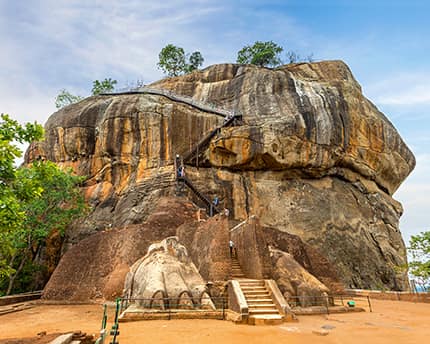
Sigiriya is the image most people carry of Sri Lanka: a fifth-century palace on a sheer rock, reached by roughly 1,200 steps past frescoes and the giant lion's paws. Pidurangala, the rock next door, gives the view back. The cave temple at Dambulla, with its painted ceilings and rows of Buddhas, lies less than an hour away.
Anuradhapura was the island's capital for over a thousand years. Its great white stupas, the sacred Bo tree and the forest monasteries are best seen by bicycle over a full day. Polonnaruwa, the later medieval capital, is more compact, with the carved Buddhas of the Gal Vihara and a huge ancient reservoir beside the ruins.
Between them lie Minneriya and Kaudulla, where elephants gather on the reservoir shores in the dry months, and quieter sites such as Ritigala, Avukana and Mihintale that most tour buses skip.
- →Sigiriya and Pidurangala: two rocks, one sunrise.
- →Anuradhapura: the oldest capital and the sacred Bo tree.
- →Polonnaruwa: compact ruins and the Gal Vihara Buddhas.
- →Minneriya: the elephant gathering, roughly July to October.
Kandy and the hill country
Kandy, the last royal capital, is home to the Temple of the Sacred Tooth Relic and sits around a lake ringed by green hills. Peradeniya's botanical gardens are just outside the city, and the Knuckles Range offers serious trekking within two hours.
Climbing south, the hills turn into tea estates. Nuwara Eliya is the old British hill station, cool and misty, with Horton Plains and the walk to World's End nearby. Ella is smaller and livelier, with Little Adam's Peak, Ella Rock and the Nine Arch Bridge within walking distance. Haputale, perched on a ridge, has the widest views of all from Lipton's Seat.
The railway between Kandy and Ella threads through all of this and is a destination in its own right. Adam's Peak, the sacred mountain climbed overnight by pilgrims, rises at the western end of the hills.
- →Kandy: the Temple of the Tooth and the lake.
- →Nuwara Eliya and Horton Plains: cool air and high plateau.
- →Ella and Haputale: walks, viewpoints and the train.
Rainforest and wild places
Sinharaja, a UNESCO-listed rainforest in the wet south-west, is the place to see Sri Lanka's endemic birds, lizards and trees. Kitulgala, closer to Colombo, adds white-water rafting and forest walks on the Kelani River.
For big animals, Yala is famous for leopards and busy jeeps; Udawalawe is the most reliable park for elephants; Wilpattu, in the north-west, is larger, slower and quieter. In the east, Kumana and Gal Oya are wilder still, and Gal Oya offers the rare sight of elephants swimming between islands in a reservoir.
Off the coast, Mirissa is the base for blue whale trips from roughly December to April, and Trincomalee takes over in the spring months on the other side of the island.
The south, west and east coasts
The south coast runs from Galle's Dutch fort past Unawatuna, Mirissa and Tangalle to the edge of Yala. It is at its best roughly December to March. The west coast, with Bentota, Beruwala and Negombo, shares that season and is closer to the airport.
The east coast flips the calendar. Trincomalee, with Nilaveli and Pigeon Island, Pasikudah's shallow bay and the surf town of Arugam Bay are at their best roughly May to September, when the south-west monsoon is roughening the other side.
This two-coast pattern is the single most useful fact in Sri Lankan planning: somewhere on the island the sea is almost always calm.
- →December to March: Galle, Mirissa, Tangalle, Bentota.
- →May to September: Trincomalee, Pasikudah, Arugam Bay.
- →October and November: rain in most places, so keep plans flexible.
The north and the regions most trips miss
The Northern Province, centred on Jaffna, feels like another country within Sri Lanka. Hindu temples such as Nallur Kandaswamy Kovil, a Dutch fort, crab curry and the quiet islands of Nainativu and Delft make two or three nights here memorable. Mannar, with its baobab trees and long causeway, is wilder still.
Other regions are underrated rather than remote. The North Western Province has Kalpitiya's dolphins and lagoon, the old capitals around Kurunegala and Yapahuwa's stone staircase. Sabaragamuwa has the gem pits of Ratnapura and waterfalls around Belihuloya. Inland Uva has Buduruwagala's rock carvings and the pilgrimage town of Kataragama.
Lankan Stays & Trails builds trips around these regions, pairing a classic circuit with one less-visited area. That one addition is often the part of a trip people talk about afterwards.
- →Jaffna and the islands: Tamil culture and quiet coast.
- →Kalpitiya and Wilpattu: dolphins, lagoons and leopards.
- →Ratnapura and Belihuloya: gems, rivers and waterfalls.
Frequently asked questions
What is the most beautiful place in Sri Lanka?
The most beautiful place in Sri Lanka depends on taste, but the tea country around Ella and Haputale is the most common answer, with misty ridges and estates falling away to the plains. Sigiriya at sunrise from Pidurangala and the bays of the south coast are close behind.
How many places can I visit in Sri Lanka in two weeks?
In two weeks most travellers comfortably see five or six bases: for example Sigiriya, Kandy, Ella or Nuwara Eliya, a safari park and one or two beaches. Trying to add more usually means long days in the car. Three or four regions done well beat eight done quickly.
Which part of Sri Lanka is best to visit?
The best part of Sri Lanka to visit depends on the month. From roughly December to March, the Cultural Triangle, the hill country and the south coast are ideal. From roughly May to September, the Cultural Triangle and hills still work, but the east coast replaces the south for beaches.
Is the north of Sri Lanka worth visiting?
The north of Sri Lanka is worth visiting for travellers interested in culture. Jaffna's Hindu temples, food, Dutch fort and islands feel distinct from the rest of the island. It is roughly seven to eight hours from Colombo by road or rail, so allow at least two or three nights.
What are the must-visit places in Sri Lanka?
The places most travellers protect are Sigiriya, Kandy, the Kandy to Ella train, Ella, a safari park such as Yala or Udawalawe, and Galle on the south coast. With more time, add Anuradhapura or Polonnaruwa, Sinharaja, Trincomalee or Jaffna depending on the season.
Where should I go in Sri Lanka for nature?
For nature in Sri Lanka, go to Sinharaja rainforest for endemic wildlife, Horton Plains and the Knuckles Range for high-country walking, and Udawalawe, Wilpattu or Gal Oya for elephants and big parks. Whale watching from Mirissa or Trincomalee adds the ocean side.
Is it better to stay in one place or move around Sri Lanka?
Moving around Sri Lanka gives far more variety, because the island's regions differ so much in landscape and climate. Most travellers enjoy two or three nights per base. Staying in one place suits a beach holiday, but even then a few day trips inland are worth the effort.