
Quick answer
The culture, wildlife and beach route uses two beach bases: Tangalle (two nights), quiet and spacious, close to Yala, and Mirissa (two nights), livelier, with the whale-watching harbour. Galle Fort is visited on the last morning. The pairing gives calm and company, short moves and whales. From May to September, the beaches move to the east coast: Trincomalee or Nilaveli and Pasikudah. Alternatives include Hiriketiya, Weligama, Unawatuna and a Galle Fort night.
Key takeaways
- Tangalle is quiet and spacious, roughly one to one and a half hours from Tissamaharama.
- Mirissa is livelier, with the whale-watching harbour and a sheltered swimming bay.
- Two different beaches give variety and short moves of an hour or so.
- Galle Fort, visited on the last morning, adds culture to the beach days.
- From May to September the beaches move to Trincomalee or Nilaveli and Pasikudah.
The logic of two beaches
After nine days of temples and safaris, most travellers want two things from the beach: rest and a little life. Tangalle provides the rest, with long bays, palms and low-key hotels. Mirissa provides the life, with cafés, a crescent beach and the harbour for whale watching. Splitting four nights between them gives both moods.
The geography helps. Tangalle is the nearest good beach to Yala, roughly one to one and a half hours away, so the move from the safaris is short. Mirissa is roughly an hour west, and Galle a further hour, on the way to the airport. Every move is short.
The route deliberately avoids the long beach strips of the west coast, which are less attractive and further from the parks.
- →Tangalle: rest.
- →Mirissa: life and whales.
- →Galle: culture on the way home.
Tangalle
Tangalle is the quietest major beach area on the south coast. Its beaches stretch either side of a busy fishing town, with sheltered coves such as Goyambokka and Silent Beach and long, wild bays such as Marakolliya and Medaketiya. Development is low-key: villas, small hotels and simple beach restaurants.
Swimming is best in the sheltered coves; the open bays can have strong waves and currents. Nearby are Mulkirigala rock temple, the Rekawa turtle watch and the Hummanaya blowhole. Tangalle suits travellers who want space and quiet.
- →Sheltered coves: Goyambokka and Silent Beach.
- →Wild bays: Marakolliya and Medaketiya.
- →Nearby: Mulkirigala, Rekawa, Hummanaya.
Mirissa
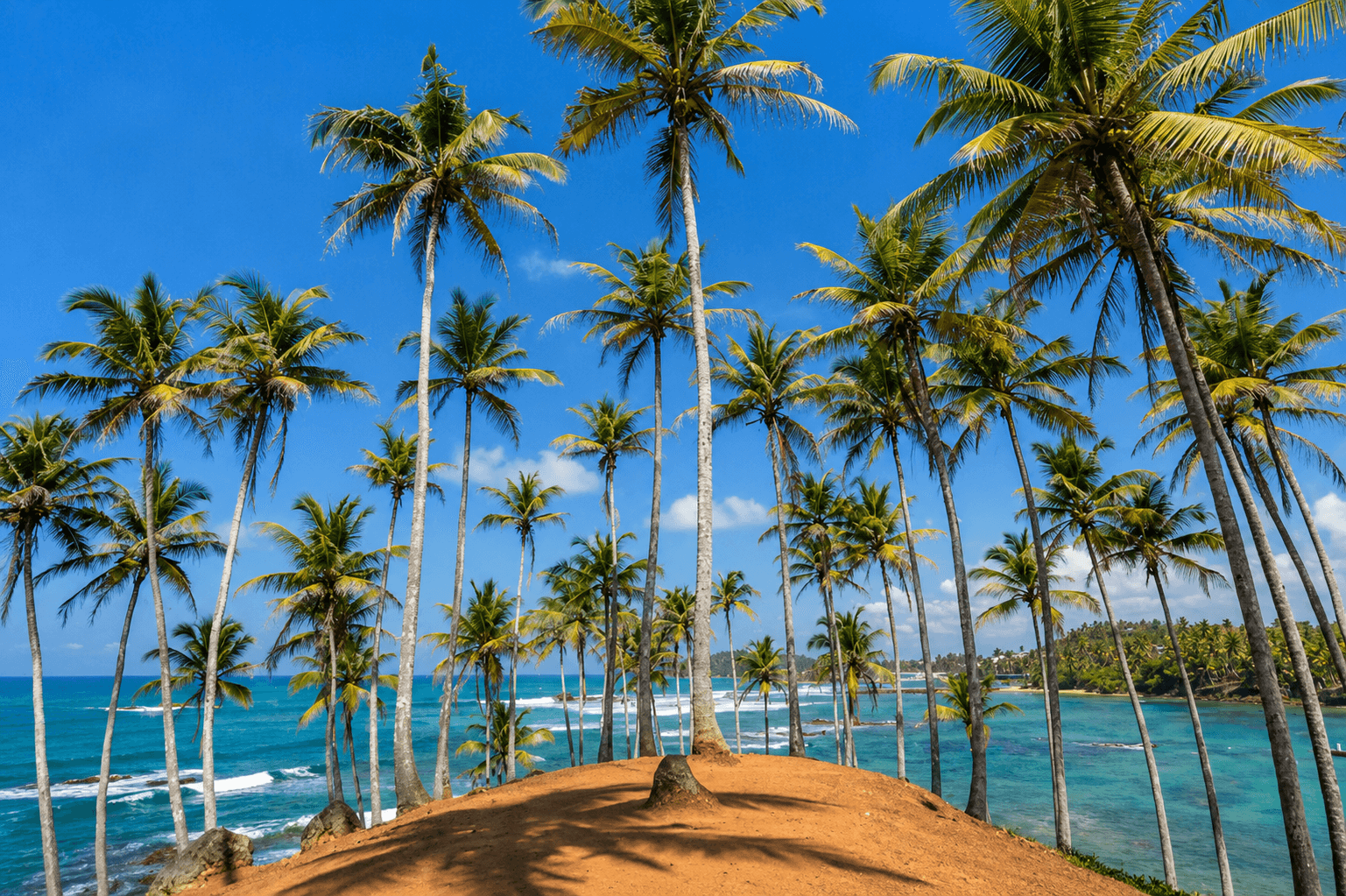
Mirissa has a curving bay with a sheltered western end, a palm-covered headland at Coconut Tree Hill and Parrot Rock at the other end. The beach is lined with cafés, bars and guesthouses, and the evenings are social, with seafood dinners on the sand. The harbour is the base for whale watching.
Mirissa can feel busy in peak season. The quieter ends of the bay, or nearby Weligama and Talalla, offer more space. Mirissa suits travellers who enjoy a lively atmosphere for a few nights.
For whale watching, staying in Mirissa itself means a short walk or tuk-tuk ride to the harbour before dawn, which makes the early start far easier. Hotels on the hill above the bay have views and breezes; those on the beach are closer to the swimming and the restaurants.
Alternatives on the south coast
Hiriketiya, a small horseshoe bay near Dickwella, is a stylish alternative to Tangalle, with gentle surf and a relaxed café scene. Weligama, with a long, shallow bay, is the best place to learn to surf and suits families. Unawatuna, near Galle, has a sheltered bay good for swimming and a lively village.
A night inside Galle Fort, instead of the second Mirissa night, turns the last day into a full cultural experience. Lankan Stays & Trails can suggest the best combination for your interests and season.
Travellers who want total seclusion can choose a villa on a quiet stretch between Tangalle and Dickwella.
- →Hiriketiya: stylish, gentle surf.
- →Weligama: learn to surf, family-friendly.
- →Unawatuna: sheltered swimming.
- →Galle Fort: history and lanes.
The east coast in summer
From roughly May to September, the south coast is in monsoon and the beaches move to the east. Trincomalee and Nilaveli have long white beaches and Pigeon Island for snorkelling. Uppuveli is livelier. Pasikudah has a long, shallow bay where you can wade far out, ideal for families.
Arugam Bay, further south, is the east coast's surf centre in this season and suits surfers and younger travellers.
The east-coast beaches have a different feel from the south: quieter, more local and with fewer restaurants on the sand. Most travellers eat at their hotel. In return, the sea is calm and clear in summer, and the beaches are often almost empty outside July and August.
- →Nilaveli: quiet, Pigeon Island.
- →Uppuveli: livelier.
- →Pasikudah: shallow and calm.
- →Arugam Bay: surf.
Frequently asked questions
Why does the route use Tangalle and Mirissa?
They offer two different moods: Tangalle is quiet and spacious, Mirissa lively with whale watching. Tangalle is also the nearest good beach to Yala, and Mirissa sits on the way to Galle and the airport, so every move is short.
Which is better, Tangalle or Mirissa?
It depends on taste. Tangalle is better for peace, space and long walks. Mirissa is better for whale watching, cafés and a social atmosphere. The route uses both, which is why many travellers enjoy the beach days so much.
Can I stay at one beach instead of two?
Yes. Four nights in one place means one fewer move. Mirissa is the better single base because of the whale-watching harbour; Tangalle is better for peace. Some travellers split the difference with Hiriketiya, between the two.
Which beach is best for swimming?
Sheltered spots such as Goyambokka near Tangalle, the western end of Mirissa bay and Unawatuna are usually safest in season. Open bays can have strong currents. Always ask locally and watch for red flags.
What are the alternatives to Tangalle?
Hiriketiya, a small bay near Dickwella with gentle surf, and the villas between Tangalle and Dickwella are good alternatives. Both are close to Yala and Mirissa, so the route's moves stay short.
Which beaches should I use from May to September?
The east coast: Trincomalee, Nilaveli or Uppuveli, and Pasikudah. The sea is usually calm and the weather dry. Arugam Bay suits surfers. The May to September version of the route uses Trincomalee or Nilaveli for three nights and Pasikudah for two.
Should the quiet beach come first or last?
On this route, quiet Tangalle comes first because it is nearest to Yala, and lively Mirissa second because it is on the way to Galle and the airport. Travellers who want to end somewhere peaceful can swap Mirissa for Talalla or a villa, keeping the drives short.