
Quick answer
The ultimate 14-day route for culture, wildlife and beaches runs Anuradhapura 1 night, Sigiriya 3, Kandy 2, Udawalawe 1, Tissamaharama 2, Tangalle 2 and Mirissa 2, with Galle Fort on the way to the airport. It covers six UNESCO sites, three safari parks plus whale watching, and four beach nights. It leaves out the hill country to make room, and suits roughly December to April; a north and east version suits May to September.
Key takeaways
- The nights split as Anuradhapura 1, Sigiriya 3, Kandy 2, Udawalawe 1, Tissamaharama 2, Tangalle 2 and Mirissa 2: thirteen nights and seven check-ins.
- Days 1 to 6 are mostly culture, days 7 to 10 mostly wildlife and days 10 to 14 mostly beach, with a safari and whale watching threaded through.
- The route visits six of Sri Lanka's eight UNESCO World Heritage Sites: Anuradhapura, Sigiriya, Polonnaruwa, Dambulla, Kandy and Galle.
- Nuwara Eliya, Horton Plains, Ella and the scenic train are left out, which frees three nights for Anuradhapura, Udawalawe and a second Yala night.
- From May to September the route turns north and east: Wilpattu, Anuradhapura, Sigiriya, Trincomalee, Pasikudah and Kandy.
Why build a fortnight around culture, wildlife and beaches
Culture, wildlife and beaches are the three reasons most first-time visitors give for choosing Sri Lanka, and the island is unusual in offering all three within a day's drive of each other. The ancient cities of the dry zone, the national parks of the south and the beaches of the south coast form a rough arc that a driver can follow without doubling back.
The standard fortnight, set out in our ultimate 14-day Sri Lanka itinerary, spends four nights in the hill country for the tea estates, Horton Plains and the train to Ella. They are lovely, but they are a fourth theme. Travellers who care most about temples, animals and the sea can give those nights to the things they came for, and the route becomes calmer and more focused as a result.
The result is a trip with a clear shape. The first six days are about history and faith, the middle four are about wildlife, and the last four are about the sea, with an elephant safari early on and whale watching near the end so the themes overlap rather than sit in boxes.
- →Culture: Anuradhapura, Sigiriya, Polonnaruwa, Dambulla, Kandy and Galle Fort.
- →Wildlife: Minneriya or Kaudulla, Udawalawe, Yala, Bundala and blue whales off Mirissa.
- →Beaches: two nights at Tangalle and two at Mirissa, with swimming, snorkelling and turtles.
The route day by day
The route starts in the far north of the Cultural Triangle and works steadily south. Anuradhapura comes first because it is the oldest of the capitals and the furthest from the coast, so the long transfer from the airport is done on day 1 while you are still fresh. Three nights at Sigiriya then cover the rock, Polonnaruwa and an elephant safari, and Kandy follows on the road south.
Day 7 is the one long drive, roughly five to six hours from Kandy to Udawalawe, skirting the southern edge of the hills through Ratnapura. From there the safari parks come in a row, and the coast follows. Galle Fort is the last stop, visited on the morning of departure because it sits on the expressway to the airport.
- →Day 1: airport to Anuradhapura (roughly four to five hours); Sri Maha Bodhi at dusk.
- →Day 2: the sacred city by bicycle; afternoon drive to Sigiriya.
- →Day 3: Sigiriya Rock at opening; afternoon elephant safari.
- →Day 4: Polonnaruwa by bicycle; village walk or Pidurangala at sunset.
- →Day 5: Dambulla Cave Temple, then Kandy and the evening puja.
- →Day 6: Peradeniya, the lake and Kandyan dancing.
- →Day 7: Kandy to Udawalawe, the longest drive.
- →Day 8: Udawalawe dawn safari; on to Tissamaharama.
- →Day 9: a full day around Yala, or Yala and Bundala.
- →Day 10: Tissamaharama to Tangalle; beach afternoon.
- →Day 11: a slow day at Tangalle; Rekawa turtles at night.
- →Day 12: on to Mirissa; Coconut Tree Hill at sunset.
- →Day 13: whale watching; afternoon swim.
- →Day 14: Galle Fort, then the airport.
The culture: six UNESCO sites in six days
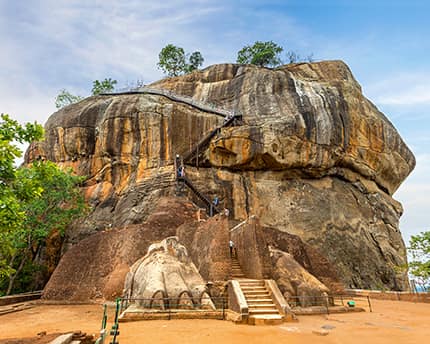
Few routes on the island pack in as much history as the first week of this one. Anuradhapura was the capital for more than a thousand years, and its great white stupas and the sacred Bo tree are still places of active worship. Sigiriya's rock citadel and Polonnaruwa's medieval city follow, then the painted caves of Dambulla and the Temple of the Sacred Tooth Relic in Kandy.
Seeing the capitals in chronological order is the quiet advantage of starting in Anuradhapura. The story moves from the earliest Buddhist monasteries to Sigiriya's fifth-century palace, the twelfth-century city at Polonnaruwa and finally the last Sinhalese kingdom at Kandy. Galle Fort, a Dutch and British trading town, closes the trip with a very different chapter.
The wildlife: three parks and the whales
Wildlife arrives in stages. The first safari is on day 3, at Minneriya, Kaudulla or Hurulu, where herds of wild elephants graze the grassland around the old reservoirs. Udawalawe on day 8 is the most reliable park in the country for elephants at close range, and Yala on day 9 is the best-known for leopards, with sloth bears, crocodiles and a huge variety of birds.
Two nights at Tissamaharama give Yala a full day rather than a rushed afternoon, which is the single biggest improvement over shorter routes. Bundala's lagoons, roughly 30 minutes away, are an easy alternative for the afternoon. Whale watching off Mirissa on day 13 completes the set, with blue whales seen on many mornings in roughly December to April.
- →Day 3: elephants in the Cultural Triangle parks.
- →Day 8: Udawalawe at dawn, elephants at close range.
- →Day 9: Yala for leopards, sloth bears and birds.
- →Day 13: blue whales and dolphins off Mirissa.
The beaches: Tangalle, Mirissa and the south coast
Four beach nights are split between two very different places. Tangalle has long, quiet bays and a relaxed, spread-out feel, ideal for recovering after the safaris. Mirissa is livelier, with a crescent of sand, cafés and the harbour for whale watching. Together they give both calm and company, and the move between them is only an hour or so.
The south coast is at its best in roughly December to April, when the sea is usually calm and clear. Swimming is safest in sheltered coves; the open bays near Tangalle can have strong currents, so swim where locals do and ask your hotel. Snorkelling, a turtle watch at Rekawa and sunset at Coconut Tree Hill fill the slower days.
- →Tangalle, two nights: quiet bays, Mulkirigala rock temple, Rekawa turtles.
- →Mirissa, two nights: whale watching, swimming, sunsets.
- →Galle Fort, a final morning: ramparts, lanes and cafés.
When to go, and who should change the route
The route is written for roughly December to April, when the south coast is calm, the whales are off Mirissa and the Cultural Triangle is dry from about January. February to April is the sweet spot for Yala. From May to September the south-west monsoon reaches the south coast, so the route turns north and east instead.
The May to September version runs Wilpattu 2, Anuradhapura 1, Sigiriya 3, Trincomalee or Nilaveli 3, Pasikudah 2 and Kandy 2, with the Minneriya elephant Gathering at its peak and whales off Trincomalee. Lankan Stays & Trails builds both versions with a private driver-guide, and can adjust the balance of the three themes for your dates and interests.
This is the fortnight we would build for travellers who want temples, safaris and beaches in equal measure. Hikers, tea lovers and anyone set on the train to Ella should choose the classic route instead, or add Ella back in by giving up Udawalawe.
Frequently asked questions
Is two weeks enough for culture, wildlife and beaches in Sri Lanka?
Yes. Two weeks is enough for all three if you leave out the hill country. This route gives six days to culture, four mostly to wildlife and four to the beach, with an elephant safari and whale watching threaded through, so none of the three themes feels squeezed.
Why does this route leave out Ella and Nuwara Eliya?
The hill country is a fourth theme, and it takes three or four nights. Leaving it out frees those nights for Anuradhapura, Udawalawe and a second night near Yala. Travellers who want tea estates and the scenic train can add Ella back by giving up Udawalawe.
How much driving does the route involve?
Roughly 24 to 28 hours over the fortnight, spread across seven moves. Most days have two hours or less. Day 1 (airport to Anuradhapura, roughly four to five hours) and day 7 (Kandy to Udawalawe, roughly five to six hours) are the two long days.
What is the best time of year for this route?
Roughly December to April, with February to April the best overall: the south coast is calm, Yala is in its prime season and whales are off Mirissa. From May to September, use the north and east version, which swaps the south coast for Trincomalee and Pasikudah.
How many safaris are included?
Three safaris are built in: an elephant safari in the Cultural Triangle on day 3, Udawalawe at dawn on day 8 and a full day around Yala on day 9. Whale watching off Mirissa on day 13 adds a fourth wildlife outing, and Bundala is an optional fifth.
Can I do this route without a private driver?
Partly. Anuradhapura, Kandy and the south coast are on rail or good bus routes, but Sigiriya, Udawalawe and Yala are not, and safaris need jeeps booked locally. A driver for the whole fortnight is simpler and, for two people, often similar in cost.