
Quick answer
Sri Lanka's most accessible coral reefs are Pigeon Island off Nilaveli on the east coast, the Bar Reef Marine Sanctuary off Kalpitiya in the north-west, and the Hikkaduwa Marine National Park sanctuary on the south-west coast. Pigeon Island offers the best snorkelling, in season from roughly May to September. The south-west reefs are best from November to April. Sri Lanka's reefs have been significantly damaged by bleaching events, most severely in 1998 and 2016, and recovery is uneven.
Key takeaways
- Pigeon Island off Nilaveli is Sri Lanka's most accessible and rewarding reef snorkelling, in season roughly May to September.
- Bar Reef off Kalpitiya is the country's largest reef system and is dived in the calm season, roughly December to April.
- The reefs on the south-west coast at Hikkaduwa, Rumassala and Unawatuna are best from November to April.
- Major bleaching events in 1998 and 2016 caused widespread coral mortality, and recovery has been uneven.
- Never stand on, touch or collect coral, and use mineral-based reef-safe sunscreen or a rash vest instead.
Where Sri Lanka's reefs are
Sri Lanka's reefs fall into three broad groups. Fringing coral reefs sit close to shore on the south-west and east coasts, at places like Hikkaduwa, Rumassala, Unawatuna, Polhena and Pigeon Island. The Bar Reef system off Kalpitiya in the north-west is the largest, a semi-barrier structure covering a substantial area. And there are sandstone and rock reefs, most famously the Great and Little Basses off the deep south, which are dramatic dive sites rather than snorkelling spots.
Because the reefs sit on opposite coasts, their seasons are opposite too. East coast reefs are calm and clear from roughly May to September. South-west coast reefs are calm and clear from roughly November to April. There is no month when all of them are good at once.
- →East coast: Pigeon Island, Nilaveli and Trincomalee area. Season roughly May to September.
- →North-west: Bar Reef Marine Sanctuary off Kalpitiya. Best roughly December to April.
- →South-west: Hikkaduwa, Rumassala, Unawatuna, Polhena. Season roughly November to April.
- →Deep south: Great and Little Basses rock reefs, advanced diving only, brief calm windows.
Pigeon Island: the best snorkelling reef
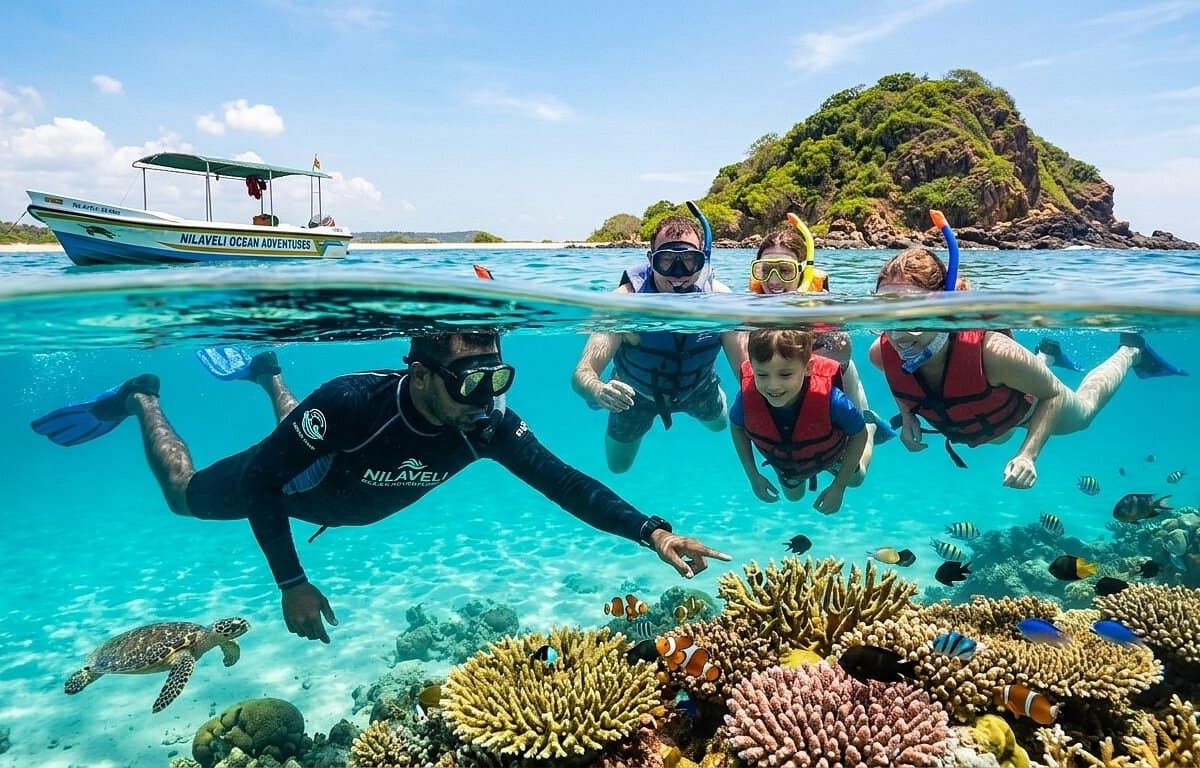
Pigeon Island National Park, a short boat ride off Nilaveli on the east coast, is the reef most visitors should aim for. The shallow lagoon on the island's sheltered side has living coral within a few metres of the sand, along with parrotfish, angelfish, surgeonfish and, reliably, blacktip reef sharks patrolling the shallows. They are small, harmless to people, and one of the most memorable things you will see with a mask on in Sri Lanka.
It is a protected national park with an entry fee, boat regulations and daily visitor limits, which help but do not eliminate pressure. The island gets busy from mid-morning. Take the earliest boat, stay off the coral, and consider the outer edge of the lagoon where there is more space and better structure.
- →Season: roughly May to September, best clarity in June and July.
- →Blacktip reef sharks in the shallows, plus dense reef fish life.
- →National park entry fee and boat rules apply; go on the first boat of the day.
- →Do not stand on the reef; the lagoon is shallow enough that people constantly do.
Bar Reef and the north-west
The Bar Reef Marine Sanctuary off Kalpitiya is Sri Lanka's largest reef complex and, in good conditions, offers the best visibility in the country. It supports high fish diversity and is reached by boat from the Kalpitiya peninsula in the calm season, roughly December to April.
Bar Reef suffered severely in the 1998 bleaching event, with reports of very high coral mortality across parts of the system, and again during the 2016 event. Recovery has been patchy. It is still a worthwhile dive and snorkel, particularly for fish life, but anyone expecting an intact Indian Ocean barrier reef will be disappointed.
The south-west reefs
Hikkaduwa Marine National Park is the most accessible reef on this coast, snorkellable straight off the beach without a boat, which is genuinely rare. Coral cover has declined substantially over the decades from bleaching, storm damage and visitor pressure, but fish life remains good and turtles are common.
Rumassala, the headland between Unawatuna and Jungle Beach, has rocky reef in sheltered water that suits nervous snorkellers. Polhena near Matara has a shallow reef-protected lagoon where turtles feed. None of these are spectacular reefs, but all are easy, safe and warm, and they are what the south-west coast has.
- →Hikkaduwa: shore-entry snorkelling in a protected sanctuary; fish and turtles.
- →Rumassala and Jungle Beach: sheltered rocky reef, good for beginners.
- →Polhena, Matara: shallow lagoon behind a reef, turtles common.
- →All follow the November to April season.
The honest picture on reef health
Sri Lanka's reefs have had a hard time. The 1998 El Nino bleaching event caused mass coral mortality across the Indian Ocean and hit Sri Lankan reefs particularly hard, with Bar Reef and Hikkaduwa among the worst affected. The 2004 tsunami caused physical damage in places. A further global bleaching event in 2016 set back much of the recovery that had occurred.
Layered on top are local pressures: destructive fishing practices in some areas, sedimentation from coastal development and river discharge, anchor damage, and simple visitor contact. The reefs that have done best are those with genuine protection and enforcement, which is the argument for paying the national park fees rather than resenting them.
None of this means you should not go. Reef tourism, done properly, is one of the strongest arguments a community has for protecting a reef. It means you should go with realistic expectations and behave well when you get there.
How to snorkel without damaging the reef
The single most damaging thing visitors do is stand on coral. In shallow lagoons like Pigeon Island the temptation is constant, and a moment of resting a foot down can break growth that took years. Wear fins, float, and if you need to rest, move to sand.
Sunscreen matters too. Oxybenzone and octinoxate, common in chemical sunscreens, are associated with coral harm. A long-sleeved rash vest is the most effective answer because it removes the need for sunscreen on your back and shoulders entirely; where you do need it, choose a mineral formulation based on non-nano zinc oxide.
- →Never stand on, touch, kick or hold coral. Rest on sand, not reef.
- →Wear a long-sleeved rash vest instead of applying sunscreen over your back.
- →Choose mineral, non-nano zinc oxide sunscreen where you do need it.
- →Do not feed fish, chase turtles, or collect shells and coral fragments.
- →Choose boat operators who use moorings or drift rather than dropping anchor on reef.
Planning reef time into a trip
If reefs matter to you, let them choose your dates. A May to September trip built around Nilaveli and Pigeon Island will give you far better snorkelling than a November to April trip built around the south-west, where the reefs are convenient rather than impressive.
Lankan Stays & Trails arranges Pigeon Island trips on the first boat of the morning and works with operators who brief properly and enforce no-contact rules. We would rather send you at dawn with a good guide than at eleven with a crowd.
Frequently asked questions
Where is the best coral reef in Sri Lanka?
Pigeon Island National Park, off Nilaveli on the east coast, offers the best and most accessible reef snorkelling, with living coral in a shallow lagoon and blacktip reef sharks in the shallows. Its season runs from roughly May to September, with the clearest water in June and July.
When is the best time to snorkel coral reefs in Sri Lanka?
It depends on the coast. East coast reefs including Pigeon Island are best from roughly May to September. South-west coast reefs at Hikkaduwa, Rumassala and Unawatuna are best from roughly November to April. Bar Reef off Kalpitiya is best from about December to April.
Has Sri Lanka's coral been bleached?
Yes, significantly. The 1998 El Nino event caused mass coral mortality across Sri Lankan reefs, particularly at Bar Reef and Hikkaduwa, and a further global bleaching event in 2016 set back much of the recovery. Reef condition today is uneven, with protected sites faring best.
Can you snorkel from the beach in Sri Lanka?
Yes, at a few places. Hikkaduwa Marine National Park allows shore-entry snorkelling on a protected fringing reef, and Rumassala near Unawatuna and Polhena near Matara have sheltered rocky reef and lagoon snorkelling. Pigeon Island requires a short boat ride from Nilaveli.
What sunscreen should I use on Sri Lankan reefs?
A mineral sunscreen based on non-nano zinc oxide, and ideally as little of it as possible. The most effective approach is a long-sleeved rash vest, which removes the need for sunscreen across your back and shoulders entirely. Avoid formulations containing oxybenzone or octinoxate.
Are there sharks on Sri Lanka's reefs?
Blacktip reef sharks are commonly seen in the shallows at Pigeon Island. They are small, shy and harmless to people, and are one of the highlights of snorkelling there. Larger sharks are occasionally seen by divers offshore but are not a concern for reef snorkellers.
Is it ethical to visit Sri Lanka's coral reefs?
Yes, if you behave well. Reef tourism gives communities a direct economic reason to protect reefs, and national park fees fund enforcement. The important thing is never standing on or touching coral, avoiding chemical sunscreens, and choosing operators who moor rather than anchor on reef.