
Quick answer
The Cultural Triangle is the region of north-central Sri Lanka holding Sigiriya Rock and the ancient cities of Anuradhapura and Polonnaruwa, typically visited over two to three nights based in Sigiriya or Habarana. Sigiriya's climb, roughly 200 metres up an ancient rock fortress, takes most couples one to two hours and is best started early, while Anuradhapura and Polonnaruwa suit a private guide who can walk a couple through the ruins at their own pace rather than a rushed group tour.
Key takeaways
- Sigiriya Rock rises roughly 200 metres above the surrounding plain, and the climb to its summit takes most couples one to two hours depending on fitness and crowds.
- Anuradhapura was Sri Lanka's capital for well over a thousand years and its ruins spread across a wide, shaded archaeological zone best explored slowly.
- Polonnaruwa's ancient city is compact enough to explore largely by bicycle, a genuinely shared activity for two rather than a walking tour.
- Habarana sits centrally between Sigiriya, Polonnaruwa and the region's national parks, making it a practical single base for the whole area.
- Sigiriya's steps are busiest mid-morning once tour coaches arrive, so an opening-time start noticeably reduces crowding on the upper sections.
What the Cultural Triangle is
The Cultural Triangle refers to the cluster of ancient sites in north-central Sri Lanka: Sigiriya Rock, the ancient city of Anuradhapura and the medieval capital of Polonnaruwa, all within a couple of hours' drive of each other. It is the historical heart of the island, and for a couple it works best treated as two or three focused days rather than a rushed single-day tour trying to see everything.
Habarana or Sigiriya town make the most practical bases, both central enough to reach every major site without long transfers, and both offer a mix of standard hotels and more distinctive stays set among paddy fields or forest.
Unlike the coast or the hill country, this region rewards an early alarm more than a late one: temperatures climb quickly once the sun is up, and several of its best experiences, the Sigiriya climb chief among them, are meaningfully better done before mid-morning.
Sigiriya Rock: a shared climb
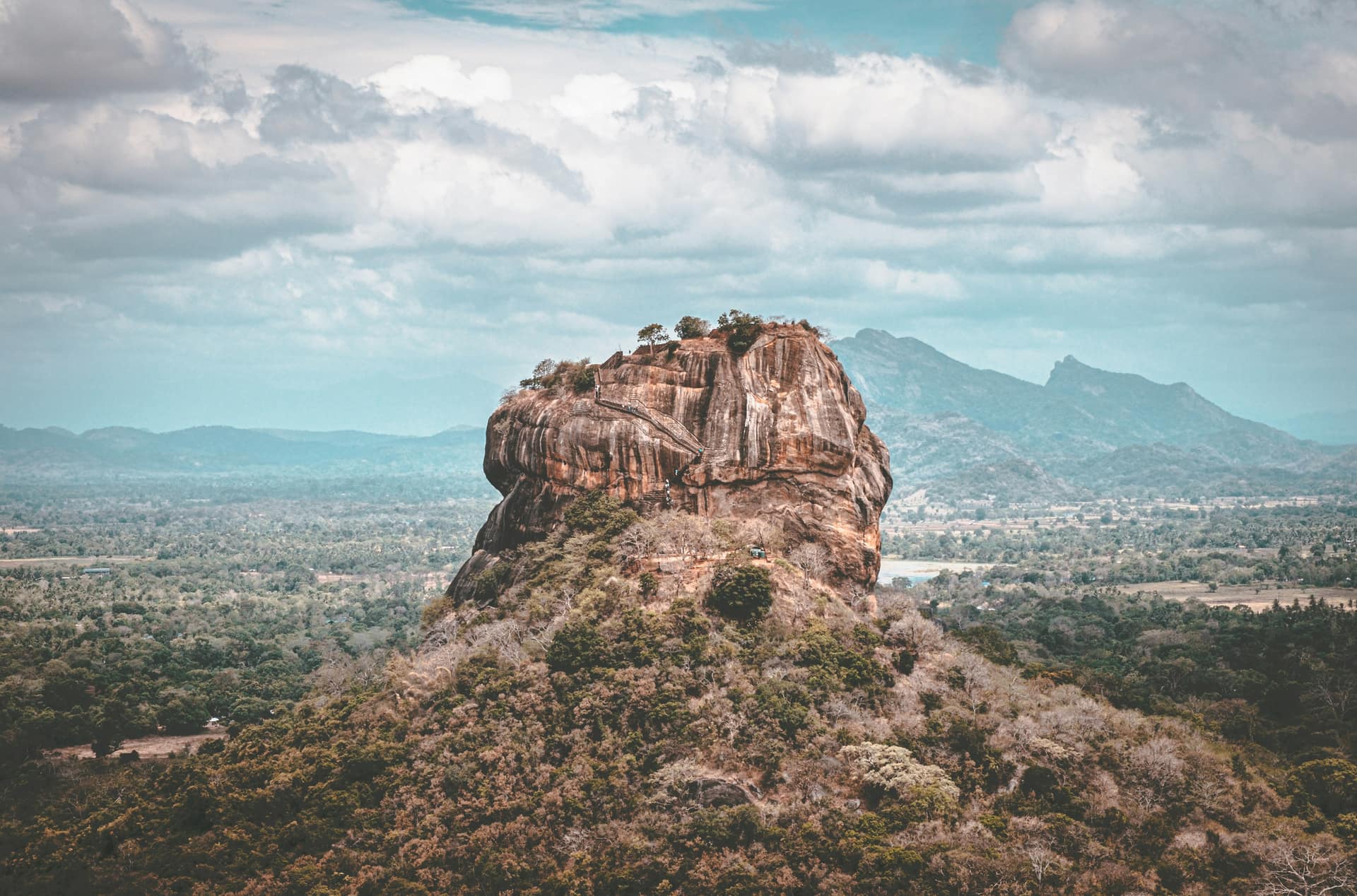
Sigiriya Rock is an ancient fortress built atop a monolithic outcrop rising roughly 200 metres above the surrounding plain, with frescoes, a mirror wall and the remains of a royal garden along the way up. The climb to the summit takes most couples one to two hours depending on fitness and how busy the steps are, and it is genuinely a shared physical challenge rather than a passive sightseeing stop. The frescoes partway up, a series of painted figures known locally as the Sigiriya damsels, survive from the original 5th-century palace and are one of the few sections of original decoration still visible on the climb.
Starting at opening time, before the heat builds and coach tours arrive, makes a real difference to the experience, both in comfort and in the quality of photographs from the top. The final ascent involves some exposed metal staircases, which is worth knowing in advance if either of you is uneasy with heights.
The gardens at the base of the rock, with their symmetrical water features, are worth a slow walk in their own right rather than treated purely as a warm-up for the climb.
- →Sigiriya's summit sits roughly 200 metres above the plain; the climb takes most couples one to two hours.
- →An opening-time start avoids the worst of the heat and the mid-morning coach crowds.
- →The final staircases are exposed metal structures, a consideration for anyone uneasy with heights.
Anuradhapura and Polonnaruwa: ruins at your own pace
Anuradhapura, Sri Lanka's capital for well over a thousand years, spreads its dagobas, monasteries and sacred bo tree across a wide, shaded archaeological zone that rewards slow, unhurried exploration rather than a checklist visit. A private guide who can select which ruins to focus on, based on what interests the two of you, makes far better use of a half day than an attempt to see every site.
Polonnaruwa, the more compact medieval capital that followed Anuradhapura, is small enough to explore largely by bicycle, which turns the visit into a genuinely shared activity rather than a walking tour trailing behind a guide. The Gal Vihara's carved Buddha statues are the site's best-known highlight and worth timing for the cooler morning light.
Quiet timing matters at both sites: arriving at opening or visiting in the late afternoon avoids the middle of the day, when the heat and the crowds are both at their peak.
- →Anuradhapura: a wide, shaded archaeological zone best explored slowly with a private guide.
- →Polonnaruwa: compact enough to explore largely by bicycle, with the Gal Vihara's carved Buddha statues its best-known highlight.
- →Both sites are quieter at opening time or late afternoon than through the middle of the day.
Habarana: a practical central base
Habarana sits roughly midway between Sigiriya, Polonnaruwa and the region's national parks, making it a genuinely practical single base for a couple who want to minimise transfer time across a two or three night stay. Stays here range from standard hotels to more distinctive lodges set among paddy fields or forest edges.
A Minneriya or Kaudulla safari, known for large elephant gatherings roughly August to October, is an easy add-on from Habarana if the timing works, giving a wildlife element to a stretch of the trip otherwise focused on history and architecture.
Sigiriya town itself, closer to the rock, suits couples who want to prioritise an early climb above everything else, since it shaves 20 to 30 minutes off the transfer that a Habarana base would otherwise require.
- →Habarana: central to Sigiriya, Polonnaruwa and the region's national parks.
- →Minneriya and Kaudulla safaris, roughly August to October, add elephant sightings to the region's history focus.
- →Sigiriya town suits couples prioritising the shortest possible transfer to an early climb.
Making an ancient-cities stop feel romantic
Ruins and temples are not an obvious romantic setting on paper, but a private guide, quiet early or late timing, and a shared physical target like the Sigiriya climb do most of the work. The sense of having done something together, rather than simply observed something, is what tends to stay with couples afterward.
Modest dress and quiet behaviour matter at all three sites, since they remain active religious and archaeological spaces rather than purely tourist attractions, and public affection is best kept low-key here as it is at temples elsewhere on the island.
A picnic breakfast at the base of Sigiriya, arranged in advance through a hotel or guide, is a small addition that turns the pre-climb wait into part of the experience rather than dead time spent queuing at the entrance gate.
Building the Cultural Triangle into a wider trip
The Cultural Triangle sits naturally at one end of a loop itinerary, connecting through the hill country toward the south coast, or paired with a short Kandy stop on the way through. Two to three nights based in Habarana or Sigiriya is generally enough to cover the region properly without rushing.
Lankan Stays & Trails runs this leg as a private, driver-guided stop, with early starts built into the schedule so a couple reaches Sigiriya before the coach groups rather than behind them.
For couples building a full route, our overview of the best places in Sri Lanka for couples from Canada covers how this region fits alongside the hill country, the coast and a Yala safari.
Frequently asked questions
Is the Sigiriya climb hard for couples?
It is a sustained but non-technical climb, taking most couples roughly one to two hours to the summit and back down, with some exposed metal staircases near the top. Reasonable fitness helps, and starting early, before the heat and crowds build, makes the climb noticeably more comfortable.
How many days do you need for the Cultural Triangle?
Two to three nights, based in Habarana or Sigiriya, is generally enough to see Sigiriya Rock and one or both of Anuradhapura and Polonnaruwa without rushing. A couple short on time can focus on Sigiriya and Polonnaruwa alone in roughly two days.
Should couples visit Anuradhapura or Polonnaruwa?
Anuradhapura suits couples wanting the older, more spiritually significant site with the sacred bo tree and wide monastic grounds, while Polonnaruwa is more compact and exploreable by bicycle, a more physically shared activity. Many couples with time visit both, since they are roughly two hours apart.
What is the best time to climb Sigiriya Rock?
Opening time, generally early morning, is best, avoiding both the midday heat and the mid-morning coach tour crowds that build on the upper steps. A late-afternoon climb is a workable alternative if a couple prefers a sunset finish, though the steps can be warm from a full day of sun.
Where should couples stay to visit the Cultural Triangle?
Habarana or Sigiriya town both make practical central bases, close enough to Sigiriya Rock, Polonnaruwa and the region's national parks to avoid long transfers. Habarana tends to offer a wider range of stay types, from standard hotels to lodges set among paddy fields.
Can you cycle around Polonnaruwa?
Yes, Polonnaruwa's ancient city is compact and largely flat, making it one of the few Sri Lankan heritage sites well suited to exploring by bicycle. It is a popular option for couples wanting a more active, shared way to see the ruins rather than a walking tour.
Is a guide necessary for Sigiriya and the ancient cities?
A guide is not required but is genuinely worthwhile, since Anuradhapura and Polonnaruwa in particular reward context that a self-guided visit would miss. A private guide can also set the pace to suit the couple rather than a fixed group tour timetable.