
Quick answer
The hill country roads on a Sri Lanka road trip are narrow, well-surfaced and full of tight hairpins, so average speeds drop to roughly 20 to 30 km/h on the steepest stretches. The best-known are the Ramboda pass between Kandy and Nuwara Eliya, the descent from Ella through Ella Gap towards Wellawaya, and the roads around Haputale. Plan hill legs of no more than three hours, travel in the morning before mist builds, and take breaks to avoid motion sickness.
Key takeaways
- Average speeds on Sri Lanka's steepest hill roads are roughly 20 to 30 km/h, which is why short distances take long in tea country.
- The Ramboda pass on the A5 between Kandy and Nuwara Eliya is the most dramatic set of hairpins on the classic road trip route.
- The road from Ella down through Ella Gap to Wellawaya drops roughly 800 metres in about 25 kilometres, past Ravana Falls.
- Mist is most common on the high passes in the afternoon, particularly during the south-west monsoon from May to September.
- Hill legs of about three hours with a stop every hour are the most comfortable way to plan the mountain section.
What Sri Lanka's hill country roads are like
Sri Lanka's hill country roads are mostly two-lane, sealed and well maintained, but they are narrow by international standards and follow the contours of the land. That means constant curves, frequent hairpins and long stretches with no safe place to overtake. Tea estates, villages and small towns sit directly on the road.
Buses are the dominant traffic and set the rhythm. They stop often, take bends wide and overtake with confidence, so experienced local drivers hold back and give them space. Tea lorries, tuk-tuks and pedestrians add to the mix.
The result is a drive that feels slow but rarely dangerous with a careful driver. Most first-time visitors find the scenery more than makes up for the pace.
- →Average speed on steep sections: roughly 20 to 30 km/h.
- →Average speed on gentler hill roads: roughly 30 to 40 km/h.
- →Overtaking: limited and best left to local drivers.
- →Road surface: generally good on the main A-roads, rougher on estate lanes.
The Ramboda pass
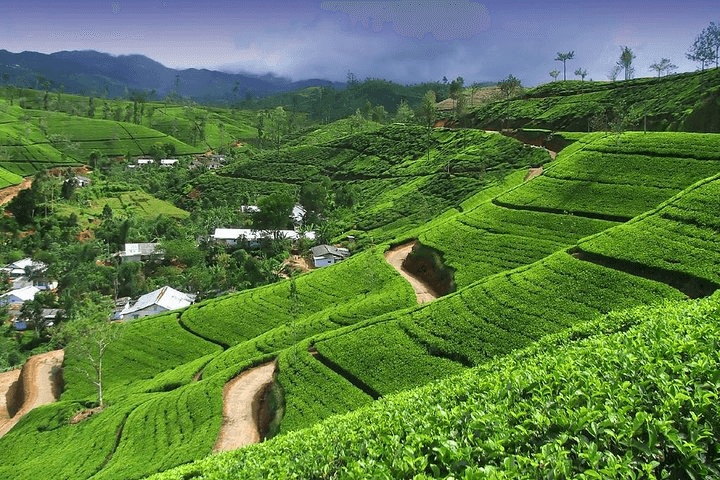
The Ramboda pass is the most dramatic section of hairpins on a classic Sri Lanka road trip. On the A5 between Pussellawa and Nuwara Eliya, the road climbs above Ramboda Falls and the Kotmale valley in a series of tight bends, with the valley opening up on one side and tea slopes rising on the other.
A tunnel bypasses one of the sharpest corners, but the climb remains steep and slow. Viewpoints and roadside hotels near Ramboda Falls make natural stopping points before the final ascent to Nuwara Eliya at almost 1,900 metres.
Travel the pass in the morning. Afternoon cloud often settles over the top, and in heavy rain the road can be slow, with water running across the surface.
Ella Gap and the road to Wellawaya
The road from Ella through Ella Gap towards Wellawaya is the steepest descent on most Sri Lanka road trips. It drops roughly 800 metres in about 25 kilometres, winding past Ravana Falls and through forest and scrub as the climate changes from cool hills to hot lowland.
Heading south to Yala on this road, drivers use low gears and brake carefully. Heading north, the climb is slow but steady. Either way, the stop at Ravana Falls, right beside the road, makes a natural break.
- →Ravana Falls: a high cascade beside the road a few kilometres below Ella.
- →Ella Gap viewpoint: wide views to the southern plains on clear mornings.
- →Wellawaya: the town at the foot of the descent, with fuel and tea shops.
Haputale and the southern edge of the hills
Haputale sits on a narrow ridge at the southern edge of Sri Lanka's hill country, and its approach roads are some of the most exposed in the island. On clear days the views run south across the lowlands to the coast. On misty days the road can be enveloped in cloud within minutes.
The road down from Haputale to Beragala and on to Wellawaya or Belihuloya is narrow and winding. It is a common route for travellers continuing south to Udawalawe, and it should be driven slowly and in daylight.
Lipton's Seat, above Dambatenne tea factory near Haputale, is reached by a single-track estate road. Tuk-tuks or the estate shuttle are often easier than a larger car.
Staying comfortable on hill roads
Staying comfortable on Sri Lanka's hill country roads is mostly about motion sickness and temperature. The bends affect some travellers strongly, particularly children and anyone reading or using a phone. The temperature changes quickly, from coastal heat to the cool of Nuwara Eliya, within a single drive.
Simple habits make a big difference. Sit facing forward with a view of the road, eat lightly before setting out and ask for breaks every hour. Keep a layer to hand inside the car rather than packed in the boot.
- →Take motion-sickness tablets before the drive, not once symptoms start.
- →Ask the driver to slow down on the bends; good drivers will not mind.
- →Keep a light jumper, water and plain snacks inside the car.
- →Open a window for fresh air rather than relying on air conditioning alone.
Planning the hill section of the route
Planning the hill section of a Sri Lanka road trip means keeping each mountain leg short. On the classic loop, Kandy to Nuwara Eliya, Nuwara Eliya to Ella and Ella to Tissamaharama are all roughly two and a half to three hours, which leaves time for stops and an arrival before dark.
Combining two hill legs into one day, such as Kandy to Ella in one go, is possible but tiring at about five hours on winding roads. If you do, start early and plan a long lunch break. Drivers on our Lankan Stays & Trails road trips are used to the hill roads and will set the pace to suit the passengers.
Frequently asked questions
How fast can you drive on Sri Lanka's hill roads?
On Sri Lanka's steepest hill roads, such as the Ramboda pass or the descent from Ella, average speeds are roughly 20 to 30 km/h. On gentler hill stretches they rise to about 30 to 40 km/h. That is why a 60-kilometre hill leg often takes two and a half hours.
Are the roads in Sri Lanka's hill country safe?
The main hill roads are well surfaced and safe in daylight with a careful, experienced driver. Risks come from narrow bends, buses overtaking, mist and heavy rain. Drive in the morning, avoid night journeys in the hills and let local drivers handle the busiest passes.
Which hill road in Sri Lanka has the most hairpins?
On the classic road trip route, the Ramboda pass on the A5 between Kandy and Nuwara Eliya has the most dramatic hairpins. Off the main route, the road to Lipton's Seat near Haputale and the Corbett's Gap road in the Knuckles range are even tighter and narrower.
Will I get car sick on Sri Lankan mountain roads?
Some travellers do, especially children and anyone reading or looking at a phone. Sit in front where possible, watch the horizon, eat lightly, keep fresh air coming in and stop every hour. Motion-sickness tablets work best if taken before the drive begins rather than halfway through.
Is there mist on the Ramboda pass?
Mist is common on the Ramboda pass, especially in the afternoon and during the south-west monsoon from about May to September. Visibility can drop to a few metres, which slows traffic considerably. Crossing the pass in the morning gives the best chance of clear views and an easier drive.
Can I self-drive the hill country roads?
Experienced drivers can self-drive the hill country roads with the right permits, but they are demanding: tight bends, buses, pedestrians and limited overtaking. Many self-drivers take the train through the hills instead, or hire a driver just for the mountain section.
How does Lankan Stays & Trails handle the hill roads?
Our drivers plan the hill legs for the morning, keep each one to about three hours and stop every hour or so. We avoid night drives in the hills and adjust the pace for children or anyone prone to motion sickness.