
Quick answer
The Cultural Triangle needs roughly two to four days for most Turkish travellers, with two days covering Sigiriya Rock and Dambulla's cave temples from a single base in Habarana or Sigiriya town, and four days allowing the full set including Anuradhapura and Polonnaruwa's ancient cities. Two days suits a first-time trip of ten days or fewer where time is tight, while three to four days suits travellers who want the full ancient-city sweep without a rushed pace.
Key takeaways
- Two days covers the essentials: Sigiriya Rock and Dambulla's cave temples, from a single Habarana or Sigiriya base.
- Three days adds either Anuradhapura or Polonnaruwa; four days allows both ancient cities without rushing.
- Sigiriya Rock involves roughly 1,200 steps and is best climbed early, ideally before 8am, to avoid heat and crowds.
- Polonnaruwa is generally easier and faster to explore than Anuradhapura, since its ruins are more compact and often covered by bicycle.
- Habarana is the most central base for reaching all four sites without repeated long transfers.
What the Cultural Triangle covers
The Cultural Triangle refers to Sri Lanka's cluster of ancient cities and sacred sites in the north-central region, anchored by four places: Sigiriya Rock, Dambulla's cave temples, Anuradhapura's ancient monastic city, and Polonnaruwa's medieval ruins. All four sit within a roughly two-hour driving radius of each other, making a single base practical for exploring the whole region.
For most Turkish travellers, this is the first major stop after arrival, roughly a three-to-four-hour drive from Colombo, and it anchors the rest of the itinerary since hill country, wildlife safaris and the coast all connect onward from here rather than from Colombo directly.
The region rewards an early start on most days, since the heat builds quickly by late morning and Sigiriya Rock in particular is far more comfortable climbed before 8am.
Two days: Sigiriya and Dambulla
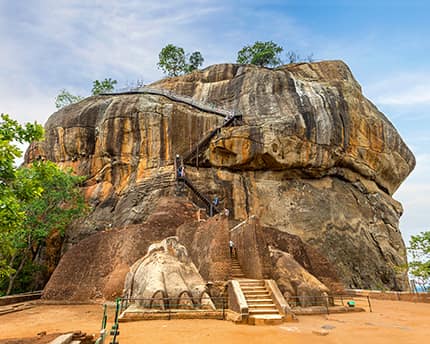
Two days is the minimum to do the Cultural Triangle justice, and it focuses on the region's two most iconic sites: Sigiriya Rock, the fifth-century rock fortress with frescoes and landscaped gardens, and Dambulla's cave temples, a complex of five caves containing Buddhist statues and murals dating back over two thousand years.
A typical two-day plan climbs Sigiriya at dawn on the first morning to beat the heat, spends the afternoon at Dambulla or resting, then uses the second day for a local activity such as a village tour or Minneriya-area elephant safari before moving on. This is the version most first-time visitors on a ten-day or shorter trip choose.
- →Day 1: dawn Sigiriya Rock climb (roughly 1,200 steps, 2-3 hours return), afternoon rest or Dambulla cave temples.
- →Day 2: Dambulla if not done already, or a half-day village and lake tour, before departing for the next region.
Three to four days: adding Anuradhapura and Polonnaruwa
Three days allows Sigiriya and Dambulla plus one of the two ancient cities, most commonly Polonnaruwa, since its ruins are more compact and can be explored efficiently, often by bicycle, in half a day. Anuradhapura is larger and more spread out, generally needing closer to a full day to see properly, including its sacred Bodhi tree and several major dagobas.
Four days is the version for travellers who want the complete Cultural Triangle experience: Sigiriya, Dambulla, Polonnaruwa and Anuradhapura, without needing to skip one or rush through both in a single combined day. This suits travellers with fourteen days or more overall, or those for whom ancient history is a specific priority for the trip.
Choose three days if time is limited and one ancient city is enough; choose four days if seeing both Anuradhapura and Polonnaruwa properly matters more than adding extra time elsewhere in the itinerary.
- →Polonnaruwa: roughly half a day, often explored by bicycle among compact, well-preserved ruins.
- →Anuradhapura: closer to a full day, given its larger, more spread-out sacred sites and dagobas.
- →Both together work as one long day for travellers determined to fit them in, though a full day each is more comfortable.
Where to base yourself
Habarana is the most central base for exploring the whole Cultural Triangle, sitting within reasonable driving distance of Sigiriya, Dambulla, Polonnaruwa and the Minneriya-Kaudulla wildlife corridor, and it also works well as a base for an elephant safari without needing to relocate. Sigiriya town itself is a close alternative, slightly closer to the rock but a little further from Anuradhapura.
Travellers prioritising Anuradhapura specifically sometimes base there for one night to avoid a long round trip from Habarana, though this is only worth the extra move on a four-day-or-longer Cultural Triangle stay.
Combining with the rest of the itinerary
The Cultural Triangle typically sits at the start of a Sri Lanka itinerary, straight after arrival from Colombo, and flows onward to hill country (Kandy, Ella) to the south-east, or to a wildlife safari via Habarana's own elephant corridor. Turkish travellers on a ten-day trip often compress this to two days to preserve time for hill country and one coast; those with fourteen days or more can comfortably extend to three or four.
The dedicated duration hub and the individual day-count itinerary guides show exactly how the Cultural Triangle's day allocation shifts across seven, ten, twelve and fourteen-day trips.
Planning the right number of days
Two days covers the essentials for a first trip; three to four days is worth it for travellers with a genuine interest in ancient history or more time overall. Either way, an early start on the Sigiriya climb makes a disproportionate difference to how enjoyable the visit feels.
Lankan Stays & Trails builds private, driver-guided Cultural Triangle stays for Turkish travellers at two, three or four days, based from Habarana and timed around the cooler morning hours.
Frequently asked questions
How many days do you need for the Cultural Triangle in Sri Lanka?
Roughly two to four days. Two days covers Sigiriya Rock and Dambulla's cave temples from a single base; four days allows the full set including Anuradhapura and Polonnaruwa's ancient cities without a rushed pace.
Can you see Sigiriya and Dambulla in one day?
It is possible but tight, since Sigiriya is best climbed at dawn and Dambulla deserves a relaxed visit afterward. Most itineraries split them across two days, or combine Sigiriya at dawn with Dambulla the same afternoon if time is limited.
Is Anuradhapura or Polonnaruwa better to visit if you only have time for one?
Polonnaruwa is generally the easier choice on limited time, since its ruins are more compact and often covered by bicycle in half a day. Anuradhapura is larger and more spiritually significant but needs closer to a full day to see properly.
Where should you stay to explore the Cultural Triangle?
Habarana is the most central base, within reasonable driving distance of Sigiriya, Dambulla, Polonnaruwa and the Minneriya-Kaudulla elephant corridor. Sigiriya town is a close alternative if the rock itself is the main priority.
How many steps are there up Sigiriya Rock?
Roughly 1,200 steps to the summit, taking around two to three hours return at a comfortable pace including time at the frescoes and summit views. An early start, ideally before 8am, avoids both the worst heat and the largest crowds.
Can the Cultural Triangle be combined with a wildlife safari?
Yes, easily. Habarana sits at the edge of the Minneriya-Kaudulla elephant corridor, so a safari there fits naturally alongside a Cultural Triangle stay without needing to relocate, unlike a dedicated Yala safari further south.
Is two days enough for a first-time visit to the Cultural Triangle?
Yes, two days is enough to see the two most essential sites, Sigiriya Rock and Dambulla's cave temples, properly. It suits travellers on a ten-day trip who want to preserve time for hill country, a safari and the coast.