
Quick answer
Jaffna suits a mid-year cricket tour, when the north is dry while Galle and Colombo see monsoon showers. It is about six to seven hours from Colombo by road or train, and about four and a half to five hours from Dambulla on the A9, so it pairs best with a Dambulla leg. Allow at least two or three nights to see the Nallur temple, Jaffna Fort, the islands and the coast, and to eat crab curry.
Key takeaways
- The north is dry in the mid-year window, while the southwest coast is in the monsoon.
- Jaffna is about six to seven hours from Colombo by road or train.
- From Dambulla, the A9 reaches Jaffna in about four and a half to five hours.
- The Nallur festival usually falls in July and August.
- Allow at least two or three nights.
Why the north, and why mid-year
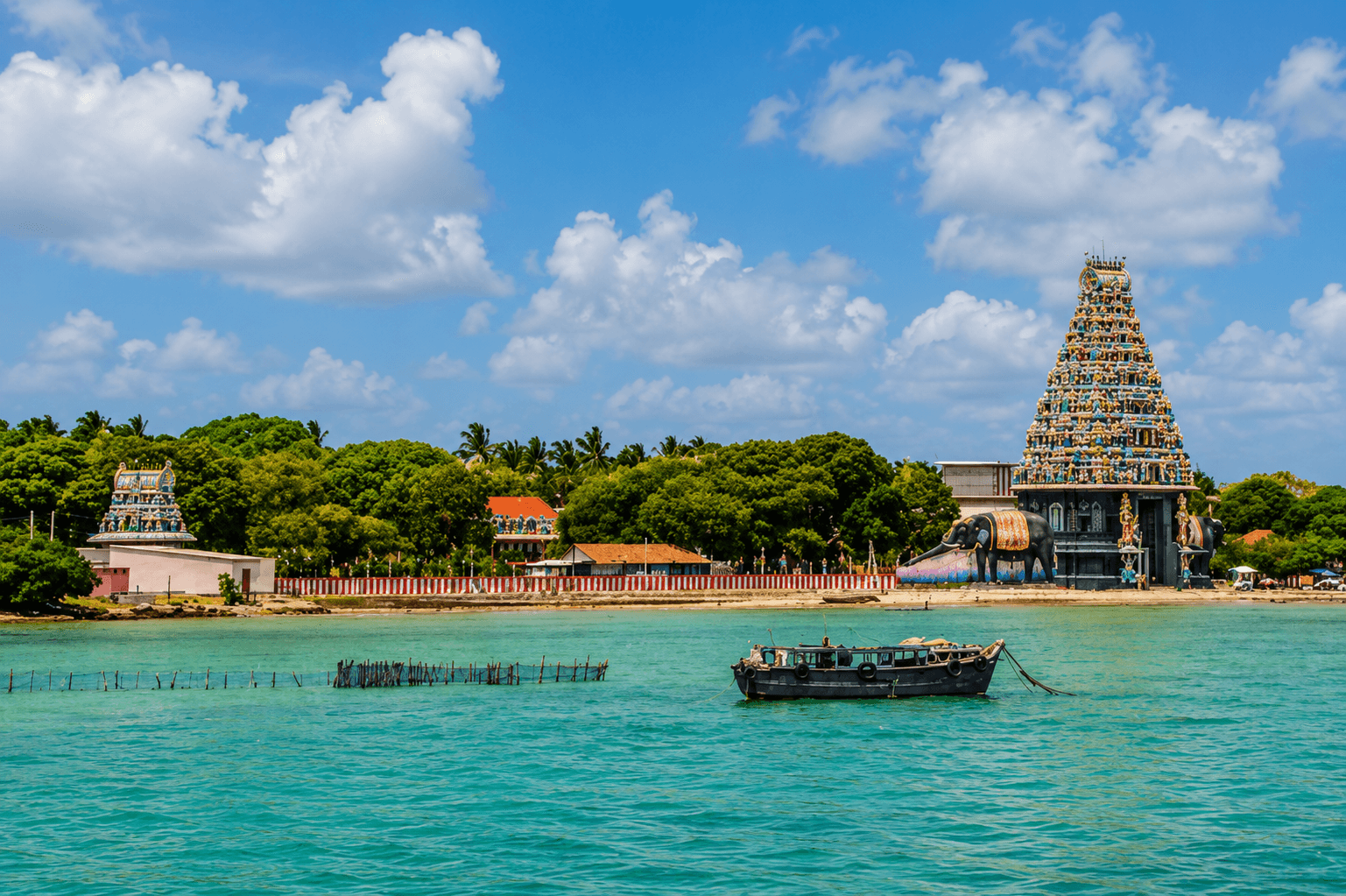
Jaffna is the heart of Sri Lanka's Tamil culture, with Hindu temples, a distinct cuisine and a landscape of palmyra palms, lagoons and flat islands. It was cut off for much of the civil war, which ended in 2009, and has reopened to visitors since.
In a mid-year tour, when the southwest monsoon brings showers to Galle and Colombo, the north is dry and hot. A few days there can be the sunniest of the trip.
For fans who have toured Sri Lanka before, it is also a way to see somewhere entirely new.
- →Tamil culture, temples and food.
- →Dry in the mid-year window.
- →A new region for return visitors.
Getting there
From Colombo, Jaffna is about six to seven hours by road or by intercity train, which is comfortable and air-conditioned in its first-class carriages. Domestic flights have operated between Colombo and Jaffna at times; check current schedules.
The best fit for a cricket trip is from Dambulla. After a white-ball match there, the A9 highway runs north through Vavuniya and Kilinochchi, reaching Jaffna in about four and a half to five hours.
Lankan Stays & Trails usually plans the north as a loop from Dambulla or Anuradhapura, returning south to Colombo for the next leg.
- →Colombo: six to seven hours by road or train.
- →Dambulla: about four and a half to five hours.
- →Check for domestic flights.
What to see
The Nallur Kandaswamy Temple, with its golden gopuram, is Jaffna's spiritual centre; men remove their shirts to enter. Jaffna Fort, built by the Portuguese and rebuilt by the Dutch, overlooks the lagoon. The public library, rebuilt after it was burned in 1981, is a symbol of the city.
Beyond the town, the islands of Nainativu, with its Hindu and Buddhist shrines, and remote Delft, with wild ponies and coral walls, are reached by causeway and ferry. Casuarina Beach and Point Pedro, the northern tip, show the quiet coast.
The Nallur festival, usually in July and August, brings 25 days of processions and huge crowds to the temple.
- →Nallur temple and its festival.
- →Jaffna Fort and the library.
- →The islands and the northern coast.
Food
Jaffna food is a highlight. Crab curry, rich with roasted spices, is the famous dish, along with mutton curries, odiyal kool, a seafood soup made with palmyra flour, and vadai and dosai for breakfast.
Jaffna is also known for its ice cream parlours and palmyra products, such as jaggery and toddy. Spice levels are often higher than in the south, so ask if you prefer milder food.
Cricket is popular in the north too, and schools in Jaffna have a long cricketing tradition, with big matches between rival colleges drawing local crowds. If one is on during your visit, it is a lively glimpse of the game away from the international grounds.
- →Crab curry.
- →Odiyal kool and mutton curries.
- →Ice cream parlours.
How long to allow
Two nights is the minimum to see Jaffna town and one island trip; three nights adds the northern coast and a slower pace. With the long journey there and back, a north loop takes four to five days from Dambulla or Colombo.
Dress modestly at temples, and check the latest travel advice, as with any region.
On the way north or back south, Anuradhapura's ancient stupas and Mihintale's hilltop shrines make a natural stop, as does Wilpattu for a safari. That turns the long journey into part of the trip rather than a transfer.
- →Two nights minimum, three is better.
- →Four to five days for the full loop.
- →Dress modestly at temples.
Frequently asked questions
Is Jaffna worth visiting on a cricket tour?
Yes, especially in a mid-year tour, when the north is dry and the southwest is in the monsoon. Jaffna offers Tamil temples, a Dutch fort, island ferries and excellent food. It pairs best with a white-ball match at Dambulla, about four and a half to five hours south.
How far is Jaffna from Colombo?
Jaffna is about six to seven hours from Colombo by road or by intercity train. Domestic flights have operated at times; check current schedules. From Dambulla, the A9 highway reaches Jaffna in about four and a half to five hours.
When is the weather good in Jaffna?
Jaffna is usually dry and hot from roughly May to September, which suits mid-year cricket tours. The northeast monsoon brings rain from roughly October to December. Early in the year, the weather is often pleasant and less hot.
What is the Nallur festival?
The Nallur festival is a 25-day Hindu festival at the Nallur Kandaswamy Temple in Jaffna, usually in July and August, with daily processions and huge crowds. Men remove their shirts to enter the temple, and everyone should dress modestly.
How many days do you need in Jaffna?
Two nights is the minimum to see the town and take one island trip. Three nights allows the northern coast and a slower pace. With travel from Dambulla or Colombo, a north loop takes about four to five days in total.
What food is Jaffna known for?
Jaffna is known for its crab curry, rich with roasted spices, as well as mutton curries, odiyal kool seafood soup, vadai, dosai and palmyra products such as jaggery. The town's ice cream parlours are popular too. Food is often spicier than in the south.
Can you visit Jaffna's islands?
Yes. Nainativu, with its Hindu and Buddhist shrines, is reached by causeway and a short ferry. Delft, further out, has wild ponies, coral walls and a quiet landscape, reached by a longer ferry. Check ferry times locally, as they depend on weather.