
Quick answer
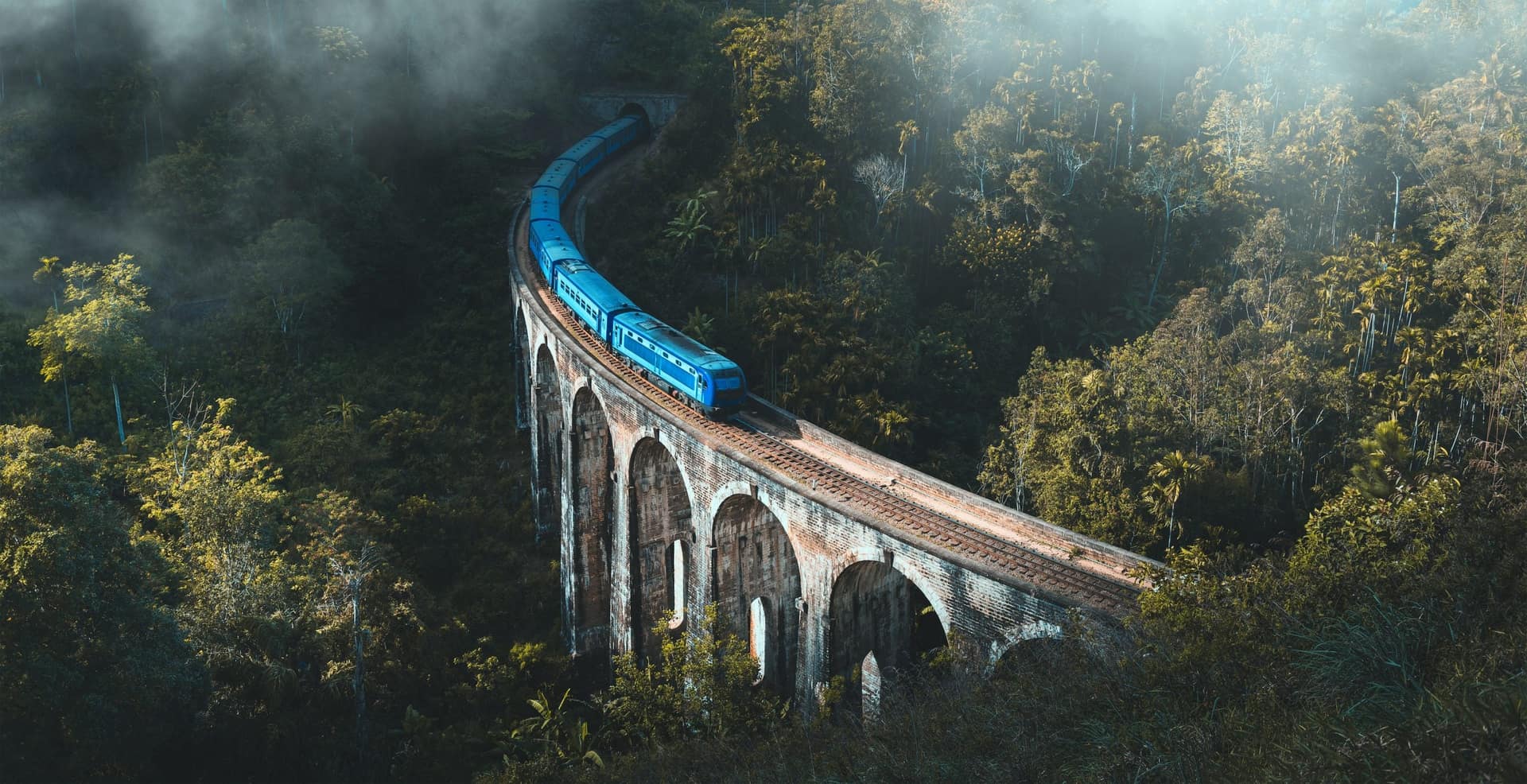
The Nine Arch Bridge near Ella was built as part of the extension of the main hill country railway from Ella to Badulla, and is commonly dated to around 1921. It is made of brick, stone and cement rather than steel, and is commonly given as roughly 91 metres long and 24 metres high. A popular story says steel meant for it was diverted to the First World War, and local tradition credits a builder named P. K. Appuhami.
Key takeaways
- The Nine Arch Bridge carries the railway between Ella and Demodara stations, on the line's final section to Badulla.
- The bridge is commonly dated to around 1921 and described as roughly 91 metres long and 24 metres high.
- Brick, stone and cement were used instead of steel, a choice often linked to wartime shortages.
- Local tradition credits the work to a Sri Lankan builder, P. K. Appuhami, though records are thin.
- The line beyond Ella reached Badulla in the mid-1920s, after the Demodara loop was completed.
Why the Nine Arch Bridge was built
The Nine Arch Bridge exists because the British colonial government wanted the main hill country railway to reach Badulla, the provincial capital of Uva and the centre of a rich tea and coffee district. The line had climbed from Colombo through Kandy and Nanu Oya over several decades, and the final stretch from Ella eastwards had to cross deep, wooded valleys.
Between Ella and Demodara the line needed to span one such valley without steep gradients. A viaduct was the answer, and the result is the curved, nine-arched bridge visitors see today, with the railway sweeping round the hillside at each end.
The bridge was never designed as a landmark. It was a working piece of engineering on a freight and passenger line, and its fame as a viewpoint is much more recent than the railway itself.
- →Purpose: to carry the hill country railway on towards Badulla.
- →Location: between Ella and Demodara stations, in a wooded valley.
- →Date: commonly given as around 1921 (hedged).
Brick, stone and no steel
The Nine Arch Bridge is built of brick, stone and cement, with no steel in the main structure, and that is what makes it distinctive. Many railway bridges of the period used steel girders, but this one relies entirely on masonry arches, like a much older style of viaduct.
A popular story says steel ordered for the bridge was diverted to the British war effort during the First World War, forcing the builders to use local materials instead. The story is widely repeated and plausible, but it is hard to confirm from records, so treat it as tradition rather than fact.
Whatever the reason, the masonry has lasted a century in a wet, steep valley, carrying trains every day, which says a good deal about the quality of the work.
- →Main materials: brick, cut stone and cement.
- →Commonly given dimensions: roughly 91 metres long, roughly 24 metres high.
- →Nine arches, set on a gentle curve.
Who built the Nine Arch Bridge
Local tradition credits the Nine Arch Bridge to a Sri Lankan builder, P. K. Appuhami, said to have worked with local labour and materials. Some versions of the story say British engineers doubted the bridge would hold until it carried its first trains. Like the steel story, it is told with conviction in Ella but is difficult to document fully.
What is clear is that large numbers of local workers built the hill country railways, often in difficult and dangerous conditions. Remembering them is part of the bridge's story, and a fair counterweight to the colonial framing that dominates many accounts.
The railway beyond Ella
The Nine Arch Bridge is one of several pieces of engineering on the final stretch of line from Ella to Badulla. A few kilometres on, at Demodara, the railway loops round a hill and passes beneath itself to lose height in a tight space. The line reached Badulla in the mid-1920s (hedged), completing the route from Colombo.
Today the bridge carries the same trains that run the famous Kandy to Ella stretch, continuing to Demodara and Badulla. Watching one cross the arches, or riding across yourself, connects the visit to the railway's original purpose.
The railway is still a working line, so the history is not just in the past. Walking on the tracks is risky and in places prohibited, and visitors should stay well clear when a train approaches.
- →Ella to Demodara: the stretch that includes the bridge.
- →Demodara loop: the spiral just beyond the bridge.
- →Badulla: the terminus, reached in the mid-1920s (hedged).
Seeing the history on a visit
The best way to appreciate the Nine Arch Bridge's history is to look at it from more than one angle: from the hillside viewpoint for the full curve, from track level for the masonry, and from below for the height of the arches. Each shows a different side of the engineering.
Lankan Stays & Trails guides often walk guests to the bridge and on to Demodara, telling the railway's story along the way. If you go alone, allow roughly an hour or more, and ask at Ella station about crossing times before you set out.
Combine the bridge with a ride on the line to Badulla for the full picture: the loop at Demodara is far easier to understand from the train window than from a map.
- →Viewpoint: the full curve of the bridge.
- →Track level: the brick and stone at close range.
- →From below: the scale of the arches.
Frequently asked questions
When was the Nine Arch Bridge built?
The Nine Arch Bridge is commonly dated to around 1921, as part of the extension of the hill country railway from Ella to Badulla. Exact construction dates are hard to confirm, so most sources give an approximate year. The line itself reached Badulla in the mid-1920s.
Who built the Nine Arch Bridge?
Local tradition credits the Nine Arch Bridge to a Sri Lankan builder, P. K. Appuhami, working with local labour. The bridge was part of a British colonial railway project, but records of the individual builders are thin, so the story is best treated as tradition rather than documented fact.
Why does the Nine Arch Bridge have no steel?
The Nine Arch Bridge is built of brick, stone and cement because, according to a popular story, the steel ordered for it was diverted to the First World War effort. The story is widely repeated in Ella but difficult to confirm. Either way, the masonry has lasted roughly a century.
How big is the Nine Arch Bridge?
The Nine Arch Bridge is commonly described as roughly 91 metres long and roughly 24 metres high, with nine arches set on a gentle curve. Figures vary slightly between sources, so treat them as approximate. The curve and the forest setting make it look larger in photographs.
Is the Nine Arch Bridge still used by trains?
Yes. The Nine Arch Bridge is on a working railway, the main hill country line from Colombo and Kandy to Badulla. Several trains cross each day in both directions. Times vary, so ask at Ella station on the day, and always step well clear of the track when a train approaches.
Where is the Nine Arch Bridge?
The Nine Arch Bridge is in the wooded valley east of Ella, between Ella and Demodara stations, in Sri Lanka's Uva Province. It is roughly 20 to 40 minutes' walk from Ella town, depending on the route, or a short tuk-tuk ride to the nearest road access.