
Quick answer
The northeast monsoon, called the Maha monsoon in Sri Lanka, blows from the Bay of Bengal from roughly November or December to February. It brings rain and rough seas to the east coast, the north, the eastern hill slopes around Ella and Badulla, and much of the Cultural Triangle, with the heaviest rain in November and December. The west and south coasts and the western hills are in its rain shadow and have their dry, calm season.
Key takeaways
- The northeast monsoon blows from roughly November or December to February, wettest in November and December.
- Rain falls on the east coast, the north, the eastern hill slopes and much of the dry zone plains.
- The west and south coasts and the western hills sit in its rain shadow and have their best weather.
- The northeast monsoon is weaker than the southwest monsoon, but its rain is the main water supply of the dry zone.
- The sea on the east coast is rough during the season, while the southwest coast is calm.
What the northeast monsoon is
The northeast monsoon is the reverse of the southwest monsoon. From about November, the Asian land mass cools and air flows out from it towards the warmer Indian Ocean. Over Sri Lanka, that flow arrives as a wind from the northeast, having crossed the Bay of Bengal and picked up moisture on the way.
The wind meets the island first on the east coast and the north, then rises over the eastern slopes of the central highlands, dropping rain as it goes. In Sri Lanka the season is called Maha, the same name as the main paddy season, which relies on its rain to fill the ancient tanks of the dry zone.
The northeast monsoon is generally weaker than the southwest monsoon, and its rain is shared with the second inter-monsoon storms that come before it. Its arrival is often gradual, with no single dramatic onset.
- →Season name in Sri Lanka: Maha.
- →Wind direction: from the northeast, across the Bay of Bengal.
- →Usual timing: roughly November or December to February.
Where it rains and where it does not
The wet side of the northeast monsoon is the east and north of the island: Trincomalee, Batticaloa, Pasikudah, Arugam Bay, Jaffna and Mannar, and the eastern slopes of the hills around Ella, Badulla and the Knuckles range. The plains of the Cultural Triangle, including Polonnaruwa and Sigiriya, also receive much of their annual rain in this season.
The dry side is the southwest. Colombo, Negombo, Bentota, Galle, Mirissa and Tangalle, and the western hill slopes around Nuwara Eliya and Adam's Peak, are in the rain shadow from about mid-December to March. That is why the classic first trip, through the Cultural Triangle, the hills and the south coast, is timed for the winter months.
- →Wet: Trincomalee, Batticaloa, Pasikudah, Jaffna, Ella, Badulla, Polonnaruwa.
- →Showers early, drier later: Sigiriya, Dambulla, Kandy.
- →Dry: Colombo, Galle, Mirissa, Bentota, Nuwara Eliya, Adam's Peak.
When it arrives, peaks and fades
The northeast wind usually begins to establish itself in November, but the rain at that time is mixed with second inter-monsoon thunderstorms, which affect the whole island. The monsoon proper is often counted from December. On the east coast, November and December are usually the wettest months.
From January, the rain eases, and by February much of the east and north is dry, though the sea there often stays rough until March. The southwest coast stays dry until the first inter-monsoon storms of March and April.
The timing varies from year to year, and the season is often wetter when a depression or cyclone in the Bay of Bengal passes close to the island.
What it does to the sea
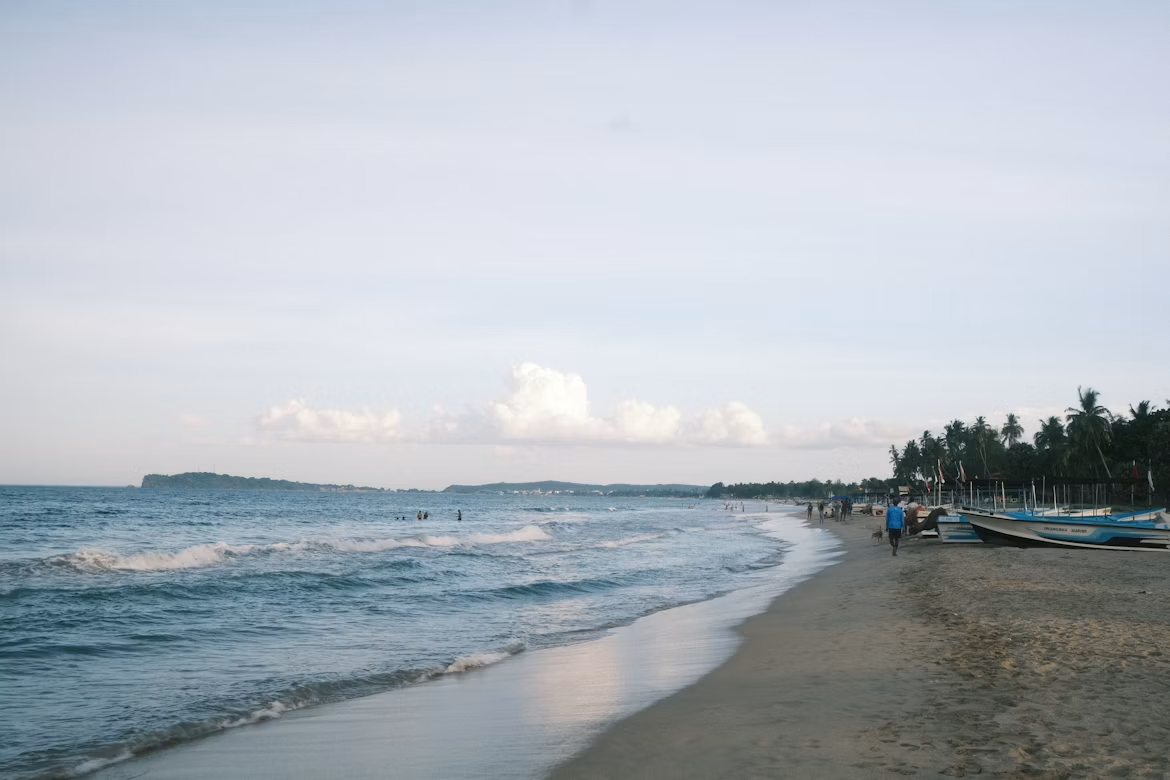
The northeast wind pushes swell onto the east coast. From about November to February, the sea at Nilaveli, Uppuveli, Pasikudah and Kalkudah is often rough and murky, snorkelling trips to Pigeon Island are frequently cancelled, and Arugam Bay's surf is out of season. Many east coast beach hotels close for part of the period.
On the southwest coast, the wind blows from the land, so the sea is calm and clear. That is when Mirissa's whale-watching season runs, when the south coast breaks have their surf season, and when swimming on the sheltered bays is easiest.
- →East coast: rough, murky, many hotels closed.
- →South and west coasts: calm, clear, peak season.
- →Whale-watching: Mirissa in season.
Travelling in the northeast monsoon
A trip between December and March naturally follows the dry side: the Cultural Triangle, the hills and the south or west coast. If the trip starts in November or early December, put the beach at the end, after the southwest has dried out.
The north and east are still worth visiting in January and February for culture, when rain eases, but not for beach time. Lankan Stays & Trails plans northeast monsoon trips on the dry side of the island and keeps the east coast for the summer.
Frequently asked questions
What is the northeast monsoon in Sri Lanka?
The northeast monsoon, called Maha in Sri Lanka, is a seasonal wind from the Bay of Bengal that blows from roughly November or December to February. It brings rain and rough seas to the east coast, the north and the eastern hills, while the west and south coasts have their dry season.
When does the northeast monsoon start and end in Sri Lanka?
The northeast wind usually begins in November, mixed with inter-monsoon storms, and the monsoon proper is often counted from December. It eases through January and is mostly over by February, though the east coast sea often stays rough until March.
Which parts of Sri Lanka are affected by the northeast monsoon?
The east coast from Trincomalee to Arugam Bay, the north around Jaffna and Mannar, the eastern hill slopes around Ella and Badulla, and much of the Cultural Triangle plains. The west and south coasts and the western hills, including Nuwara Eliya, are in the rain shadow.
Is the south coast dry during the northeast monsoon?
Yes, mostly. The central highlands block the northeast wind, so the south and west coasts have their dry season from about mid-December to March. The sea is calm and clear, whale-watching runs from Mirissa and the beaches are at their best.
Is the northeast monsoon stronger than the southwest monsoon?
Generally no. The northeast monsoon is usually weaker and its rain is shared with the second inter-monsoon storms that come before it. But its rain is vital to the dry zone, filling the tanks that water the main Maha paddy season.
Does the northeast monsoon affect Ella?
Yes. Ella and Badulla sit on the eastern slopes of the hills, which face the northeast wind, so they receive monsoon showers from about November to January. Mornings are often clear, but afternoon cloud and rain are common. Nuwara Eliya, on the western side, is drier at that time.
How does Lankan Stays & Trails plan around the northeast monsoon?
Trips between December and March usually follow the dry side of the island, through the Cultural Triangle, the hills and the south or west coast. If a trip starts in November, the beach is placed at the end. The east coast is kept for the summer months.