
Quick answer
The Sigiriya frescoes are around twenty surviving paintings of women on the west face of the rock, painted in the late fifth century during King Kashyapa's reign. They show women from the waist up, emerging from clouds and carrying flowers. Interpretations include celestial apsaras, court women and lightning and cloud goddesses. They are reached by a spiral staircase, and photography in the gallery has been prohibited in recent years.
Key takeaways
- Around twenty female figures survive in the Sigiriya fresco gallery, of what may once have been hundreds across the rock face.
- The frescoes date to the late fifth century, during King Kashyapa's reign of roughly 477 to 495 CE.
- Interpretations include apsaras, court women, and Senarath Paranavithana's lightning and cloud goddesses.
- The frescoes were attacked with paint by vandals in 1967 and have since been restored and closely protected.
- The gallery is reached by an exposed spiral staircase, and photography inside has been prohibited in recent years.
What the Sigiriya frescoes show
The Sigiriya frescoes show women painted from the waist up, as if emerging from clouds. Many carry flowers or trays of blossoms, some appear in pairs with one attendant figure, and they wear elaborate jewellery and headdresses. Their skin tones vary, which some scholars read as a distinction between rank or role.
Around twenty figures survive, in a sheltered pocket on the western face of the rock. Traces of plaster elsewhere on the face suggest that many more once existed, and estimates of the original number run into the hundreds. What remains is what the overhang protected from weather.
- →Women shown from the waist up, emerging from clouds.
- →Many carry flowers; some appear with attendants.
- →Elaborate jewellery, headdresses and fine linework.
- →Around twenty survive; hundreds may once have existed.
Who are the Sigiriya maidens?
No inscription identifies the women in the Sigiriya frescoes, so their identity has been argued for more than a century. The most common reading is that they are apsaras, celestial nymphs, scattering flowers from the sky. Another holds that they are women of Kashyapa's court, perhaps queens and attendants in procession to a temple.
Senarath Paranavithana, who studied Sigiriya for decades, proposed that the figures represent Vijjukumari and Meghalata, lightning and cloud goddesses, with the rock itself standing for a divine mountain. Each reading supports a different idea of what Sigiriya was, which is why the question matters.
How the frescoes were painted
The Sigiriya paintings were made on a prepared plaster ground applied to the rock, using natural pigments: reds, yellows and ochres from earth minerals, with green and black. Strictly, much of the work is painted onto dry or near-dry plaster rather than true wet fresco, though the name fresco has stuck.
The linework is confident and fluid, and in several figures you can see where the painter corrected an arm or a hand, with the earlier line still visible. Those corrections are one of the most human details on the rock, and worth looking for.
- →Painted on a plaster ground over the rock face.
- →Natural mineral pigments: reds, yellows, ochres, green and black.
- →Look for visible corrections in hands and arms.
- →Protected only by the natural overhang of the rock.
Damage and conservation
The Sigiriya frescoes suffered their worst modern damage in 1967, when vandals attacked several figures with paint. Conservators restored most of the damage, but the episode changed how the gallery is managed.
Light, humidity, dust and touch remain the main threats. Flash photography damages pigment of this age, and in recent years photography in the gallery has been prohibited altogether. Check the signage on the day and follow the attendants, who enforce it firmly.
Reaching the fresco gallery
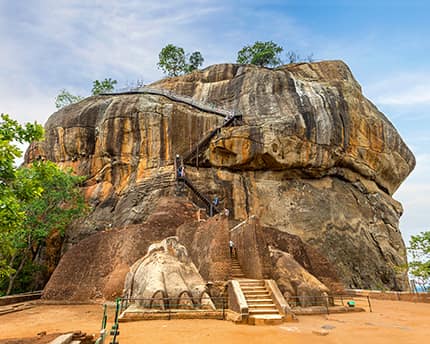
The Sigiriya fresco gallery is reached by a narrow metal spiral staircase attached to the rock face, above the terrace gardens. It is the most exposed point on the climb and the one people with a fear of heights find hardest. There is often a queue on it by mid-morning.
The gallery itself is a shallow ledge, so you move along in a line. Arrive at opening to have a few quiet minutes, and ask your guide to point out the correction lines and the differences between figures before you go up, because there is little room to talk inside.
- →Reached by a narrow, exposed metal spiral staircase.
- →Queues build from mid-morning.
- →The gallery is a shallow ledge; you move through in a line.
- →Get the explanation before you go up, not inside.
Getting the most from the frescoes
The Sigiriya Museum near the ticket office displays reproductions of the frescoes that you can study closely and photograph, which the gallery itself does not allow. Seeing them first makes the real paintings far easier to read.
Lankan Stays & Trails schedules the museum before the climb on every guided Sigiriya morning. Ten minutes with the copies turns a hurried glance in a crowded gallery into something you actually remember.
Frequently asked questions
Who are the women in the Sigiriya frescoes?
Nobody knows for certain. Common interpretations are apsaras, or celestial nymphs, women of King Kashyapa's court, and Senarath Paranavithana's theory that they represent lightning and cloud goddesses. No inscription identifies them.
How many frescoes are there at Sigiriya?
Around twenty female figures survive in the Sigiriya fresco gallery. Traces of plaster on the rock face suggest that many more once existed, with estimates running into the hundreds, but only those protected by the overhang have lasted.
Can you take photos of the Sigiriya frescoes?
Photography in the Sigiriya fresco gallery has been prohibited in recent years to protect the paintings, and attendants enforce it. Rules can change, so check the signage on the day. The Sigiriya Museum displays reproductions that can be studied and photographed.
How old are the Sigiriya frescoes?
The Sigiriya frescoes date to the late fifth century, during King Kashyapa's reign of roughly 477 to 495 CE. That makes them roughly fifteen hundred years old and among the finest surviving ancient paintings in South Asia.
Were the Sigiriya frescoes damaged?
Yes. In 1967 vandals attacked several figures with paint. Conservators restored most of the damage, and access and photography in the gallery have been tightly controlled since. Light, humidity and touch remain ongoing threats.
Is the spiral staircase to the frescoes scary?
Some people find it so. The metal spiral staircase to the fresco gallery is narrow and fixed to the open rock face, with views straight down. It is enclosed by railings and mesh, and taking it slowly, looking at the steps rather than out, helps most people.
Are the frescoes and the mirror wall the same thing?
No. The frescoes are paintings in a sheltered pocket higher on the rock. The mirror wall is a polished plaster wall along the gallery path below, covered in more than 1,800 graffiti left by visitors, many of them responding to the paintings.