
Quick answer
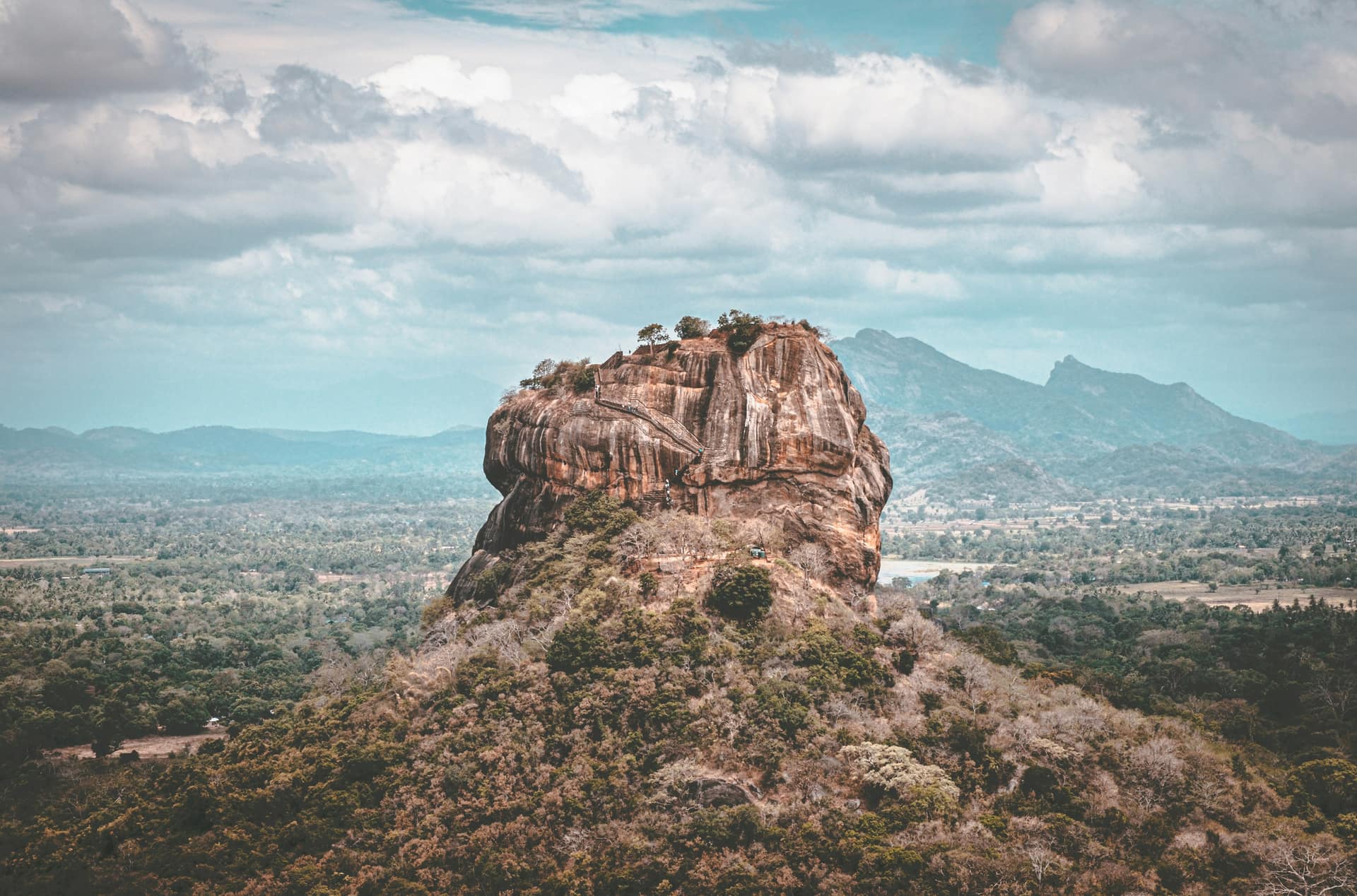
Sigiriya is a fifth-century royal citadel built by King Kashyapa, who reigned roughly 477 to 495 CE, on and around a granite monolith rising roughly 200 metres above the plain of Sri Lanka's Cultural Triangle. A full visit takes two to three hours and roughly 1,200 steps, passing the water gardens, boulder gardens, the fresco gallery, the mirror wall and the lion's paws before the summit palace. Arrive at opening, around 7am, and allow a morning.
Key takeaways
- Sigiriya was King Kashyapa's capital for roughly eighteen years, from about 477 to 495 CE, and a Buddhist monastery for centuries before and after.
- The site is a planned city, not just a rock: water gardens, boulder gardens, terraces, two moats and the Sigiriya Wewa tank all belong to one design.
- Around twenty painted women survive in the fresco gallery, and more than 1,800 visitor poems were scratched into the mirror wall between roughly the 8th and 10th centuries.
- The climb is roughly 1,200 steps and two to three hours, with almost no shade above the boulder gardens.
- Sigiriya has been a UNESCO World Heritage Site, listed as the Ancient City of Sigiriya, since 1982.
What Sigiriya actually is
Sigiriya is an ancient city in Sri Lanka's Cultural Triangle, built around a single granite monolith that rises roughly 200 metres from flat dry-zone forest. King Kashyapa made it his capital in the late fifth century, putting a palace on the summit, a lion gateway halfway up and a planned city of gardens, ramparts and moats at its foot.
The rock's history is far longer than Kashyapa's reign. People sheltered under its boulders thousands of years earlier, Buddhist monks lived in its caves from roughly the 3rd century BCE, and after the king's death the site returned to the monks for several more centuries. The Sigiriya you climb is all of those layers at once.
- →Prehistoric occupation at the Aligala rock shelter, several thousand years ago.
- →Buddhist cave monasteries from roughly the 3rd century BCE.
- →Kashyapa's royal capital, roughly 477 to 495 CE.
- →A monastery again until roughly the 13th or 14th century.
- →Rediscovered by the British in 1831; UNESCO-listed in 1982.
The story behind Sigiriya
King Kashyapa seized the throne of Anuradhapura from his father, King Dhatusena, who was killed on his orders. The rightful heir, Kashyapa's half-brother Moggallana, fled to India. Kashyapa moved his court to Sigiriya, a rock that was both defensible and spectacular, and built there for the rest of his reign.
In 495 CE Moggallana returned with an army. Kashyapa rode out to meet him, and the chronicles record that he died on the battlefield. Moggallana moved the capital back to Anuradhapura and gave the rock to the Buddhist monks. The full account, and how far to trust the chronicles, is in our page on King Kashyapa and the story of Sigiriya.
The Sigiriya site, part by part
Sigiriya's visitor route runs east from the western entrance along a single axis, so the site unfolds in a fixed order. Each part below has its own page on this site, and together they take roughly two to three hours at a steady pace.
- →Moats and ramparts: an outer and inner moat enclose the western precinct, with the Sigiriya Wewa tank to the south.
- →Water gardens: symmetrical pools, island pavilions and gravity-fed fountains laid out on the east-west axis.
- →Boulder gardens: natural boulders carved into shelters, including the Cobra Hood Cave and the Audience Hall rock.
- →Fresco gallery: a sheltered pocket in the rock face where around twenty painted women survive.
- →Mirror wall: a once-polished plaster wall covered in more than 1,800 visitor verses.
- →Lion's paw terrace: the halfway platform where two giant paws remain of a brick lion gateway.
- →Summit palace: roughly 1.5 hectares of foundations, cisterns and terraces with a view across the plain.
- →Sigiriya Museum: near the ticket office, and best visited before the climb.
What the Sigiriya climb asks of you
The Sigiriya climb is roughly 1,200 steps, most of them stone stairs and the steepest sections on metal staircases bolted to the rock. Most reasonably active adults manage it in about an hour up with rests. The two points people find hardest are the exposed spiral staircase to the fresco gallery and the final stairway above the lion's paws, where the drop is visible.
Heat matters more than fitness. Above the boulder gardens there is almost no shade, and by late morning the dry zone is often in the low thirties Celsius. Starting at opening, around 7am, is the single most useful decision you can make.
- →Roughly 1,200 steps; allow two to three hours in total.
- →Hardest points: the spiral staircase and the stairs above the lion's paws.
- →Wasp and hornet colonies live on the upper face; wire-mesh shelters sit on the route.
- →Carry at least a litre of water per person and wear shoes with grip.
When to visit Sigiriya
Sigiriya lies in Sri Lanka's dry zone, so it is visitable all year. The wettest stretch is roughly October to December, while January to April and June to September are generally drier, with April and May the hottest. Because the island has two monsoons, there is always a good coast to pair with a Sigiriya visit.
Time of day matters more than month. Opening, around 7am, is cool and quiet; the late afternoon is the second-best window, softer in light but hotter on the lower stairs. Poya full-moon days and school holidays bring large domestic crowds, and are worth checking before you fix a date.
Around Sigiriya: what to pair it with
Sigiriya sits at the centre of the Cultural Triangle, which makes it the most practical base for the region. The Dambulla cave temple is roughly 30 to 40 minutes away, Polonnaruwa roughly an hour and a half, and the elephant parks of Minneriya and Kaudulla are close enough for an afternoon safari. Pidurangala, the neighbouring rock, gives the classic view of Sigiriya itself.
Two nights is the minimum we would plan around Sigiriya, and Lankan Stays & Trails builds most Cultural Triangle stays at two or three. That allows the rock at opening one day and Polonnaruwa or a safari the next, without either becoming a rush.
- →Pidurangala: the view of Sigiriya, roughly 45 minutes up with a boulder scramble.
- →Dambulla cave temple: roughly 30 to 40 minutes by road.
- →Polonnaruwa: roughly 1.5 hours, a full day with Gal Vihara.
- →Minneriya, Kaudulla or Hurulu: elephant safaris, park choice depends on season.
- →Ritigala and Aukana: quieter half-days for a third night.
Frequently asked questions
What is Sigiriya famous for?
Sigiriya is famous as the fifth-century rock citadel of King Kashyapa, with a palace on the summit of a roughly 200-metre granite monolith, a gateway of giant lion's paws, painted women in a sheltered fresco gallery and some of the oldest landscaped gardens in Asia. It is a UNESCO World Heritage Site.
How long do you need at Sigiriya?
Allow two to three hours for the climb and the gardens, or three to four with the Sigiriya Museum and a guide. To see the area properly, including Pidurangala, Dambulla and Polonnaruwa, plan two or three nights based in or near Sigiriya.
Who built Sigiriya?
King Kashyapa built the royal city at Sigiriya during his reign of roughly 477 to 495 CE, after seizing the throne from his father. The rock had already been a Buddhist monastic site for centuries, and it returned to the monks after Kashyapa's death.
Is Sigiriya hard to climb?
Sigiriya is moderately hard: roughly 1,200 steps, some on steep metal staircases, with almost no shade above the boulder gardens. Most reasonably active adults manage it in about an hour upwards with rests. The heat is usually harder than the steps, so start at opening.
What time does Sigiriya open?
Sigiriya opens around 7am, with last entry in the late afternoon. Hours can change, so confirm locally the day before. Arriving at opening gives the coolest climb and the emptiest upper staircases before tour groups arrive from mid-morning.
What is the best month to visit Sigiriya?
January to April and June to September are generally the driest months at Sigiriya, with April and May the hottest. The wettest stretch is roughly October to December, when afternoon storms are common but mornings are often still climbable.
Does Lankan Stays & Trails arrange Sigiriya visits?
Yes. We run Sigiriya as part of private, driver-guided Cultural Triangle itineraries, with an opening-time start, a licensed site guide on request and time for the museum. Most trips pair the rock with Dambulla, Polonnaruwa or an elephant safari over two or three nights.