
Quick answer
King Kashyapa built Sigiriya as his royal capital after seizing the throne of Anuradhapura from his father, King Dhatusena, around 477 CE. Fearing his half-brother Moggallana, the rightful heir who had fled to India, Kashyapa ruled from the rock for roughly eighteen years. Moggallana returned with an army in 495 CE, Kashyapa died in the battle that followed, and the capital moved back to Anuradhapura.
Key takeaways
- King Kashyapa ruled Sri Lanka from Sigiriya for roughly eighteen years, from about 477 to 495 CE.
- Kashyapa's father, King Dhatusena, was killed on his orders; the Culavamsa places the death at the Kala Wewa tank.
- Moggallana, Kashyapa's half-brother and the rightful heir, fled to India and returned with an army in 495 CE.
- The main written source is the Culavamsa, a Buddhist chronicle compiled centuries later, so the moral framing should be read with care.
- After Kashyapa's death Sigiriya was given to the Buddhist monks and the capital returned to Anuradhapura.
How King Kashyapa took the throne
King Kashyapa was the elder son of King Dhatusena of Anuradhapura, but his mother was not of royal rank. His half-brother Moggallana, son of the queen, was the heir. With the help of Dhatusena's army commander Migara, Kashyapa deposed his father and took the throne, and Moggallana fled to South India.
The chronicles say Kashyapa demanded to know where his father's treasure was hidden. Dhatusena led him to the Kala Wewa, the great irrigation tank he had built, took water in his hands and said that this was all his wealth. Kashyapa had him killed, and the Culavamsa records that he was walled up alive.
- →Kashyapa was the elder son but not the heir, because of his mother's rank.
- →Moggallana, the heir, fled to South India.
- →The general Migara helped Kashyapa depose Dhatusena.
- →Dhatusena's death is placed at the Kala Wewa tank, near today's Aukana Buddha.
Why Kashyapa chose Sigiriya
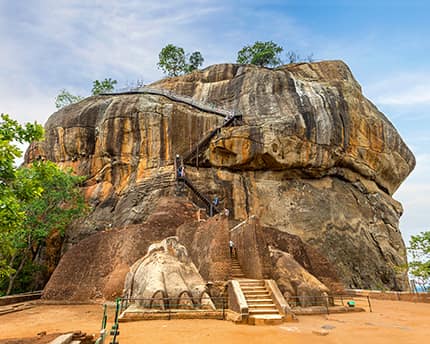
King Kashyapa moved his court from Anuradhapura to Sigiriya, roughly 60 kilometres south-east, and the traditional explanation is fear. A granite monolith roughly 200 metres high with sheer sides is the most defensible site in the region, and a king expecting his brother's army had good reason to want it.
Fear does not explain the gardens, the frescoes or the lion gateway. Kashyapa built a city designed to impress, and some historians read Sigiriya as a statement of kingship as much as a refuge, an attempt to rival the sacred capital he had left. Both readings can be true at once.
Eighteen years at Sigiriya
King Kashyapa's reign at Sigiriya lasted roughly eighteen years, which is the only reason the site exists in its current form. In that time the court built the summit palace, the lion gateway, the moats and ramparts, and the symmetrical water gardens on the western approach, a programme of work on a scale that required a large and organised labour force.
The chronicles are hostile to Kashyapa, but they also record him as a patron of Buddhist monasteries during his reign, and later tradition softened his image. Whether he repented or was simply a practical ruler making peace with the sangha, the record does not let us say.
- →Summit palace, cisterns and terraces on roughly 1.5 hectares.
- →The lion gateway on the halfway terrace, of which only the paws survive.
- →Water gardens, boulder gardens and terrace gardens below.
- →An inner and outer moat with ramparts on the western side.
The battle of 495 CE and Kashyapa's death
In 495 CE Moggallana returned from South India with an army. King Kashyapa came down from Sigiriya to fight in the open rather than wait on the rock. The Culavamsa says that during the battle his war elephant turned aside to avoid marshy ground, his troops took it for a retreat and broke, and Kashyapa, left alone, took his own life with his dagger.
Moggallana became king, moved the capital back to Anuradhapura and handed Sigiriya to the Buddhist monks. The palace on the summit was left to decay, and the rock's second monastic life began.
How much of the Kashyapa story to trust
The Kashyapa story comes mainly from the Culavamsa, the continuation of the Mahavamsa chronicle, written by Buddhist monks and compiled centuries after the events. It is a moral history as much as a factual one, and a king who killed his father was always going to be cast as a villain.
Archaeology confirms that Sigiriya was built in a short, intense period in the late fifth century, which fits the chronicle's dates. The details of Dhatusena's death and the elephant at the battle cannot be checked. A good site guide will tell you which parts are chronicle and which are evidence, and that distinction is worth asking for.
- →Confirmed: a short, intense building period at Sigiriya in the late fifth century.
- →Confirmed: the site's return to monastic use afterwards.
- →Chronicle only: Dhatusena walled up at Kala Wewa, and the elephant at the battle.
- →Debated: whether Sigiriya was mainly a palace, a monastery or both.
Seeing Kashyapa's story at Sigiriya today
The Kashyapa story is easiest to feel at three points on the climb: the water gardens, which only a king with a large workforce could have commissioned; the lion's paws, the gateway to a palace built to be seen; and the summit, where the throne platform looks back towards Anuradhapura.
The Aukana Buddha, beside the Kala Wewa tank where Dhatusena is said to have died, is roughly an hour to an hour and a half from Sigiriya. Lankan Stays & Trails often pairs the two on a second or third day, because the tank gives the rock its ending.
Frequently asked questions
Who was King Kashyapa?
King Kashyapa, also written Kasyapa, ruled Sri Lanka from roughly 477 to 495 CE. He was the elder son of King Dhatusena, took the throne by deposing and killing his father, and moved the capital from Anuradhapura to Sigiriya, where he built the royal city that survives today.
Why did Kashyapa build Sigiriya?
The traditional answer is defence: Kashyapa feared his half-brother Moggallana, the rightful heir, and a sheer granite rock was the safest capital available. The gardens, frescoes and lion gateway suggest he also wanted a capital that displayed royal power to rival Anuradhapura.
How did King Kashyapa die?
According to the Culavamsa chronicle, Kashyapa died in 495 CE in battle against Moggallana. When his elephant turned aside to avoid marshy ground, his army took it for a retreat and scattered, and Kashyapa took his own life with his dagger.
What happened to Sigiriya after Kashyapa?
After Kashyapa's death Moggallana moved the capital back to Anuradhapura and gave Sigiriya to the Buddhist sangha. The rock served as a monastery for several more centuries, roughly until the 13th or 14th century, before it was largely abandoned to the forest.
How long did Kashyapa rule from Sigiriya?
Roughly eighteen years, from about 477 to 495 CE. That short reign is why Sigiriya's royal buildings date to one intense construction period, and why the site was never extended as a capital by later kings.
Is the story of Kashyapa true?
The outline is broadly supported: archaeology dates Sigiriya's royal buildings to the late fifth century, matching the chronicle. Details such as Dhatusena being walled up and the elephant at the final battle come only from the Culavamsa, a Buddhist chronicle written centuries later.