
Quick answer
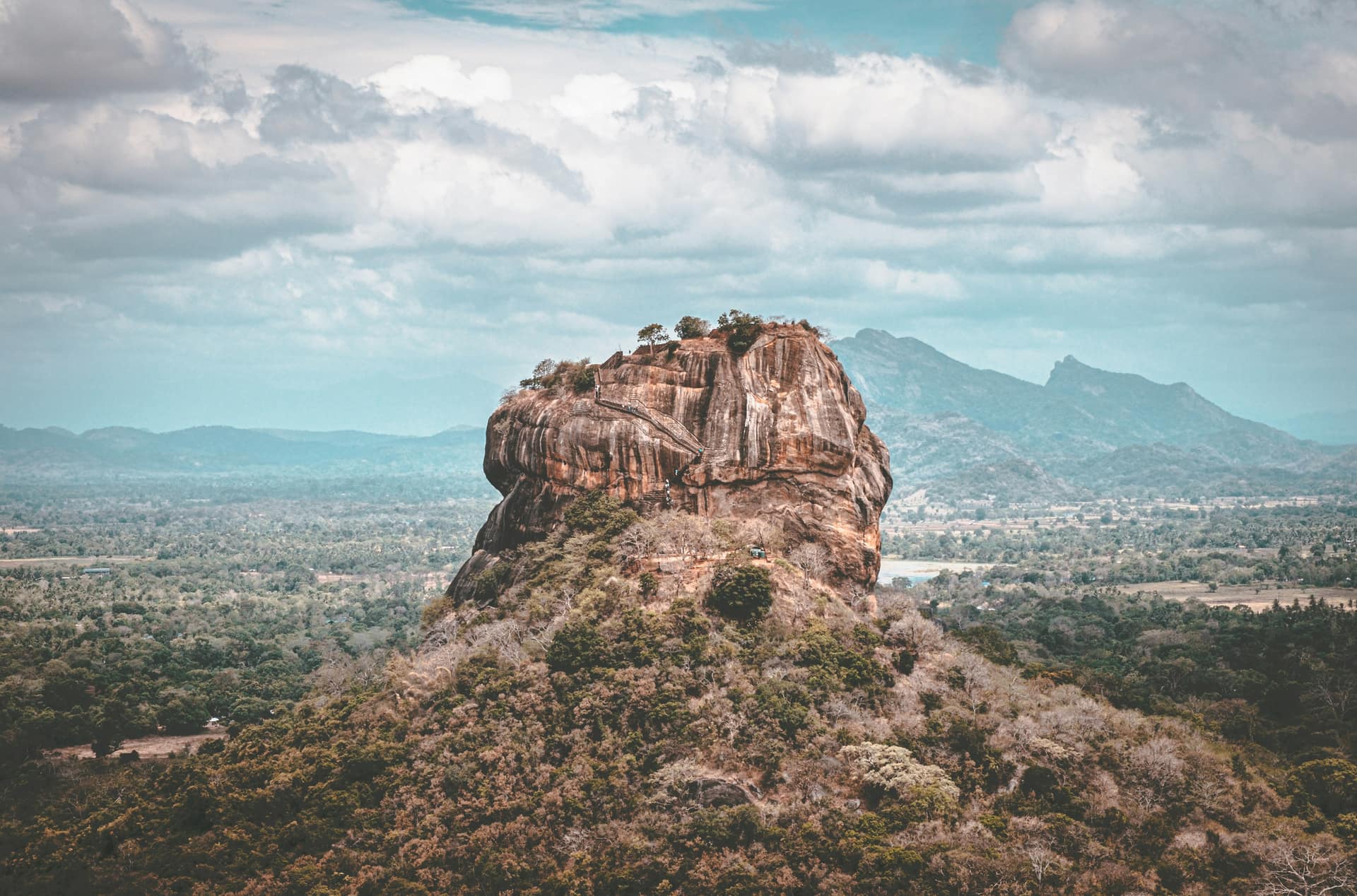
Sigiriya means lion rock. The name comes from Sinhagiri, from sinha, lion, and giri, rock or mountain, and the medieval graffiti on the mirror wall spell it Sihigiri. The lion was literal: King Kashyapa built a colossal brick-and-plaster lion on the halfway terrace, with the final staircase passing through its open mouth. Only the two giant paws survive, which is why the terrace is called the lion's paw terrace.
Key takeaways
- Sigiriya derives from Sinhagiri: sinha means lion and giri means rock or mountain.
- The mirror-wall graffiti, mostly from roughly the 8th to 10th centuries, call the rock Sihigiri.
- The name refers to a real brick-and-plaster lion gateway built on the halfway terrace in Kashyapa's time.
- Only the lion's two front paws survive, uncovered during H. C. P. Bell's excavations from the 1890s.
- The lion is also the symbol of the Sinhala people, whose name shares the same root.
Sigiriya, word by word
Sigiriya is a modern form of Sinhagiri, a compound of two words shared by Sinhala, Pali and Sanskrit. Sinha means lion, and giri means rock, hill or mountain. The name therefore means lion rock or lion mountain, which is why the English name Lion Rock is a translation rather than a nickname.
Spellings vary. Older sources write Sigiri, the medieval graffiti use Sihigiri, and English texts sometimes use Sigiriya Rock, which is a slight redundancy. All refer to the same place.
- →Sinha: lion.
- →Giri: rock, hill or mountain.
- →Sinhagiri: the classical form.
- →Sihigiri: the form used in the mirror-wall graffiti.
- →Sigiriya: the modern name, often translated as Lion Rock.
The real lion at Sigiriya
King Kashyapa's builders made a colossal lion on the halfway terrace of Sigiriya, the plateau at the foot of the final ascent. It was built of brick and covered in plaster, and it seems to have been shaped so that the final staircase to the summit passed up through the lion's open mouth and body.
The effect would have been deliberate theatre: a visitor to the palace walked into a lion and emerged at the top of the rock. The head and body have long since collapsed. The two enormous front paws, with carved claws, survive on either side of the stairway.
Why a lion?
The lion is the emblem of Sinhala kingship and of the Sinhala people, whose name comes from the same root. The origin legend of Prince Vijaya traces the royal line to a lion, and the lion appears on the national flag today.
For Kashyapa, a king whose claim to the throne was contested, building a gateway in the form of a lion was a statement of legitimacy as much as decoration. It turned his capital into an emblem of kingship that nobody arriving at the palace could miss.
- →The lion is the emblem of Sinhala kingship.
- →The Sinhala people's name shares the root sinha.
- →The Vijaya origin legend traces the royal line to a lion.
- →A lion gateway asserted legitimacy for a contested king.
Seeing the lion's paws today
The lion's paws at Sigiriya sit on the halfway terrace, reached after the fresco gallery and the mirror wall. They were buried under the debris of the collapsed lion until H. C. P. Bell's excavations uncovered them from the 1890s.
The paws are large enough that a person standing between them looks small, which is the best way to photograph them. The terrace is also where the final metal stairway to the summit begins, and where many visitors pause before the steepest part of the climb.
Other names around Sigiriya
The name Sigiriya now covers the village, the wider area and the rock itself. Pidurangala, the neighbouring rock, has its own name and its own history as a monastery. Sigiriya Wewa, the tank to the south, takes the rock's name.
When locals say Sigiriya they may mean the village rather than the site, which matters when giving directions. Lankan Stays & Trails drivers generally refer to the rock as the fortress or the site to avoid that confusion.
- →Sigiriya: the rock, the ancient city, the village and the area.
- →Pidurangala: the neighbouring rock to the north.
- →Sigiriya Wewa: the tank on the south side.
- →Lion Rock: the English translation of Sigiriya.
Frequently asked questions
What does Sigiriya mean?
Sigiriya means lion rock. It comes from Sinhagiri, combining sinha, lion, and giri, rock or mountain. The name refers to a colossal brick lion gateway that once stood on the rock's halfway terrace.
Why is Sigiriya called Lion Rock?
Because King Kashyapa built a giant brick-and-plaster lion on the halfway terrace, with the staircase to the summit passing through its mouth. The body has collapsed, but the two front paws survive, and the English name Lion Rock is a direct translation of Sigiriya.
How do you pronounce Sigiriya?
A close English approximation is SEE-gi-ri-ya, with a light stress on the first syllable and the g pronounced hard, as in give. Locals often say it quickly, so it may sound closer to SEE-gree-ya in conversation.
What is Sihigiri?
Sihigiri is the form of the name used in the mirror-wall graffiti, mostly written between roughly the 8th and 10th centuries. It is an older Sinhala form of Sinhagiri, lion rock, and appears in many of the verses visitors wrote about the frescoes.
Was there really a lion at Sigiriya?
Yes. A colossal lion made of brick and plaster stood on the halfway terrace. Visitors climbed the final staircase through its mouth. Only the two giant paws survive, uncovered during excavations from the 1890s.
Is Sigiriya the same as Lion Rock?
Yes. Lion Rock is the English translation of Sigiriya. Both names refer to the same granite monolith and ancient city in Sri Lanka's Cultural Triangle, a UNESCO World Heritage Site since 1982.