
Quick answer
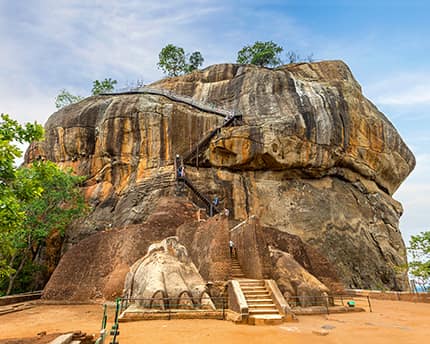
The lion's paw terrace is a plateau on the north side of Sigiriya, roughly halfway up, where a colossal brick-and-plaster lion once formed the gateway to the summit palace. Visitors climbed through its open mouth. Only the two enormous front paws survive, uncovered in excavations from the 1890s. From the terrace, a steep metal stairway climbs the final section to the summit, typically 15 to 25 minutes.
Key takeaways
- The lion's paw terrace is a broad plateau on the north side of Sigiriya, at roughly the halfway point of the climb.
- King Kashyapa's builders made a colossal lion of brick and plaster here, with the stairway passing through its mouth.
- Only the two front paws survive, uncovered during H. C. P. Bell's excavations from the 1890s.
- The final stairway from the terrace to the summit typically takes 15 to 25 minutes and is the most exposed stretch.
- Wire-mesh shelters on the terrace protect visitors if the wasp and hornet colonies on the rock face are disturbed.
What the lion's paw terrace is
The lion's paw terrace is a flat plateau on the northern side of Sigiriya, reached after the fresco gallery and the mirror wall. It forms a natural landing between the lower climb and the sheer final ascent, and it is where King Kashyapa placed the gateway to his summit palace.
The terrace is broad enough for groups to gather, and it has some shade in the morning. It is the obvious rest stop on the climb, and most people spend ten to fifteen minutes here before the last section.
The lion that was
Kashyapa's builders made a colossal lion on the terrace, built of brick and finished in plaster, attached to the face of the rock. The stairway to the summit passed up through the lion's open mouth and body, so that visitors entered the palace by walking through the lion.
The head and body have collapsed and disappeared, leaving scars and brickwork on the rock face above. The two front paws, with carved claws and large enough to dwarf a person standing between them, survive on either side of the stairway entrance.
- →Built of brick and plaster against the rock face.
- →The stairway passed through the lion's open mouth.
- →The head and body collapsed long ago.
- →The two front paws, with carved claws, remain.
How the paws were found
The lion's paws at Sigiriya were buried under debris from the collapsed lion until H. C. P. Bell's excavations from the 1890s cleared the terrace. Before that, visitors saw a mound of rubble at the foot of the rock face rather than the gateway.
Bell's discovery gave the name Lion Rock a physical meaning again, and the paws have been the terrace's centrepiece ever since.
Wasps and hornets at the lion's paw terrace
The rock face above the lion's paw terrace is home to wasp and hornet colonies, which can become aggressive if disturbed by noise, smoke or strong smells. The terrace has wire-mesh shelters for visitors to enter if an attack begins, and site staff sometimes close the upper stairway on bad days.
Keep your voice down on the terrace and the final stairs, avoid strong perfume or insect repellent with heavy scent, and follow staff instructions immediately. Attacks are uncommon, but they are the reason for the shelters.
- →Keep noise low on the terrace and upper stairs.
- →Avoid strong perfume and heavily scented products.
- →Know where the wire-mesh shelters are.
- →Follow staff instructions without delay.
The final climb from the lion's paws
The final stairway from the lion's paw terrace to the summit of Sigiriya is the steepest and most exposed part of the climb. It runs up the bare rock on metal steps and handrails, with old footholds cut into the rock visible beside it. Most people take 15 to 25 minutes.
If anyone in your group is unsure about heights, this is the place to decide. The terrace is a worthwhile end point in its own right, with good views over the gardens, and those who stay can wait in the shade while others go up.
- →Steep metal stairway on bare rock, with handrails.
- →Typically 15 to 25 minutes to the summit.
- →The most exposed part of the climb.
- →The terrace is a fine place to stop if heights are a problem.
Timing the lion's paw terrace
At opening, around 7am, most visitors reach the lion's paw terrace within 45 minutes to an hour of entering. By mid-morning it can be crowded, with queues forming at the foot of the final stairway.
Lankan Stays & Trails plans its Sigiriya mornings so that groups reach the terrace before the tour-bus peak, and guides use the stop to tell the lion's story while everyone recovers. For the best photograph, stand a person between the paws for scale.
Frequently asked questions
What is the lion's paw at Sigiriya?
The lion's paws are the surviving front paws of a colossal brick-and-plaster lion that formed the gateway to Kashyapa's summit palace. The stairway passed through the lion's mouth. The rest of the lion collapsed long ago.
How far up Sigiriya is the lion's paw terrace?
Roughly halfway, on the north side of the rock, after the fresco gallery and the mirror wall. Most visitors reach it within 45 minutes to an hour of entering at opening, depending on pace and queues.
How long is the climb from the lion's paws to the summit?
Typically 15 to 25 minutes. It is the steepest and most exposed section of the Sigiriya climb, on metal stairs with handrails up the bare rock face. Take it slowly and hold the handrails on both sides.
Can you stop at the lion's paws and not go to the top?
Yes. Many visitors who are uncomfortable with heights stop at the lion's paw terrace, which has views over the gardens and some shade in the morning. Others in the group can continue and return the same way.
Are there hornets at the lion's paw terrace?
Wasp and hornet colonies live on the rock face above the terrace. Attacks are uncommon but possible if they are disturbed. Wire-mesh shelters are provided, and staff sometimes close the upper stairs on bad days.
Was there really a lion at Sigiriya?
Yes. The colossal lion was made of brick and plaster and built against the rock face on the terrace, with the stairway leading through its mouth. It gave Sigiriya its name, which means lion rock.