
Quick answer
A good stay in Sigiriya lasts two to three nights. Climb Sigiriya rock when it opens at around 7 am on one morning, and climb Pidurangala for sunrise on another, starting at about 5.15 am. Fill the hot middle of the day with a pool, a cooking class or a rest, and spend late afternoons in the villages, on a tank bund or on a safari. Choose your stay by type first, from treehouse to resort, then by area.
Key takeaways
- Two to three nights in Sigiriya allows both rocks, a sunrise, a safari or day trip and at least one slow local afternoon.
- Sigiriya rock normally opens around 7 am, after sunrise, so sunrise itself is best watched from Pidurangala, a hotel or the tank bund.
- Pidurangala takes roughly 30 to 45 minutes to climb, ends in a short scramble and gives the classic view of Sigiriya rock.
- The range of stays is unusually wide for a rural area, from treehouses and homestays to eco lodges and large resorts with pools.
- Local experiences such as cooking classes, farm visits, village walks and temple visits are best placed in the afternoons and evenings.
The shape of a good Sigiriya stay
The shape of a good Sigiriya stay follows the heat. The dry zone is warm from mid-morning to mid-afternoon for most of the year, so the best hours for climbing and walking are early, from about 5.30 am to 10 am, and late, from about 3.30 pm until dark at roughly 6.30 pm. The middle of the day is for food, shade, a pool or a class indoors.
Within that pattern, two mornings do the heavy lifting. One goes to Sigiriya rock at opening and the other to Pidurangala at sunrise. The rest of the stay is built from shorter pieces: a safari at Minneriya, Kaudulla or Hurulu in the afternoon, a trip to Dambulla or Polonnaruwa, a cooking class, a village walk or simply time by the pool.
That is why two nights is the minimum and three is comfortable. On a single night, you have to choose between the rocks and you will feel rushed. With three, the stay becomes the restful middle of a Sri Lanka trip rather than a box ticked between long drives.
- →Mornings, about 5.30 to 10 am: climbs, walks and birds.
- →Middle of the day: lunch, rest, pool, ayurveda or a cooking class.
- →Late afternoon, about 3.30 to 6.30 pm: safaris, villages, sunsets.
- →Evenings: dinner at your stay, early to bed for the next dawn.
Sigiriya rock in one morning
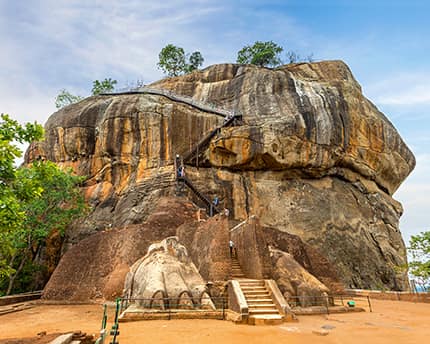
Sigiriya rock is the reason most people come, and it deserves an unhurried morning. Arrive at the ticket office before it opens at around 7 am, pass through the water gardens and boulder gardens, climb past the frescoes and the mirror wall to the lion's paws, and finish on the summit before the heat builds. Allow roughly two to three hours, or three to four with a guide and the museum.
The site is covered in detail elsewhere on this site, from the history of King Kashyapa to each stage of the climb, so this guide does not repeat it. The point for planning a stay is simple. Put the rock on a morning when you are rested, keep the afternoon free, and do not try to fit it into an arrival or departure day if you can avoid it.
Pidurangala, the second rock
Pidurangala is the rock roughly 1 to 2 km north of Sigiriya, reached in 5 to 10 minutes by tuk-tuk from the village. Tickets are sold at the temple at its base for a modest fee. A path of uneven stone steps climbs through forest, past a large brick reclining Buddha, to a short boulder scramble and a broad summit that faces Sigiriya across the forest.
Most people climb it for sunrise, starting at about 5.15 to 5.30 am, which means a torch and a little nerve on the steps. Others prefer it at sunset, when the light falls on Sigiriya's western face. Either way, it is a more physical climb than Sigiriya's built staircases, but much shorter, at roughly 30 to 45 minutes to the top.
- →Distance from the village: roughly 1 to 2 km.
- →Climb: roughly 30 to 45 minutes, steeper and rougher than Sigiriya.
- →Last section: a boulder scramble of 5 to 10 minutes using your hands.
- →Dress: shoulders and knees covered at the temple at the base.
Sunrise and the early hours
Sunrise in Sigiriya falls roughly between 5.50 am and 6.30 am through the year, which is before the main rock normally opens. That surprises many visitors, who expect to watch the sun come up from the summit. In practice the best sunrise places are Pidurangala, the bund of the Sigiriya tank, a hotel terrace with a view of the rock, or a hot air balloon in season.
Clouds are part of the gamble, especially from October to December. A grey dawn still has its rewards: cooler air, birdsong, mist in the forest and empty paths. Treat sunrise as a bonus of an early start rather than the only reason for it.
Where to stay, by type
Where to stay in Sigiriya is best decided by type of stay before area. The choice is unusually wide for a rural district: treehouse rooms on stilts, family homestays, simple guesthouses and hostels, mid-range hotels with pools, eco lodges in the scrub, villas for groups and a handful of large resorts, several of them a short drive from the rock.
Area matters less than people expect, because almost everywhere is within about 10 to 20 minutes of the rock by tuk-tuk. The real differences are atmosphere, food, the pool, the view of the rock and how easy early starts are. Kandalama, roughly 30 to 40 minutes away, suits a resort stay, while Sigiriya village suits walkers and early risers.
Prices follow the island's usual pattern. Budget travellers manage on roughly US$30-50 a day each, mid-range on roughly US$80-180, and luxury from roughly US$250, with rooms the largest part of the bill.
- →Treehouses and eco lodges: nature and sounds of the forest.
- →Homestays and guesthouses: home cooking and local hosts.
- →Mid-range and resort hotels: pools, space and comfort.
- →Villas: groups and families who want a base to themselves.
Local life and experiences
Local life around Sigiriya is farming life. Villages are strung along tanks and paddy fields, and the year turns on two rice seasons, Maha from roughly October to March and Yala from roughly April or May to September. That gives visitors plenty to see without anything staged: farmers in the fields, buffalo in the tanks, roadside stalls selling curd and treacle, small temples and weekly markets.
The most rewarding experiences are the simplest. A cooking class in a village kitchen, an early bird walk, a walk between paddy fields at sunset or a visit to a village temple tells you more than a packaged tour. Choose hosts who are paid directly and fairly, and avoid anything that uses animals or children as props.
At Lankan Stays & Trails we plan Sigiriya stays with at least one free afternoon, because that is when most of these encounters happen.
Planning your stay
Planning a stay in Sigiriya starts with the number of nights. Two nights covers both rocks and one afternoon activity. Three nights adds a safari, a day trip to Polonnaruwa or Dambulla and a slow day. Four or more turns Sigiriya into a base for the Cultural Triangle, with day trips to Anuradhapura, Ritigala or Aukana.
Then fix the mornings. Put Sigiriya rock on the first full morning and Pidurangala on the second, or the other way round if the forecast favours it. Book the stay, the cooking class and any safari once the mornings are set, and leave space for the weather.
Frequently asked questions
How many nights should you stay in Sigiriya?
Two nights is the minimum for a relaxed visit, because it allows Sigiriya rock on one morning and Pidurangala at sunrise on another. Three nights is better, adding a safari, a day trip to Polonnaruwa or Dambulla and an afternoon of local experiences without rushing any of them.
Can you see sunrise from Sigiriya rock?
Not under normal opening hours. The rock opens at around 7 am, while sunrise falls roughly between 5.50 am and 6.30 am. For sunrise, most travellers climb Pidurangala, which opens earlier, or watch from the Sigiriya tank bund or a hotel terrace with a view of the rock.
Is Pidurangala better than Sigiriya?
Neither is better, because they do different things. Sigiriya is the historic site, with gardens, frescoes and the summit palace. Pidurangala is a shorter, rougher climb that gives the famous view of Sigiriya rock, especially at sunrise. With two nights, most travellers climb both on different mornings.
Where is the best place to stay in Sigiriya?
The best place depends on the type of stay you want more than the area. Sigiriya village suits walkers and early risers, the Pidurangala road suits sunrise climbers, and the Kandalama area suits resort stays. Almost everywhere is within about 10 to 20 minutes of the rock by tuk-tuk.
What is there to do in Sigiriya apart from the rock?
Apart from the rock, you can climb Pidurangala, take an elephant safari at Minneriya, Kaudulla or Hurulu, join a cooking class, walk through paddy fields and villages, visit a village temple, take an ayurveda treatment or make day trips to Dambulla and Polonnaruwa.
When is the best time of year for a stay in Sigiriya?
The driest months are roughly January to April and June to September, with April and May the hottest. October to December brings more rain and cloud, though mornings are often clear enough to climb. Sigiriya is visited all year, and a stay of two or three nights gives you a weather buffer.