
Quick answer
During the Kandy Esala Perahera, let the procession date decide the order. If it falls in the opening days of your trip, keep the standard order and reach Kandy early. If it falls late, consider running Ella first and arriving in Kandy on the way back north. The perahera is usually held in July or August, though the dates shift each year with the lunar calendar and must be confirmed before booking.
Key takeaways
- The Kandy Esala Perahera is usually held in July or August, with dates shifting by the lunar calendar.
- Kandy sits in the middle of the standard route, so a fixed date there constrains everything either side.
- The final nights of the procession are the largest and the hardest to find accommodation for.
- A perahera date in the opening days keeps the standard order; a late date may justify reversing.
- July and August fall in the south-west monsoon, so the coastal section should be on the east coast.
What the perahera is and when it happens
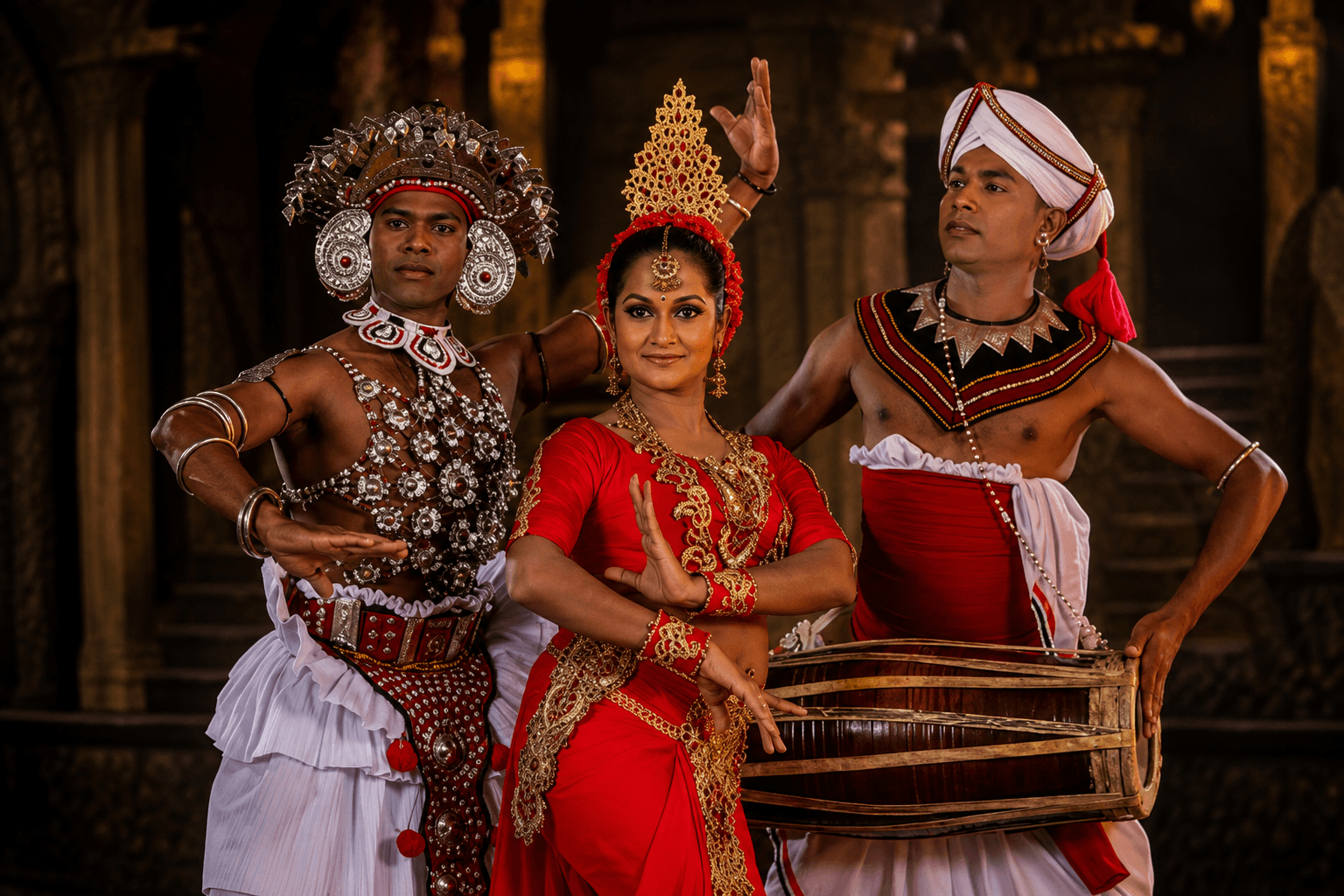
The Esala Perahera is a procession held in Kandy honouring the Sacred Tooth Relic, housed at the Temple of the Sacred Tooth Relic. It runs over a series of nights, building in scale, with caparisoned elephants, Kandyan dancers, drummers, whip-crackers and fire performers.
It is usually held in July or August, but the dates shift each year with the lunar calendar and are announced rather than fixed in advance. Any date you read more than a year ahead should be treated as an estimate and confirmed before booking anything around it.
The nights build towards the final and largest processions, known as the Randoli Perahera, which are the ones most visitors want to see and also the ones where accommodation and viewing space are hardest to secure.
- →Held in Kandy, honouring the Sacred Tooth Relic.
- →Usually July or August; dates shift each year with the lunar calendar.
- →Runs over a series of nights, building in scale.
- →The final Randoli nights are the largest and busiest.
Why one fixed date constrains the whole route
Kandy sits in the middle of the standard route, between the Cultural Triangle and the hill country. A fixed date there means the days before it and the days after it are both determined, which is unusual in a Sri Lankan itinerary where most stops can slide.
If the procession falls on, say, your fourth night, the standard order works perfectly: two nights at Sigiriya, one further night wherever it fits, then Kandy for the perahera, then the train to Ella. Nothing needs to change.
If it falls on your ninth night, the standard order would put you in Kandy on day three and back in Kandy on day nine, which means doubling back. That is the situation where running Ella first and arriving in Kandy on the return leg produces a cleaner route.
- →Kandy sits mid-route, so a fixed date there determines both sides.
- →An early perahera date works with the standard order unchanged.
- →A late date would otherwise force a return to Kandy.
- →Doubling back through the Kandy corridor is the failure to avoid.
Running it in reverse for a late perahera
The reversed version runs the hill country first and the Cultural Triangle second. Arrive and take a night near the airport or in Colombo, drive up to Nuwara Eliya or board the train at Nanu Oya for Ella, spend two or three nights in the hill country, then come down to Kandy for the procession.
After the perahera, continue north to Sigiriya for two nights and out to the airport in roughly four to five hours, or to Trincomalee on the east coast, which is in season in July and August and sits within reasonable reach of the Cultural Triangle.
That version places the Sigiriya climb late, around day eight or nine, so protect it: a light day beforehand and a firm commitment to the opening start around seven. Lankan Stays and Trails builds this shape most years for travellers whose dates fall against the standard order.
- →Airport night, then the hill country, then Kandy for the procession.
- →Continue north to Sigiriya, then out to the airport or to Trincomalee.
- →Trincomalee is in season in July and August.
- →Protect the late Sigiriya climb with a light day before it.
Accommodation and viewing
Kandy accommodation is heavily booked and expensive around the procession, particularly on the final nights, and minimum stays are common. Properties with a view over the route charge a substantial premium, and seats on balconies along the streets are sold separately and well in advance.
Staying outside Kandy and travelling in is possible but the roads close and crowds are very large, so it involves a long evening and an uncertain return. Most travellers who have done both prefer to pay for the night in the town.
Book further ahead than you would for anything else in the itinerary. This is the one element where a late decision genuinely removes the option rather than merely raising the price.
- →Kandy accommodation is heavily booked and expensive around the procession.
- →Minimum stays are common over the final nights.
- →Balcony viewing seats are sold separately and well in advance.
- →Road closures make travelling in from outside a long and uncertain evening.
What July and August mean for the rest of the trip
The perahera falls in the south-west monsoon window, which affects the south and west coasts. That means the beach section of a perahera trip should be on the east coast rather than at Mirissa, using Trincomalee, Nilaveli or Pasikuda.
This works in the route's favour. Trincomalee sits within reasonable reach of Sigiriya and Habarana, so a trip that ends in the Cultural Triangle after the procession can run out to the east coast rather than back to the airport, which is one of the few cases where a northern finish is genuinely convenient.
Whale watching also moves with the season, running off Trincomalee roughly May to September. As always, choose operators that keep their distance and do not chase or encircle animals, and treat a guaranteed-sighting promise as a warning rather than a selling point.
- →July and August fall in the south-west monsoon window.
- →Put the beach section on the east coast: Trincomalee, Nilaveli or Pasikuda.
- →Trincomalee sits within reach of the Cultural Triangle.
- →Whale watching off Trincomalee runs roughly May to September.
Frequently asked questions
When is the Kandy Esala Perahera?
Usually in July or August, though the dates shift each year with the lunar calendar and are announced rather than fixed far in advance. Any date found more than a year ahead should be treated as an estimate and confirmed before booking.
Should I change my route to see the Esala Perahera?
Only the order, and only if the date falls late in your trip. Kandy sits mid-route, so an early procession date works with the standard order unchanged, while a late one may justify running Ella first and reaching Kandy on the way back north.
How far ahead should I book Kandy for the perahera?
Further ahead than anything else in the itinerary. Accommodation is heavily booked and expensive, minimum stays are common over the final nights, and balcony viewing seats along the route are sold separately and well in advance.
Can I stay outside Kandy and travel in for the perahera?
It is possible but awkward. Roads close, crowds are very large, and the return afterwards is slow and uncertain. Most travellers who have tried both prefer to pay the premium for a night in the town rather than manage the journey.
Which nights of the perahera are best?
The final nights, known as the Randoli Perahera, are the largest and the ones most visitors want. They are correspondingly the hardest for accommodation and viewing space, so earlier nights are a reasonable compromise if booking late.
What is the weather like in Sri Lanka during the perahera?
July and August fall in the south-west monsoon, which affects the south and west coasts. The Cultural Triangle stays comparatively dry and the east coast around Trincomalee is in its season, so the beach section should move east.
Does the perahera affect the rest of my Sri Lanka trip?
Mainly through Kandy accommodation and road closures on procession nights. The rest of the country operates normally, though domestic travel increases. Build the itinerary outwards from the procession date rather than fitting it in afterwards.