
Quick answer
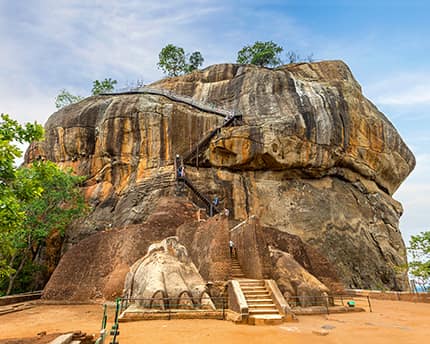
The best photographs of Sigiriya are taken from outside the site: from Pidurangala at sunrise, from the bund of Sigiriya Wewa in late afternoon, and from the paddy fields and roads around the village. On the site itself, the water gardens reflect the rock at opening, the lion's paws need a person for scale, and the summit looks straight down on the gardens. Photography in the fresco gallery has been prohibited in recent years, and drones need prior permission.
Key takeaways
- The classic image of Sigiriya is taken from Pidurangala, roughly 45 minutes' climb away, ideally at sunrise.
- The bund of Sigiriya Wewa gives the rock reflected in water in the late afternoon.
- On site, the water gardens reflect the rock best at opening, around 7am, with low light and still water.
- Photography in the fresco gallery has been prohibited in recent years; the Sigiriya Museum has reproductions.
- Drones are prohibited at Sigiriya without prior written permission.
The best views of Sigiriya from outside
You cannot photograph Sigiriya's full profile while standing on it. The strongest images of the rock are taken from around it, and the best of them from Pidurangala, the neighbouring rock to the north. At sunrise, with mist on the plain, it is the definitive Sigiriya photograph.
Other viewpoints are easier to reach. The bund of Sigiriya Wewa, the tank to the south, gives the rock reflected in still water in the late afternoon. The paddy fields and village roads around Sigiriya give the rock rising behind rural scenes, which often photographs more interestingly than the rock alone.
- →Pidurangala: the classic view, best at sunrise.
- →Sigiriya Wewa bund: reflections in the late afternoon.
- →Paddy fields and village roads: the rock in its landscape.
- →Hotel terraces: convenient, variable angles.
Photographs on the Sigiriya site
On the site itself, the water gardens are the first strong subject. At opening, around 7am, low light and still pools reflect the rock along the central axis. The boulder gardens photograph well in low light too, when the texture of the caves and carved steps shows.
Higher up, the lion's paws need a person between them for scale, which is best done before crowds build. From the gallery path and the summit, look down on the water gardens, where the symmetry of the pools becomes clear, especially with long morning shadows.
When the light works
Sigiriya's light is best early and late. At opening, the low sun from the east lights the gardens and the plain, while the western rock face is still in shade. In the late afternoon, the sun from the west lights the rock face warm orange.
Midday is the worst time: hard overhead light flattens the rock and the heat haze softens distant views. It is also the hottest and most crowded time, which makes it doubly worth avoiding.
- →Early morning: gardens and plain lit, rock face in shade.
- →Late afternoon: western rock face lit warm orange.
- →Midday: flat light, haze and crowds.
- →Wet season: dramatic skies, but cloud can hide the summit.
Lenses and gear
A standard zoom covers most of Sigiriya. A wide angle helps on the summit and in the gardens, and a short telephoto compresses the rock from Pidurangala or the tank bund. Phones do well in good light.
Carry less than you think. The stairways are narrow, hands are needed for rails and tripods are awkward and may be restricted. Keep the camera on a strap and the bag small.
- →Standard zoom: covers most shots.
- →Wide angle: summit and gardens.
- →Short telephoto: the rock from Pidurangala or the tank.
- →Leave tripods and large bags behind.
Photography rules at Sigiriya
Photography in the Sigiriya fresco gallery has been prohibited in recent years to protect the paintings, and attendants enforce it firmly. The Sigiriya Museum has reproductions you can photograph. Never use flash near original paint or plaster anywhere.
Drones are prohibited at Sigiriya without prior written permission, which is rarely granted for casual use. Do not step outside railings or lean over drops for a shot, and avoid blocking narrow stairs while photographing.
A photographer's Sigiriya plan
For photography, the ideal plan is two mornings and one evening near Sigiriya: Pidurangala at sunrise on one day, Sigiriya at opening on the other, and the Sigiriya Wewa bund at sunset in between.
Lankan Stays & Trails builds photography-focused Cultural Triangle stays around exactly this pattern, with a driver on hand for pre-dawn starts and a guide who knows where the light falls at each hour.
Frequently asked questions
Where is the best place to photograph Sigiriya?
From Pidurangala, the neighbouring rock, at sunrise. It gives the classic image of Sigiriya rising from the plain, often with mist below. The bund of Sigiriya Wewa in the late afternoon is the best easy alternative.
Can you take photos of the frescoes at Sigiriya?
Photography in the fresco gallery has been prohibited in recent years to protect the paintings, and attendants enforce it. Check signage on the day. The Sigiriya Museum near the entrance has reproductions you can photograph.
Can I use a drone at Sigiriya?
Not without prior written permission from the relevant authorities, which is rarely granted for casual use. Drones can also disturb the wasp colonies on the rock face. Assume the answer is no.
What is the best time to photograph Sigiriya?
Early morning for the gardens and the view from the summit, and late afternoon for the western rock face lit warm orange. Sunrise from Pidurangala gives the best overall image of the rock. Avoid midday.
Can you bring a tripod to Sigiriya?
Tripods are awkward on Sigiriya's narrow stairways and may be restricted, especially in busy periods. Leave them in the vehicle for the climb, and use them instead at outside viewpoints such as Pidurangala or the Sigiriya Wewa bund.
What lens should I bring to Sigiriya?
A standard zoom covers most shots. Add a wide angle for the summit and gardens and a short telephoto for the rock from Pidurangala or the tank. Keep kit light, since you need hands free for the rails.
Can you see the rock from the top of Sigiriya?
No. From the summit you see the plain, the water gardens below and Pidurangala to the north, but not Sigiriya itself. For photographs of the rock, go to Pidurangala, the tank bund or the fields around the village.