
Quick answer
Day 4 of the 10-day Sri Lanka itinerary for Swiss travellers combines a morning at the Dambulla cave temples, a UNESCO-listed complex of five caves with Buddhist murals and statues, with an afternoon choice between the ancient ruined city of Polonnaruwa or an elephant-focused safari at Minneriya or Kaudulla reservoir, depending on season. Both afternoon options run roughly two to three hours and suit different interests: history and archaeology at Polonnaruwa, or wildlife at Minneriya and Kaudulla.
Key takeaways
- The Dambulla cave temples hold five caves of Buddhist murals and statues dating back over two thousand years, visited in a morning slot of roughly one and a half to two hours.
- Polonnaruwa, Sri Lanka's medieval capital, offers a half-day of ruins including the Gal Vihara rock-cut Buddha statues, best explored by bicycle or on foot across a compact, walkable site.
- Minneriya or Kaudulla, depending on the season's water levels, is the region's main elephant-gathering safari option, typically run as a two-to-three-hour afternoon jeep safari.
- Minneriya's elephant gathering is most reliable roughly June to September, so travellers on this route in other months may find Kaudulla or Polonnaruwa the stronger choice; always confirm current conditions locally.
- Both afternoon options pair comfortably with the Dambulla morning, making day four a full but not overly rushed day before the transfer to Kandy on day five.
The Dambulla cave temples
The Dambulla cave temples, a UNESCO World Heritage site cut into a granite outcrop, hold five caves filled with Buddhist murals, painted ceilings and statues of the Buddha, some dating back more than two thousand years. A visit typically takes roughly one and a half to two hours, including the short climb up to the cave entrance.
Modest dress is required, as with any active Buddhist site: shoulders and knees covered, and shoes removed before entering the caves themselves, so sandals are more practical here than lace-up shoes.
Scheduling Dambulla for the morning, before the afternoon's Polonnaruwa or Minneriya option, keeps the day balanced rather than front-loading everything into a single long outing.
- →Typical visit length: roughly one and a half to two hours including the approach.
- →Modest dress required: shoulders and knees covered, shoes removed inside the caves.
- →Best visited in the morning, before the day's second activity.
Option A: the ancient city of Polonnaruwa
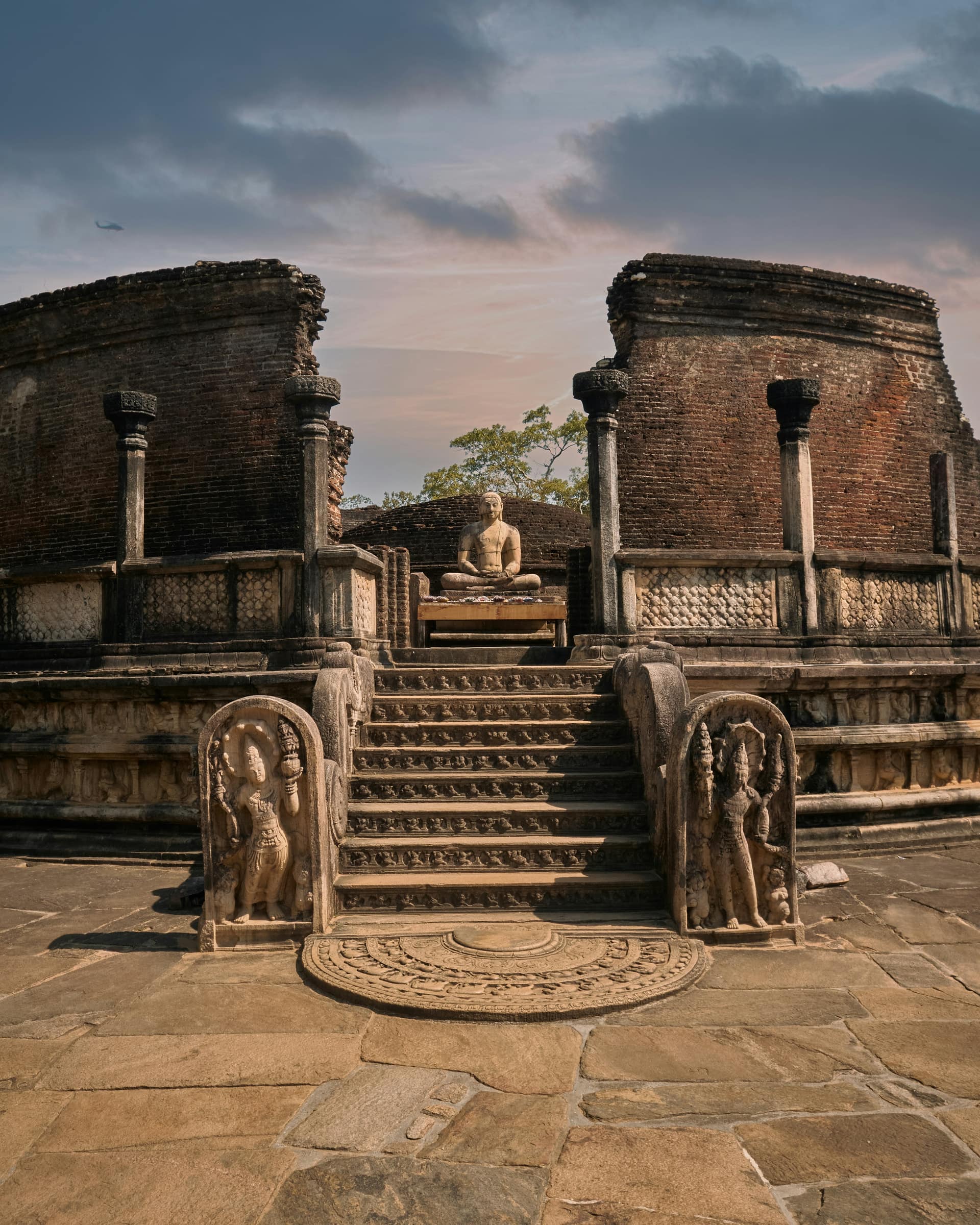
Polonnaruwa, Sri Lanka's medieval capital from roughly the 11th to 13th centuries, is a compact archaeological site best explored by bicycle or a slow walk across its temples, palace ruins and reservoirs. The Gal Vihara, a set of rock-cut Buddha statues carved directly into a granite face, is the site's best-known highlight.
A half-day at Polonnaruwa, roughly two to three hours on-site plus transfer time, suits travellers with a strong interest in history and archaeology, and pairs naturally with the morning's Dambulla visit since both sites share a similar era of Sri Lankan Buddhist heritage.
- →Polonnaruwa dates from roughly the 11th to 13th centuries as the island's medieval capital.
- →Bicycle hire on-site is a popular way to cover the spread-out ruins comfortably.
- →The Gal Vihara rock-cut Buddha statues are the site's most photographed feature.
Option B: elephants at Minneriya or Kaudulla
Minneriya National Park is known for what is sometimes called 'the gathering', when large numbers of wild elephants converge on the reservoir's shrinking waterline, most reliably seen roughly June to September. Outside that window, nearby Kaudulla National Park often becomes the stronger option depending on current water levels, so it is worth confirming with your driver-guide close to travel dates.
A jeep safari here typically runs roughly two to three hours in the afternoon, and while elephants are the highlight, the parks also support birdlife, deer and occasionally other wildlife along the drive.
- →Minneriya's elephant gathering is most reliable roughly June to September; confirm current conditions before travel.
- →Kaudulla is a common alternative when Minneriya's water levels or season do not favour elephant viewing.
- →A typical jeep safari runs roughly two to three hours, usually scheduled for the afternoon.
Which option suits which traveller
Travellers who prioritise history, archaeology and quieter sightseeing generally lean towards Polonnaruwa, especially those who already have a wildlife safari planned later in the trip at Yala or Udawalawe on day eight and want variety rather than a second safari-style outing this early.
Travellers keen to maximise wildlife sightings, or visiting during the stronger elephant-gathering months, often prefer Minneriya or Kaudulla instead, treating it as a taster ahead of the more comprehensive safari later in the route.
Planning day 4 within the wider route
Either afternoon option keeps day four to a sensible length, ready for an early start on day five's transfer to Kandy, roughly three hours further south. There is no strong reason to attempt both Polonnaruwa and Minneriya on the same day, since the added transfer time between them makes for a long, tiring stretch without much extra benefit.
Lankan Stays & Trails builds this as a flexible choice discussed with each traveller ahead of the trip, since the right call often depends on season and how much wildlife time is already planned later in the itinerary.
Frequently asked questions
Should you visit Polonnaruwa or Minneriya on day 4?
It depends on interest and timing. Polonnaruwa suits travellers prioritising history and archaeology, while Minneriya or Kaudulla suits those wanting an early wildlife highlight, particularly during Minneriya's stronger elephant-gathering months of roughly June to September.
How long does the Dambulla cave temple visit take?
Roughly one and a half to two hours, including the short climb to the cave entrance and time inside the five caves of murals and statues, best scheduled for the morning before the day's second activity.
When is the best time to see elephants at Minneriya?
Roughly June to September is the most reliable window for Minneriya's elephant gathering around the reservoir, though this shifts with rainfall and water levels each year, so it is worth confirming locally close to your travel dates.
Is one day enough for both Dambulla and Polonnaruwa or Minneriya?
Yes, a morning at Dambulla followed by an afternoon at either Polonnaruwa or Minneriya/Kaudulla fits comfortably into a single day, without needing to attempt both afternoon options on the same day.
What should you wear to visit Dambulla cave temple?
Modest dress covering shoulders and knees is required, and shoes must be removed before entering the caves, so sandals are more practical than lace-up footwear for this stop.
Is Kaudulla a good alternative to Minneriya?
Yes. Kaudulla National Park is a common alternative when Minneriya's season or water levels are less favourable for elephant viewing, and both parks are reached from the same Cultural Triangle base.