
Quick answer
Day 4 of the 10-day Sri Lanka itinerary for Turkish travellers begins with Dambulla's cave temple complex in the morning, a UNESCO World Heritage Site with five caves of Buddhist statues and murals dating back over two thousand years, followed by an afternoon choice between Polonnaruwa's ancient city or a Minneriya National Park elephant safari. Polonnaruwa suits travellers who prioritise history and ruins explored by bicycle or tuk-tuk; Minneriya suits those prioritising wildlife, particularly from roughly June to September when the elephant gathering is at its largest.
Key takeaways
- Dambulla's cave temple complex holds five caves of Buddhist statues and murals, entered via a climb of a few hundred steps up a rock outcrop.
- Polonnaruwa's ancient city, Sri Lanka's medieval capital, is compact enough to explore by bicycle or tuk-tuk in a half-day visit.
- Minneriya National Park's elephant gathering, one of Asia's largest, peaks roughly June to September around the reservoir's receding shoreline.
- Day four is deliberately gentler than day three, with no long climb required for either the Dambulla or Polonnaruwa portion.
- Choosing Polonnaruwa or Minneriya is largely a matter of priority between history and wildlife, since both are comfortably reachable from a Habarana or Sigiriya base.
Dambulla's cave temples in the morning
Dambulla's cave temple complex, a UNESCO World Heritage Site, sits inside five caves carved into a rock outcrop, holding more than 150 Buddha statues and extensive ceiling murals, some dating back over two thousand years and still in active use as a place of worship.
The climb to the caves is a few hundred steps, considerably gentler than Sigiriya, and the interior is cool and shaded, a welcome contrast after the previous day's exposed ascent. Modest dress, shoulders and knees covered, and shoes removed before entering are expected, as at any active Buddhist site.
- →Five caves, more than 150 Buddha statues, murals dating back over two thousand years.
- →Climb: a few hundred steps, shaded and considerably gentler than Sigiriya.
- →Dress code: shoulders and knees covered; shoes removed before entering the caves.
The afternoon choice: Polonnaruwa or Minneriya
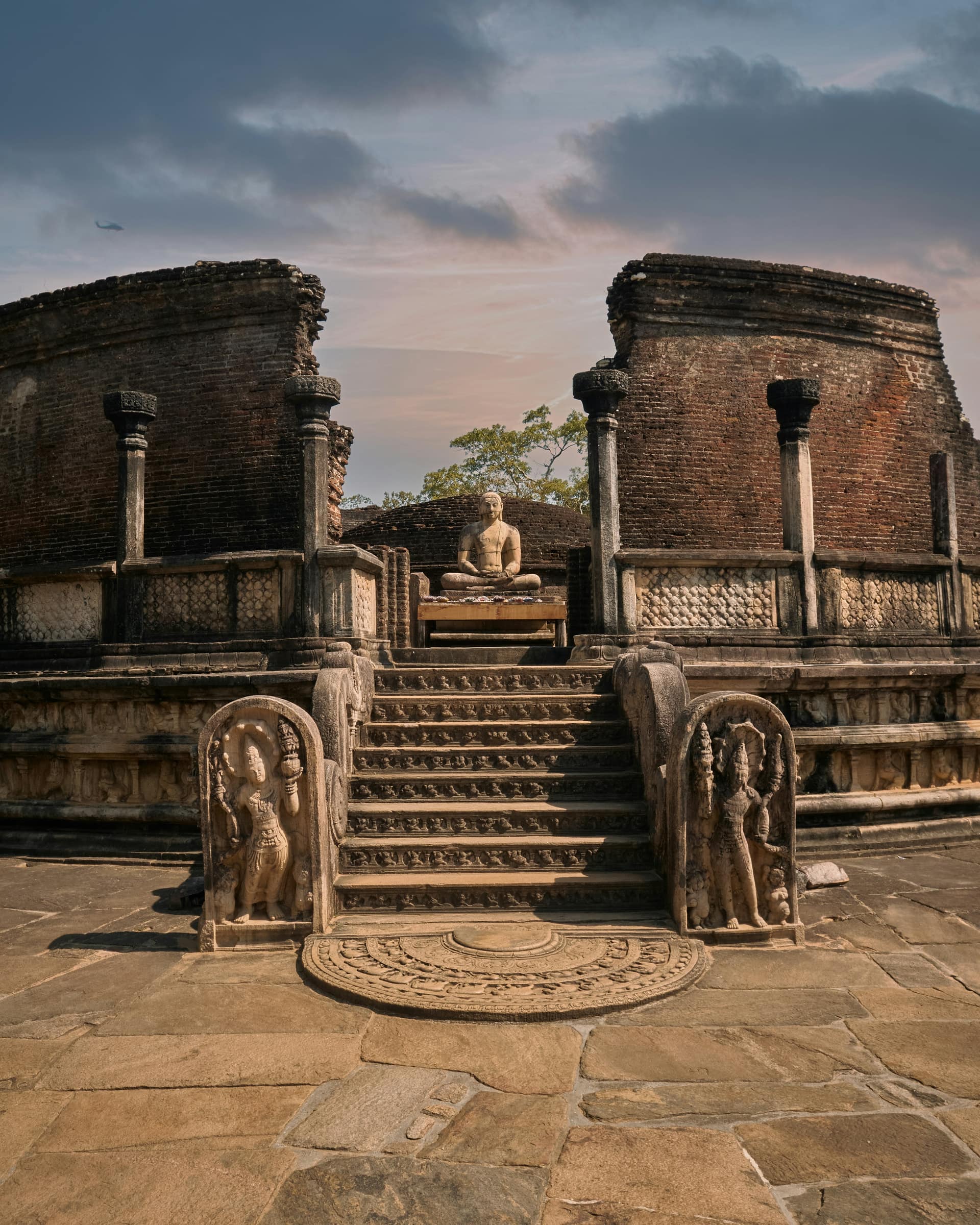
Polonnaruwa, Sri Lanka's medieval capital from the 11th to 13th centuries, is compact enough to explore by bicycle or tuk-tuk in a half-day, taking in the Gal Vihara's rock-cut Buddha statues, the Royal Palace ruins and the Vatadage's circular relic house.
Minneriya National Park, roughly 30 to 45 minutes from a Habarana base, is best known for its elephant gathering around the reservoir, one of the largest wild elephant congregations in Asia, particularly strong roughly June to September as the water recedes and grazing concentrates near the shore.
- →Polonnaruwa: ancient ruins, Gal Vihara statues, explored comfortably by bicycle or tuk-tuk.
- →Minneriya: elephant safari by open jeep, strongest gathering roughly June to September.
- →Both are reachable within roughly 30 to 45 minutes of a Habarana or Sigiriya base.
Who should choose which
Polonnaruwa suits travellers who found Sigiriya and Dambulla's history genuinely absorbing and want a third historical layer, exploring at a relaxed cycling pace rather than a jeep safari's more structured format.
Minneriya suits travellers prioritising wildlife, especially outside the elephant gathering's peak months, when a Yala safari later in the trip may focus more on leopards than elephant numbers, making Minneriya's near-guaranteed elephant sightings a useful complement.
Practicalities for the day
Comfortable, modest clothing works for both Dambulla and Polonnaruwa, while the Minneriya safari calls for neutral colours and, ideally, closed shoes for the open jeep. Water and sun protection matter for either afternoon option given the exposed terrain at both sites.
Foreign-visitor entry tickets apply at Dambulla and Polonnaruwa, and safari jeep hire plus park entry apply at Minneriya, both best arranged through your driver-guide the evening before.
Planning this day
Decide between Polonnaruwa and Minneriya the evening before with your driver-guide, since the choice affects the afternoon's transport and timing rather than the morning's Dambulla visit, which stays fixed either way.
Lankan Stays & Trails builds both options into the standard ten-day itinerary and can swap between them based on season and personal priority, history versus wildlife, without disrupting the rest of the route.
Frequently asked questions
What is inside the Dambulla cave temples?
Five caves carved into a rock outcrop, holding more than 150 Buddha statues and extensive ceiling murals, some dating back over two thousand years. It remains an active place of Buddhist worship, not solely a historical site.
Should you visit Polonnaruwa or do a Minneriya safari?
It depends on priority. Polonnaruwa suits those who want a third layer of ancient history explored by bicycle or tuk-tuk, while Minneriya suits those prioritising wildlife, particularly during the elephant gathering roughly June to September.
When is the best time to see elephants at Minneriya National Park?
Roughly June to September, when the reservoir's water recedes and grazing concentrates near the shrinking shoreline, drawing one of Asia's largest gatherings of wild elephants in one place.
How do you get around Polonnaruwa's ancient city?
By bicycle or tuk-tuk, both widely available near the site entrance. The ancient city is compact and flat enough that a half-day visit comfortably covers the Gal Vihara statues, the Royal Palace ruins and the Vatadage.
Is Dambulla harder to climb than Sigiriya?
No, considerably gentler. Dambulla's climb is a few hundred steps up a shaded rock outcrop, a much easier ascent than Sigiriya's roughly 1,200 steps on largely exposed staircases the previous day.
What should you wear to visit Dambulla cave temples?
Modest clothing covering shoulders and knees, as at any active Buddhist site, and shoes that are easy to remove, since footwear comes off before entering the caves themselves.