
Quick answer
A Sri Lanka temple itinerary for Canadian travellers typically runs 7 to 9 days, covering the Temple of the Sacred Tooth Relic in Kandy, the cave temples at Dambulla, the sacred city of Anuradhapura with its Bo Tree, and Kataragama, a multi-faith pilgrimage site sacred to Buddhists, Hindus and Muslims alike. Shoulders and knees covered and shoes removed before entering any shrine room are non-negotiable at every site, and visiting Kandy's Tooth Relic temple during one of its daily puja ceremonies, rather than outside those hours, gives a considerably more meaningful sense of the site as a living place of worship.
Key takeaways
- The Temple of the Sacred Tooth Relic in Kandy holds what is believed to be a tooth relic of the Buddha and is Sri Lanka's most significant Buddhist pilgrimage site.
- Dambulla's cave temples, a short drive from Sigiriya, contain five caves of Buddhist murals and statues dating back over two thousand years.
- Anuradhapura's Sacred Bo Tree is believed to be grown from a cutting of the original tree under which the Buddha attained enlightenment, and is among the oldest documented trees in the world.
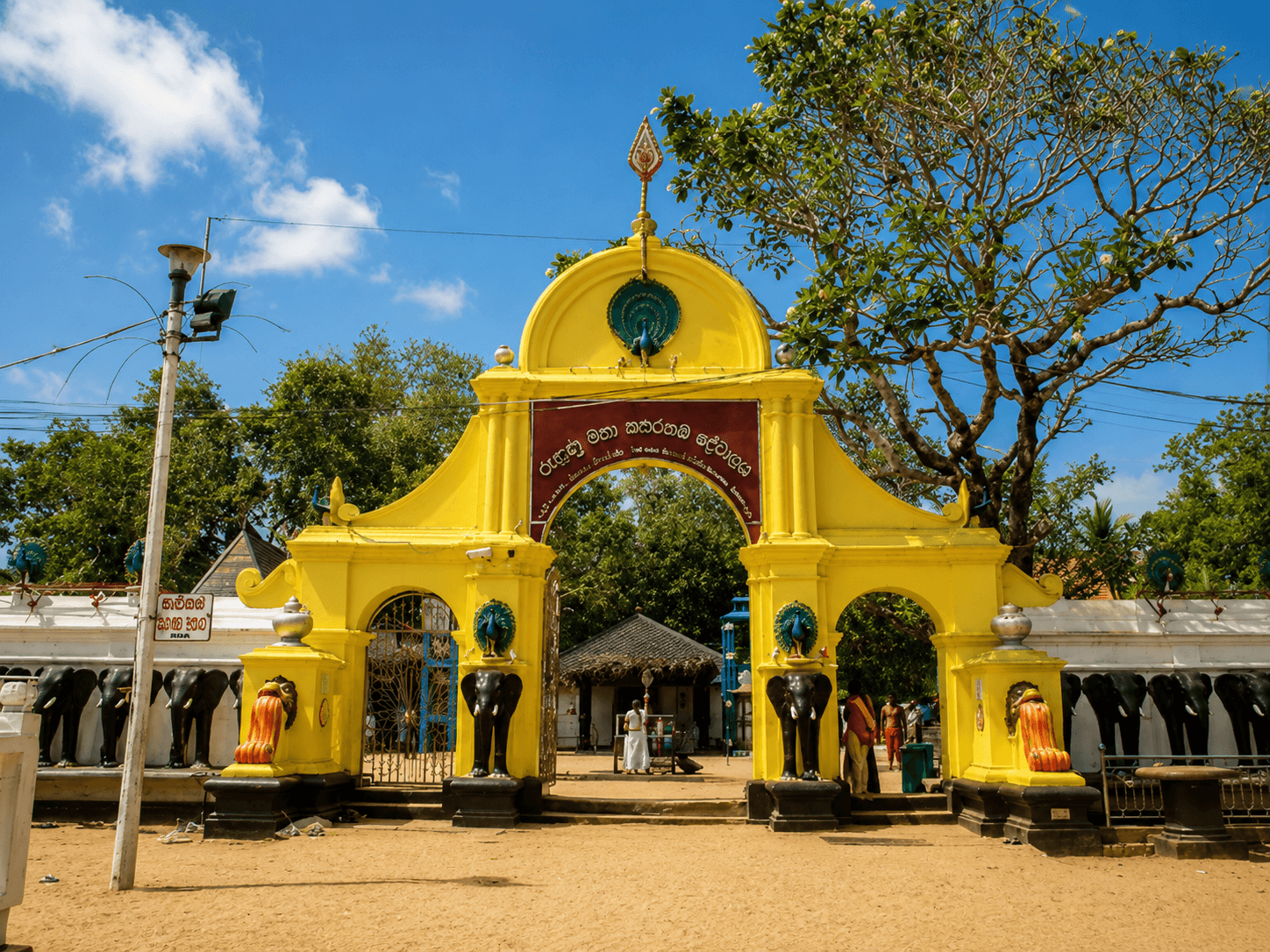
- Kataragama is a multi-faith pilgrimage site, sacred to Buddhists, Hindus and Muslims, and its evening rituals are open to respectful visitors.
- Shoulders and knees covered and shoes removed before entering any shrine room applies at every temple regardless of faith, and is worth planning outfits around for the whole trip.
What a Sri Lanka temple itinerary looks like
A temple-focused itinerary moves through sites spanning multiple faiths and eras: the Buddhist Tooth Relic temple in Kandy, the ancient cave temples at Dambulla, the sacred city of Anuradhapura, and Kataragama's multi-faith pilgrimage complex in the south. The route deliberately covers this range rather than concentrating on Buddhist sites alone, reflecting Sri Lanka's genuinely mixed religious landscape.
Timing a visit around an active ceremony, rather than simply the opening hours, changes the experience considerably. The Tooth Relic temple's daily puja ceremonies and Kataragama's evening rituals both give a much stronger sense of these places as living sites of worship rather than static monuments.
A sample 8-day route
This sample times visits around active ceremonies where possible.
- →Days 1 to 2: Kandy, for the Temple of the Sacred Tooth Relic, ideally timed around one of its daily puja ceremonies.
- →Days 3 to 4: Dambulla and Sigiriya, for the cave temples' murals and statues.
- →Days 5 to 6: Anuradhapura, for the Sacred Bo Tree and the wider sacred city.
- →Days 7 to 8: Kataragama, for its multi-faith pilgrimage complex, ideally including an evening ritual visit.
Etiquette across different faiths
Dress requirements, shoulders and knees covered, shoes removed before entering a shrine room, apply consistently across Buddhist temples, Hindu kovils and mosques alike, and are worth planning for at every stop on this itinerary rather than treating as a one-off adjustment for a single site. Some temples also ask visitors to cover their head or provide a wrap at the entrance; carrying a light scarf covers most situations.
Photography rules vary by site and sometimes by specific shrine within a larger complex; asking before photographing an active ceremony or a monk is the sensible default rather than assuming it is permitted everywhere the way it might be at a purely historical monument.
Practicalities for a temple-focused trip
Many temples, including Dambulla and parts of Anuradhapura, involve walking on stone or tiled surfaces that can be extremely hot in bare feet during the middle of the day; visiting earlier in the morning avoids this as well as the worst crowds and heat. A small entry donation is customary at many active temples, worth carrying some smaller local currency notes for.
Kataragama's rituals, including fire-walking during certain festival periods, draw large crowds and should be approached with particular respect and a willingness to stay at the edge of any ceremony rather than pushing in for a closer view.
Planning your temple itinerary
Kandy's Tooth Relic temple, Dambulla's cave temples, Anuradhapura's sacred city and Kataragama's multi-faith complex, timed around active ceremonies where possible and with dress etiquette planned for throughout, is the framework for a genuinely rewarding temple-focused trip.
Lankan Stays & Trails builds private, driver-guided temple itineraries for Canadian travellers, timing visits around ceremonies and explaining etiquette specific to each site along the way.
Frequently asked questions
How many days should a Sri Lanka temple itinerary be?
7 to 9 days is typical, covering the Temple of the Sacred Tooth Relic, Dambulla's cave temples, Anuradhapura's sacred city and Kataragama's multi-faith pilgrimage complex.
What should you wear to temples in Sri Lanka?
Shoulders and knees covered, with shoes removed before entering any shrine room. This applies consistently across Buddhist temples, Hindu kovils and mosques, so it's worth planning outfits for the whole trip around it.
What is the Temple of the Sacred Tooth Relic?
Sri Lanka's most significant Buddhist pilgrimage site, in Kandy, believed to hold a tooth relic of the Buddha. It holds daily puja ceremonies, which are the best time to visit for a sense of it as a living place of worship.
Is Kataragama worth visiting on a Sri Lanka temple itinerary?
Yes, as a genuinely multi-faith site sacred to Buddhists, Hindus and Muslims alike. Its evening rituals are open to respectful visitors and offer a different experience from the largely Buddhist sites elsewhere on the itinerary.
How old is the Sacred Bo Tree in Anuradhapura?
Believed to be grown from a cutting of the original tree under which the Buddha attained enlightenment, and is among the oldest documented trees in the world, planted well over two thousand years ago.
Can you take photos inside Sri Lanka's temples?
Rules vary by site and sometimes by specific shrine within a complex. Asking before photographing an active ceremony or a monk is the sensible default rather than assuming it's permitted everywhere.