
Quick answer
For Indian travellers, Sri Lanka is generally the more convenient destination to reach, with direct flights from Chennai, Mumbai, Delhi, Bengaluru and other cities taking roughly one and a half to four and a half hours, while Bali typically requires a connection through Singapore, Kuala Lumpur or another Southeast Asian hub, extending total journey time considerably. Choose Bali for an established villa, surf and wellness-retreat scene with a strong beach-club culture; choose Sri Lanka for wildlife safaris, ancient cities and hill country within one country, generally reached faster and at a lower cost from India.
Key takeaways
- Sri Lanka has direct flights from multiple Indian cities, roughly one and a half hours from Chennai and up to four and a half hours from Delhi, while Bali generally requires a connecting flight from India.
- Indian passport holders need an Electronic Travel Authorisation or visa for Sri Lanka, while Indonesia offers visa-on-arrival or e-visa options for Indian travellers to Bali; both should be confirmed before booking.
- Sri Lanka has wildlife Bali doesn't: leopard and elephant safaris at Yala and Udawalawe, and blue whale watching off two coasts.
- Bali's villa, surf and wellness-retreat infrastructure is considerably more developed for independent, scooter-based travel than Sri Lanka's.
- Sri Lanka's day-to-day touring costs generally run lower for Indian travellers than Bali's increasingly built-up tourist areas like Canggu and Seminyak.
The short answer for Indian travellers
If a well-oiled villa and wellness scene on a compact island you can explore independently by scooter matters most, and the longer, connecting flight from India doesn't put you off, Bali delivers a genuinely excellent holiday on its own terms.
If you want a shorter, more direct flight from India and a trip that moves through mountains, ancient cities, wildlife safaris and several distinct coastlines, Sri Lanka offers considerably more range within one country, generally reached faster and at a lower cost.
- →Shorter, more direct flight from India, wildlife, ancient cities, greater variety: Sri Lanka.
- →Established villa and wellness scene, independent scooter travel: Bali.
- →Both: good surf and beaches, strong value relative to Indian costs.
- →Fewer crowds and a less commercialised feel: generally Sri Lanka.
Getting there from India
Sri Lanka's flight connectivity from India is genuinely exceptional. Direct flights to Colombo operate from Chennai, Bengaluru, Mumbai, Delhi, Kochi, Hyderabad and other cities, taking roughly ninety minutes from Chennai and up to around four and a half hours from Delhi, mostly direct or with one convenient stop.
Bali is reachable from India but typically requires a connection, most commonly through Singapore, Kuala Lumpur or another Southeast Asian hub, since direct India-to-Bali service has been limited and inconsistent over the years. Total journey time to Bali from most Indian cities, once the connection is factored in, generally runs longer than the equivalent Sri Lanka trip.
- →Sri Lanka: direct flights from multiple Indian cities, roughly 1.5 to 4.5 hours depending on origin.
- →Bali: typically a connection via Singapore or Kuala Lumpur; direct India-Bali routes have been limited and inconsistent.
- →Sri Lanka is generally the faster, more predictable journey from most Indian cities.
Visas and entry
Indian passport holders normally need an Electronic Travel Authorisation or visa to enter Sri Lanka, a requirement that has changed more than once in recent years, including periods of a free-entry pilot scheme, so it should be confirmed on the official Sri Lankan immigration portal shortly before travel.
Indonesia has generally offered Indian travellers visa-on-arrival or e-visa options for Bali, which is often more straightforward to arrange, though fees and specific requirements shift periodically, so this too should be checked against the current official guidance before booking either trip.
Beaches and surf: closer than you'd think
Bali's beaches vary by coast: Kuta, Seminyak and Canggu have volcanic grey-to-black sand and a lively beach-club scene, while Nusa Dua and the Bukit peninsula have whiter sand and calmer water. Uluwatu's cliffside breaks and Canggu's beach breaks have made Bali one of the world's best-known surf destinations, and they can be genuinely crowded in the water at peak times.
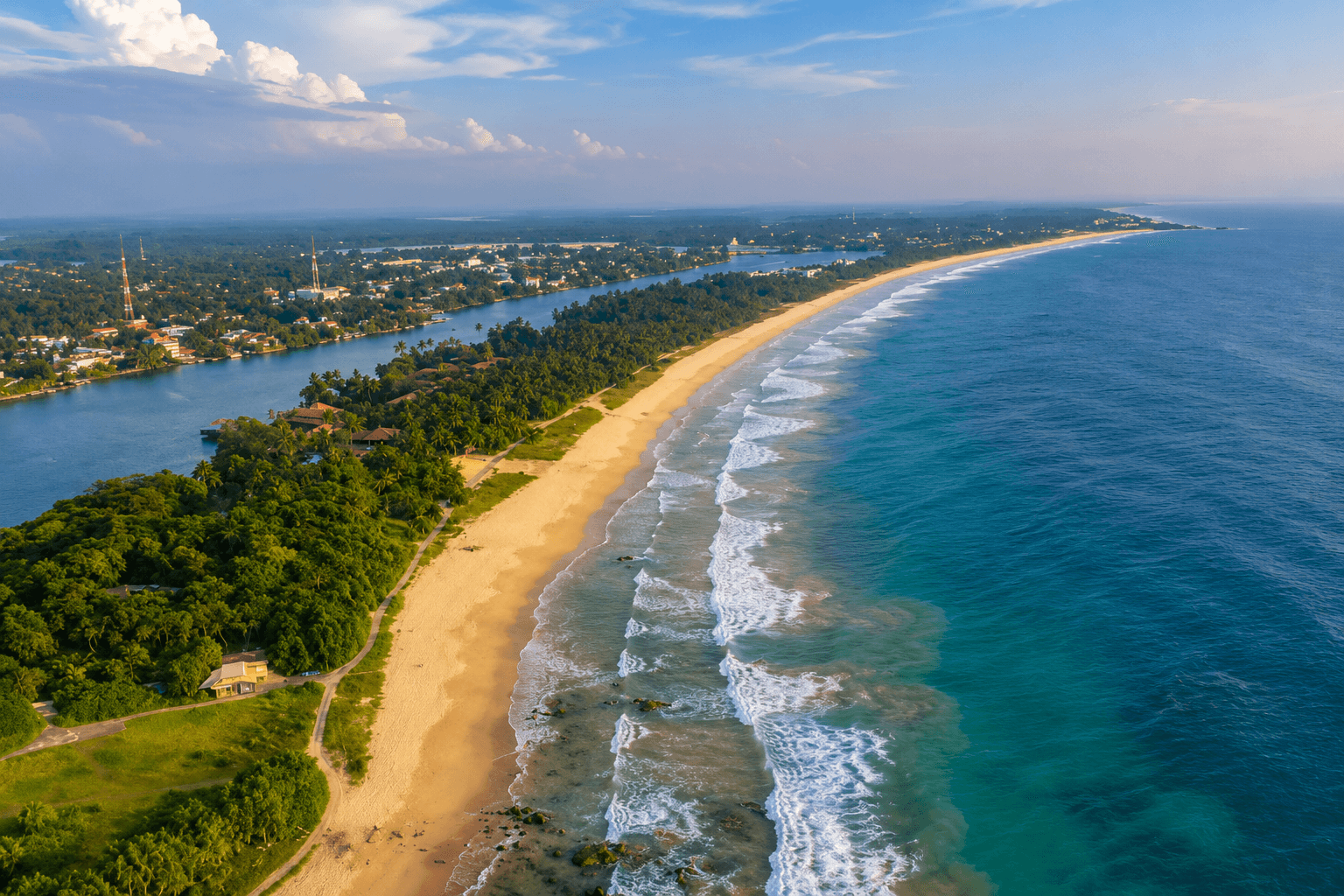
Sri Lanka's beaches, Mirissa, Unawatuna, Nilaveli, are good golden-sand ocean beaches across two coastlines that come into season at opposite times of year. Arugam Bay's Main Point is a serious right-hand point break rated among Asia's best, and it's considerably less crowded than Bali's headline breaks, with gentler options nearby for beginners.
- →Bali: volcanic sand in the south, whiter sand at Nusa Dua, world-famous but often crowded surf.
- →Sri Lanka: golden-sand ocean beaches on two coasts, with Arugam Bay's Main Point a genuine world-class right-hander.
- →Neither has the Maldives' lagoon-and-coral-sand beaches; both are good, not exceptional, on beach quality alone.
Culture, landscape and wildlife
Bali's culture runs deep: Hindu-Balinese temples at Tanah Lot and Uluwatu, the UNESCO-listed subak rice terrace system, active volcanoes at Batur and Agung, and a genuinely distinctive Indonesian cuisine. It's a small island, but the cultural and landscape density within it is real, and it will feel notably familiar in places for Indian travellers given its shared Hindu heritage.
Sri Lanka's difference is breadth rather than depth in any single register: multiple UNESCO World Heritage Sites spanning ancient cities, cave temples and colonial forts, cool hill-country tea estates, rainforest, and wildlife Bali simply doesn't have, leopard safaris at Yala, elephant gatherings at Minneriya, and blue whale watching off two coasts. If wildlife matters to your trip, Sri Lanka wins outright.
- →Bali: Hindu-Balinese temples, UNESCO rice terraces, active volcanoes, distinctive Indonesian food.
- →Sri Lanka: multiple UNESCO sites, tea country, rainforest, leopard and elephant safaris, blue whale watching.
- →Wildlife is Sri Lanka's clearest advantage; Bali has no comparable safari experience.
Cost and getting around
Both destinations offer strong value against Indian city prices, though Bali's most popular areas, Canggu and Seminyak especially, have grown noticeably pricier as tourism infrastructure has expanded. Bali is famously easy and cheap to get around independently, a scooter, a short ride-hailing trip, or a driver for the day between Ubud, Canggu and the Bukit peninsula, all within a compact area.
Sri Lanka is a considerably bigger, more geographically varied country, and touring it independently by scooter isn't realistic the way it is in Bali. A private driver-guide is the standard way to see it, affordable relative to Indian touring costs, and day-to-day spending on food, entry fees and transport generally runs lower than in Bali's more developed tourist zones.
- →Bali: compact, scooter-friendly, easy for independent travel, though pricier in popular areas.
- →Sri Lanka: larger and more varied; a private driver-guide is the standard, affordable way to tour it.
- →Sri Lanka's day-to-day costs generally run lower than Bali's built-up tourist zones.
Deciding between them
If a shorter, more predictable direct flight from India matters, along with wildlife, ancient history and genuinely different landscapes within one country, Sri Lanka is the stronger fit. If routing ease from India matters less than a polished, independent-travel-friendly island with a strong wellness scene, Bali is very likely the right call, and it's worth saying so plainly even though it isn't what we sell.
Lankan Stays & Trails builds private, driver-guided Sri Lanka itineraries. If Sri Lanka is the right trip for what you want, we can help plan it properly; if what you actually want is Bali, we'd rather tell you that than sell you the wrong holiday.
Frequently asked questions
Is Sri Lanka better than Bali for Indian travellers?
It depends on what you want. Sri Lanka is generally faster and more direct to reach from India and offers wildlife safaris, ancient cities and hill country. Bali has a more developed villa and wellness scene but typically needs a connecting flight from India.
Is there a direct flight to Bali from India?
Direct India-to-Bali routes have been limited and inconsistent over the years; most Indian travellers connect via Singapore, Kuala Lumpur or another Southeast Asian hub. Sri Lanka, by contrast, has direct flights from multiple Indian cities, including Chennai in roughly ninety minutes.
Is Sri Lanka cheaper than Bali for Indians?
Neither has a consistent, decisive cost advantage on accommodation, but Sri Lanka's day-to-day touring costs, driver-guides, food, entry fees, generally run lower than Bali's more developed and increasingly pricier tourist zones like Canggu and Seminyak, and the shorter flight can lower the overall trip cost too.
Do Indians need a visa for Bali or Sri Lanka?
Both require entry documentation. Indonesia has generally offered Indian travellers visa-on-arrival or e-visa options for Bali, while Sri Lanka requires an Electronic Travel Authorisation or visa. Confirm current requirements for both before booking, as they change periodically.
Which has better beaches, Sri Lanka or Bali?
Both are good, not exceptional, on pure beach quality. Bali has volcanic grey-to-black sand in the south and whiter sand at Nusa Dua; Sri Lanka has golden-sand ocean beaches across two coasts that come into season at different times of year.
Does Sri Lanka have wildlife safaris like Bali?
Sri Lanka has wildlife experiences Bali doesn't offer at all: leopard safaris at Yala, elephant gatherings at Minneriya, and blue whale watching off two coasts. This is Sri Lanka's clearest advantage if wildlife matters to your trip from India.
Can Indians combine Sri Lanka and Bali in one trip?
It's possible but adds significant flying time and cost, since there's no direct flight between the two and a connection via Singapore or Kuala Lumpur is required. Most travellers from India are better served choosing one destination for a single trip.