
Quick answer
Sri Lanka's west and south coasts, running through Negombo, Bentota, Kandy's surrounding hills and the roads between them, are lined with coconut palm groves, bright green paddy fields and patches of jungle, a genuinely tropical scenery shaped by year-round warmth and Sri Lanka's two-monsoon rainfall pattern. Turkey's Mediterranean and Aegean coastline, around Antalya, Bodrum and Fethiye, has its own striking scenery of pine forest, olive groves and rocky coves, but it is a dry-climate landscape without the sustained humidity that produces palms, paddy and jungle at this scale.
Key takeaways
- Sri Lanka's west coast, including the stretch through Negombo and Bentota, is characteristically lined with coconut palm groves, a landscape shaped by year-round warmth and consistent rainfall.
- Paddy fields, flooded rice cultivation typically at its most vividly green during and shortly after the rainy months, are a common sight on road journeys between Sri Lanka's coast and its interior.
- Sri Lanka's interior includes patches of jungle and dense secondary forest, particularly visible on the road routes connecting the coast to Kandy and the hill country.
- Turkey's Mediterranean and Aegean coastline is shaped by a dry-summer climate that produces pine forest, olive groves and scrubland rather than tropical palm and paddy scenery.
- The Bentota River area combines palm-lined banks, mangroves and river safaris with beach access nearby, a specific kind of tropical scenery within Sri Lanka's west coast.
Two coastlines shaped by two different climates
Turkey's Mediterranean and Aegean coast has hot, dry summers and cooler, wetter winters, a climate that produces pine-covered hillsides, olive groves, citrus orchards and scrubby maquis vegetation above a rocky or sandy shoreline. It is a genuinely attractive landscape and one many travellers return to year after year.
Sri Lanka's west and south coasts sit in a tropical climate zone with consistent year-round warmth and rainfall delivered by its two-monsoon system, and that combination of heat and moisture produces an entirely different kind of scenery: dense green vegetation, coconut palms and cultivated rice paddies rather than dry Mediterranean scrub.
Coconut palms along the west coast
The road running along Sri Lanka's west coast, through towns such as Negombo and down towards Bentota, is characteristically lined with coconut palm groves, some of them working plantations, others simply part of the everyday landscape around villages and beaches. Coconut is a genuine part of the local economy and diet, not just a scenic backdrop.
Roadside stalls selling king coconut, a variety with orange-tinted husks used mainly for its water, are a common sight along these routes, and stopping for one is a small but distinctly tropical part of travelling this coast.
- →Coconut palm groves line much of the road between Negombo and Bentota on Sri Lanka's west coast.
- →King coconut, sold roadside for its water, is a distinctly local variety worth trying.
- →Coconut cultivation is a genuine part of the regional economy, not purely a scenic feature.
Paddy fields on the road inland
Travelling inland from the coast towards Kandy or the Cultural Triangle typically passes flooded paddy fields, cultivated for rice, at their most vividly green during and shortly after the rainy months. The reflections off the flooded fields and the patchwork pattern of individual plots are a recognisable feature of rural Sri Lankan scenery.
Because paddy cultivation depends on Sri Lanka's rainfall patterns, the fields look different across the year, sometimes flooded and vividly green, at other times drier and closer to harvest, so the exact look on any given trip depends on timing and region.
Jungle and forest along the interior routes
Sections of road connecting the coast to the interior, and routes through areas such as the approaches to Sinharaja Forest Reserve or the roads around Habarana and Sigiriya, pass through patches of dense jungle and secondary forest, a further layer of tropical scenery distinct from the coastal palm groves.
This mix of coast, cultivated paddy and patches of forest within a single day's driving is part of what makes a touring route through Sri Lanka visually varied in a way a single-resort Turkish Riviera stay, fixed at one coastal point, does not offer.
- →Interior road routes pass through patches of dense jungle and secondary forest.
- →Habarana and the approaches to Sigiriya include noticeably forested stretches.
- →A single day's drive can move through coast, paddy and jungle scenery in sequence.
Bentota: palms, river and beach together
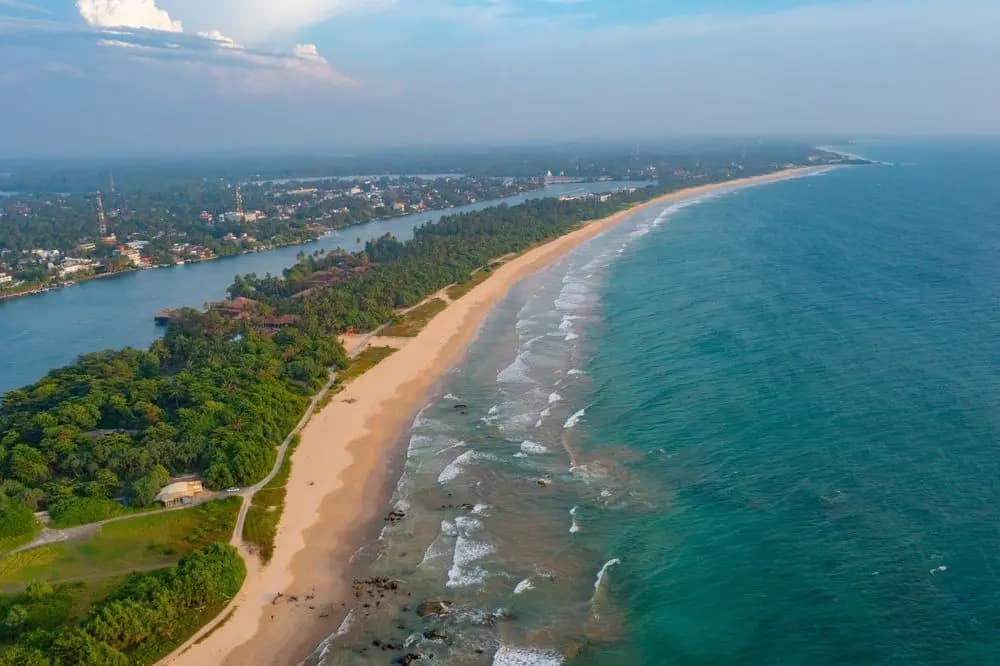
Bentota, on Sri Lanka's west coast, is a useful example of how this tropical scenery comes together in one place: palm-lined riverbanks along the Bentota River, mangrove patches supporting birdlife, and a wide sandy beach all within a short distance of each other. A river safari here typically combines mangrove viewing with a chance of spotting water monitors and a range of birdlife.
This layering of river, mangrove and beach scenery within one small area is a specifically tropical combination, distinct from anything found on Turkey's Mediterranean or Aegean coastline.
Seeing this scenery on a trip from Turkey
For a Turkish traveller flying the non-stop Turkish Airlines route from Istanbul to Colombo, roughly nine to ten hours, much of this tropical scenery is visible simply through the ordinary business of travelling between stops, the coast road to Bentota, the inland route to Kandy or Sigiriya, rather than requiring a dedicated excursion.
We at Lankan Stays & Trails generally build in a short river safari or a village stop along these routes specifically to slow down and take in this scenery, rather than treating the drive between destinations as pure transit time.
Frequently asked questions
Does Sri Lanka look tropical compared to Turkey?
Yes. Sri Lanka's west and south coasts feature coconut palms, paddy fields and patches of jungle typical of a tropical climate, while Turkey's Mediterranean and Aegean coast has a dry-summer climate producing pine forest, olive groves and scrubland instead.
What is a king coconut?
King coconut is a coconut variety with an orange-tinted husk, grown widely in Sri Lanka and sold roadside mainly for its water rather than its flesh. It is a common, inexpensive refreshment along coastal and inland roads.
When are Sri Lanka's paddy fields at their greenest?
Paddy fields typically look most vividly green during and shortly after the rainy months, when they are flooded for cultivation. The exact timing varies by region given Sri Lanka's two-monsoon rainfall pattern, so this should be treated as a general guide.
Is Bentota a good place to see Sri Lanka's tropical scenery?
Yes, Bentota combines palm-lined riverbanks, mangroves and a wide beach within a short distance, making it a practical single stop to see several types of tropical scenery together, typically via a river safari alongside beach time.
Is there jungle near Sri Lanka's beaches?
Patches of jungle and secondary forest appear along several interior routes not far from the coast, including approaches to Sinharaja Forest Reserve and roads around Habarana, rather than directly on the beach itself.
Why doesn't Turkey have coconut palms and paddy fields?
Turkey's Mediterranean and Aegean coast has a dry-summer climate that does not provide the sustained heat and rainfall coconut palms and rice paddy cultivation require, so its characteristic scenery is pine forest, olive groves and scrubland instead.
What is the best way to see Sri Lanka's tropical scenery from the coast to the interior?
A driver-guided road route between the coast and Kandy or the Cultural Triangle typically passes through coconut groves, paddy fields and patches of jungle in sequence, making the journey itself part of the tropical scenery rather than pure transit.