
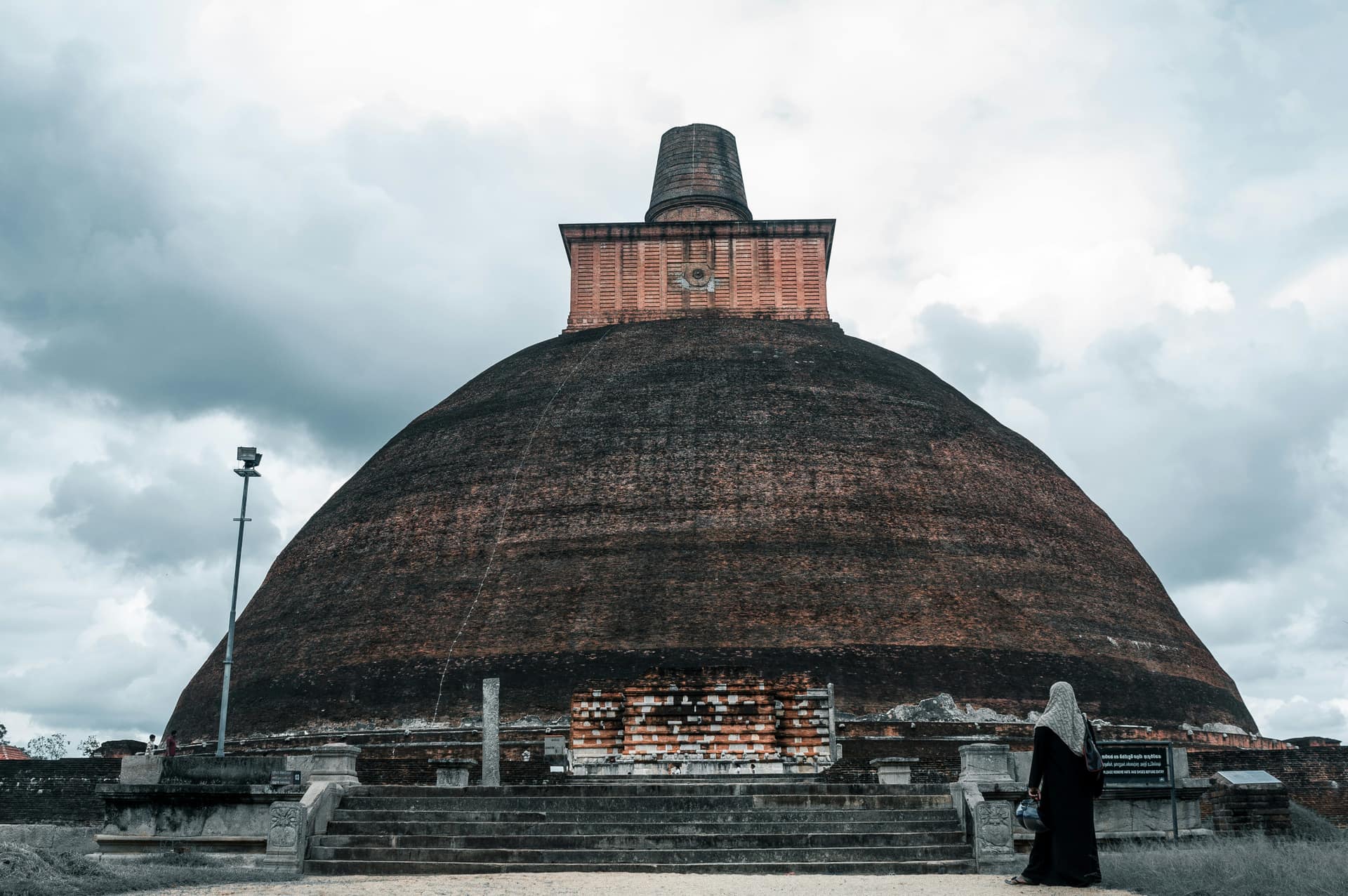
Quick answer
Temple etiquette in Sri Lanka requires covering shoulders and knees, removing shoes and hats before entering sacred areas, and avoiding overt affection such as kissing or embracing inside temple grounds. This applies at every active site, from the Temple of the Tooth in Kandy to the Dambulla Cave Temple, and matters because these remain working places of worship for local communities, not backdrops for tourism, so a couple's visible respect is noticed and appreciated.
Key takeaways
- Shoulders and knees must be covered at every Buddhist and Hindu temple in Sri Lanka, for both partners, regardless of heat.
- Shoes and hats come off before entering the inner areas of the Temple of the Tooth in Kandy and the Dambulla Cave Temple's five caves.
- Public displays of affection such as kissing or embracing are inappropriate inside temple grounds and are noticed even when not explicitly signposted.
- Never turn your back to a Buddha statue for a photograph or climb on any statue; both cause serious offence and have led to fines for tourists.
- A light scarf or sarong carried in a day bag solves a dress-code gap at short notice, since some sites offer only limited loan wraps at the entrance.
Temple etiquette matters beyond the rules
Sri Lanka's major temples are not preserved monuments alone; they are active places of worship where local families come daily to pray, make offerings and observe Poya (full moon) rituals. A couple visiting is a guest inside someone else's ongoing spiritual life, not a visitor to a museum.
Framing it this way changes the visit for the better. Dressing modestly and behaving quietly is not a hoop to jump through for entry, it is the basic courtesy that lets a couple actually witness the devotion, incense and drumming that make these places atmospheric in the first place.
Getting this right also tends to be rewarded: monks, worshippers and site staff are visibly warmer towards visitors who clearly understand the setting.
Dress and conduct expectations
Both partners need shoulders and knees covered, meaning no vest tops, shorts or short skirts inside temple grounds; a loose shirt and trousers or a knee-length skirt work well in the heat. Shoes and hats come off before stepping onto the inner floors of most temples, so slip-on footwear saves time at busy entrances.
Keep your voice low, avoid pointing your feet towards a Buddha statue or another person while seated, and never touch a monk if you are a woman, since this is a point of religious discipline for ordained monks rather than a matter of manners alone.
- →Cover shoulders and knees, both partners, at every temple
- →Remove shoes and hats before entering inner floors and shrine rooms
- →Keep voices low and avoid pointing feet at statues or people
- →Women should avoid physical contact with monks as a point of religious protocol
Public affection at temples
Sri Lanka is culturally conservative about public displays of affection generally, and this is felt most strongly at religious sites. Handholding is unremarkable, but kissing, embracing or otherwise overt affection inside a temple compound draws attention and reads as a lapse of respect for the setting rather than a private moment.
This is worth stating plainly rather than assuming it is obvious: save affectionate moments for outside the temple grounds, on a viewpoint or beach, where the same gesture reads completely differently.
The Temple of the Tooth and Dambulla Cave Temple
The Temple of the Tooth (Sri Dalada Maligawa) in Kandy houses a sacred tooth relic of the Buddha and is Sri Lanka's holiest shrine. Its evening puja ceremony, announced by drumming, draws large crowds of devotees, and couples attending should expect a full dress-code check at the entrance and a slow-moving queue during the ceremony itself.
The Dambulla Cave Temple, roughly two hours from Kandy in the Cultural Triangle, holds five caves of Buddha statues and painted ceilings reached by a set of steps up a rock outcrop. Shoes come off at the base of the final approach, so expect to walk the last stretch barefoot on warm stone, and time the visit for morning to avoid both heat and the midday tour-group peak.
- →Temple of the Tooth, Kandy: full dress-code check, evening puja draws crowds
- →Dambulla Cave Temple: shoes off before the final approach, walk barefoot on stone
- →Both sites charge an entry ticket; confirm current pricing locally
- →Morning visits avoid both heat and the busiest tour-group hours
Photography at temples
Photography is generally allowed in temple courtyards and of the architecture itself, but posing with your back to a Buddha statue, or any pose that looks disrespectful (mimicking a statue's posture, sitting on a shrine base), is taken seriously and has led to fines and even deportation for tourists in the past.
Always ask before photographing monks or worshippers directly, particularly during active prayer, and expect some inner shrine rooms to prohibit photography altogether, marked at the entrance.
Planning temple visits as a couple
Pack one light scarf or sarong each in your day bag for the whole trip, since it solves a dress-code gap instantly at any site, even ones offering loan wraps that can run short during busy periods. Building temple visits into the cooler morning hours also makes the whole experience more comfortable and less rushed.
Lankan Stays & Trails times temple visits around quieter hours and briefs couples on each site's specific etiquette before arrival, so nothing comes as a surprise at the entrance.
Frequently asked questions
What should couples wear to visit temples in Sri Lanka?
Both partners need shoulders and knees covered, so a loose shirt with trousers or a knee-length skirt works well. Shoes and hats come off before entering the inner floors of most temples, and a light scarf or sarong is useful to carry for any dress-code gap.
Is it okay to hold hands or kiss at a temple in Sri Lanka?
Handholding is generally unremarkable, but kissing or embracing inside temple grounds draws attention and is considered disrespectful of the setting. Save more overt affection for outside the temple compound, such as at a viewpoint or beach.
What is the dress code at the Temple of the Tooth in Kandy?
Shoulders and knees must be covered and shoes removed before entering the inner shrine area, with a full check typically enforced at the entrance. Evening puja ceremonies draw large crowds, so arrive with time to spare for queuing and the dress check.
Can you take photos inside Sri Lankan temples?
Photography is usually permitted in courtyards and of the architecture, but posing with your back to a Buddha statue or mimicking a statue's pose is considered seriously disrespectful. Some inner shrine rooms prohibit photography entirely, so check signage at each site.
Do you need to remove shoes at the Dambulla Cave Temple?
Yes, shoes come off before the final approach up the rock to the five caves, meaning the last stretch is walked barefoot on warm stone. Visiting in the morning avoids both the heat on bare feet and the busiest tour-group hours.
Why do temples in Sri Lanka have strict dress codes?
These are active places of worship used daily by local communities for prayer and offerings, not preserved monuments alone. The dress code and conduct expectations are the basic courtesy shown to worshippers whose ongoing spiritual life a visitor is temporarily stepping into.
Does Lankan Stays & Trails prepare couples for temple visits?
Yes, Lankan Stays & Trails briefs couples on each temple's specific dress code and conduct expectations before arrival and times visits around quieter hours. This means nothing comes as a surprise at the entrance and the visit itself is more relaxed.